Pharmacological Management of Gastrointestinal Disorders
Explores the pharmacological approaches to managing gastrointestinal issues, including diarrhea, IBS, IBD, and motility disorders, by targeting neurological and chemical pathways. Discusses specific drug classes, mechanisms of action, and clinical considerations.
The gastrointestinal (GI) tract is far more than a simple series of mechanical pipes for food processing; it is a highly sensitive, intensely wired surveillance network. It possesses its own nervous system and maintains a constant, complex chemical conversation with the brain, the immune system, and the circulatory system. Because of this intricate "gut-brain axis," treating GI disorders requires more than just adjusting "plumbing." Clinicians must strategically manipulate neurological and chemical pathways to address whether an issue stems from hyperactive motility, functional hypersensitivity, structural inflammation, or delayed gastric emptying.
Diarrhea and Motility Management
Diarrhea is often driven by hyperactive intestinal motility, where the transit time is so rapid that the bowel cannot effectively reabsorb water. To manage this, clinicians often turn to opioids, which activate receptors in the gut to paralyze motility and slow transit.
Opioids and the "Booby Trap" Mechanism
While the use of opioids for stomach issues might seem counterintuitive in the context of the opioid epidemic, pharmaceutical engineering has created specialized formulations to mitigate abuse risk. Difenoxylate (Lomotil) is a prime example. It combines an opioid with a sub-therapeutic dose of atropine, a harsh anticholinergic.
When taken as prescribed, the atropine level is negligible. However, if a patient attempts to abuse the medication by taking large quantities to achieve a high, they trigger a "booby trap": the massive dose of atropine induces severe side effects such as extreme dry mouth, tachycardia (racing heart), and urinary retention.
Clinical Caution: Never use opioids to treat infectious diarrhea (e.g., E. coli). Diarrhea is often a defense mechanism to expel pathogens; paralyzing the gut can trap bacteria inside the intestine, prolonging the infection and increasing tissue damage. In these cases, antibiotics like rifaximin are preferred.
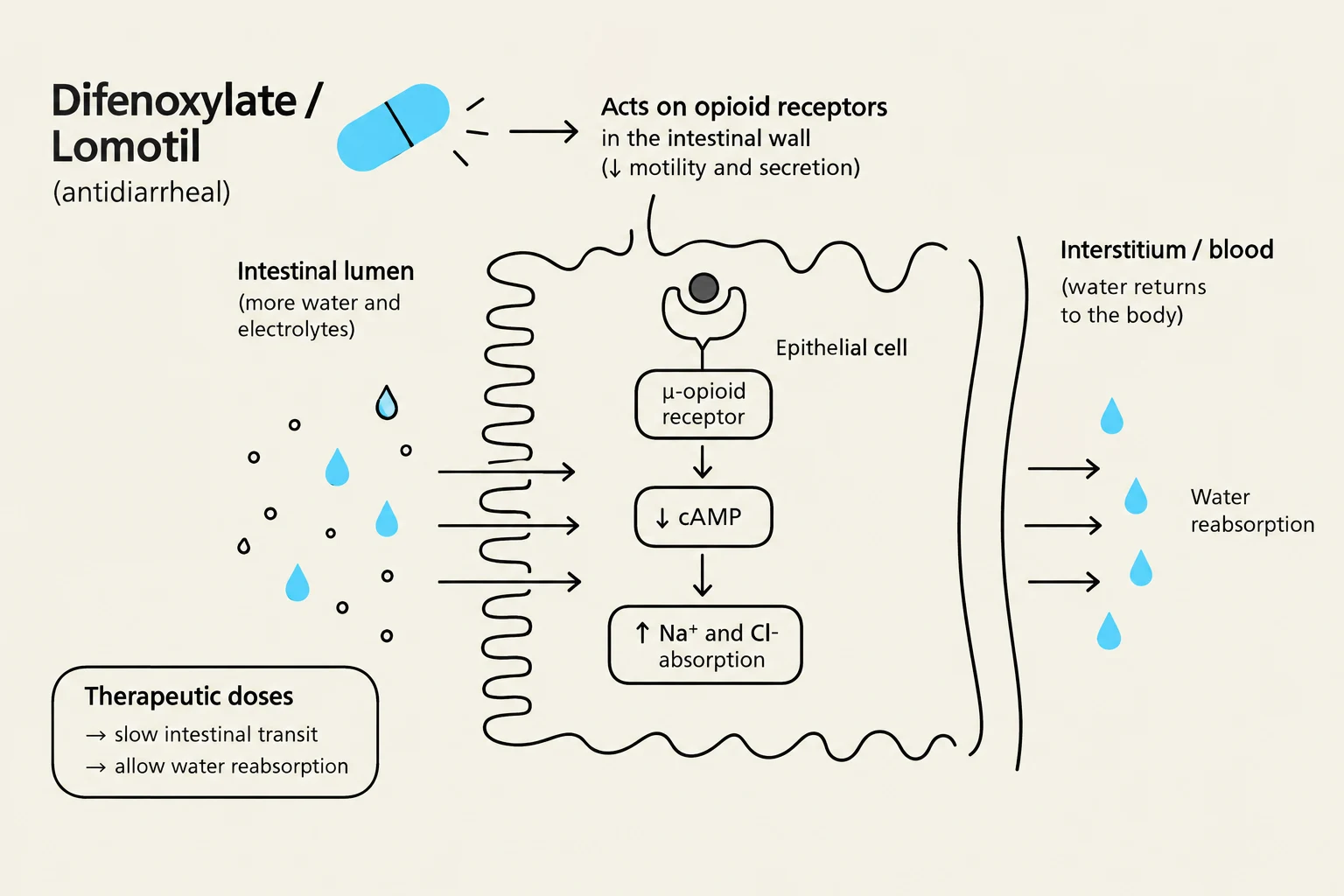
Diagram illustrating the mechanism of action of Difenoxylate/Lomotil, an antidiarrheal medication, on the intestinal wall. It shows how the drug acts on opioid receptors in epithelial cells, leading to decreased motility and secretion, and increased sodium and chloride absorption, ultimately resulting in water reabsorption.
Irritable Bowel Syndrome (IBS)
Unlike inflammatory diseases, IBS is a functional disorder. The bowel appears structurally normal on scans, but the nervous system wiring is hyper-responsive. Normal physiological processes, such as the stretching of the gut after a meal, trigger exaggerated pain signals through the gut-brain axis.
Neurological Dampening and Serotonin Blockade
To calm this hyperactive pain network, clinicians often use low-dose Tricyclic Antidepressants (TCAs). These are not used to treat mood disorders in this context, but rather to chemically dampen the visceral pain signals traveling from the gut to the brain.
For more severe, diarrhea-predominant IBS (IBS-D), specifically in women, Alosetron (Lotronex) is utilized. Alosetron is a 5-HT3 receptor antagonist that blocks serotonin receptors in the bowel, significantly slowing colonic transit and firming the stool.
Blackbox Warning: Alosetron carries a severe blackbox warning due to the risk of "over-slowing" the gut. This can lead to severe constipation, bowel perforation, or ischemic colitis, where the sluggish bowel cuts off its own blood supply.
Inflammatory Bowel Disease (IBD)
Inflammatory Bowel Disease, which encompasses Crohn’s disease and Ulcerative Colitis, is a structural, immune-mediated disease. Here, the immune system attacks the intestinal lining, necessitating a shift from motility management to immunosuppression.
The Step-Wise Approach to Inflammation
5-Aminosalicylates (5-ASA): Drugs like sulfasalazine act as a "Trojan horse". The drug remains inactive until gut bacteria break it down into two parts: 5-ASA (the active anti-inflammatory agent that coats the intestinal wall) and sulfapyridine (the component responsible for systemic side effects). Because sulfapyridine can suppress bone marrow, continuous CBC (Complete Blood Count) monitoring is mandatory to check for anemia or granulocytopenia.
Glucocorticoids: For more intense inflammation, steroids like budesonide are used. Budesonide is engineered for site-specific release, dissolving only at the specific pH of the inflamed ileum and ascending colon. Furthermore, any drug that enters the bloodstream undergoes high first-pass metabolism in the liver, minimizing systemic toxicity.
Immunomodulators and Biologics: For long-term remission, azathioprine is used, though it has a delayed onset and may take up to 6 months to reach therapeutic levels. For aggressive, refractory cases, biologics like infliximab (Remicade) are employed. Infliximab is a monoclonal antibody that neutralizes TNF-alpha, a primary trigger for inflammation. However, by neutralizing a pillar of the immune system, patients face increased risks of opportunistic infections, such as tuberculosis.
This diagram illustrates the differences between Irritable Bowel Syndrome (IBS) and Inflammatory Bowel Disease (IBD), highlighting their primary causes, gut effects, pain mechanisms, common triggers, and key treatment focuses.
Prokinetics and Localized Therapy
When the clinical goal is to increase motility rather than decrease it, clinicians turn to prokinetics.
Enhancing Motility
Prokinetics such as metoclopramide enhance the action of acetylcholine to increase upper GI motility. This is particularly useful for conditions like diabetic gastroparesis, where the stomach is functionally paralyzed.
Contraindications: Prokinetics must never be used in patients with mechanical bowel obstructions, perforations, or GI hemorrhages, as forcing motility against a blockage can cause a catastrophic rupture. Additionally, long-term use of metoclopramide can lead to irreversible tardive dyskinesia.
Specialized Localized Treatments
Pancrelipase: For patients with cystic fibrosis or pancreatitis who cannot secrete their own digestive enzymes, pancrelipase provides replacement enzymes (lipase, amylase, and protease) to aid digestion.
Nitroglycerin: While commonly known for treating chest pain, topical nitroglycerin is used to treat chronic anal fissures. As a potent smooth muscle relaxant, it relaxes the internal anal sphincter, which breaks the cycle of spasms and increases blood flow to promote healing.
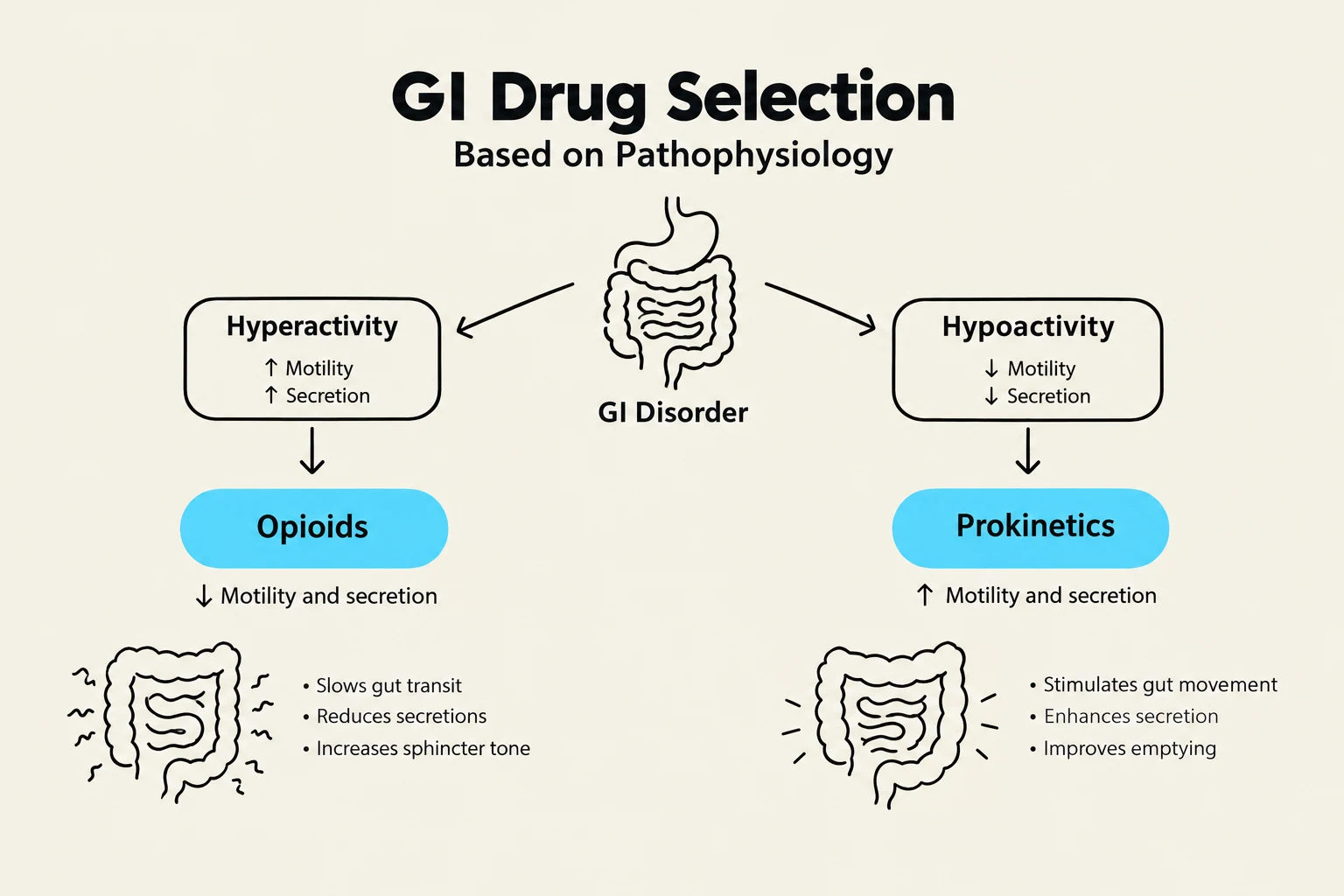
This diagram illustrates the selection of gastrointestinal drugs based on pathophysiology, differentiating between hyperactivity and hypoactivity of the GI tract and the corresponding drug classes (Opioids and Prokinetics) used to manage them.
By understanding the underlying pathophysiology—whether it is a "chemical smoke detector" in the brain or an immune attack in the gut—clinicians can move beyond simple symptom management to precise, mechanism-based therapy.
Keep reading for free.
Create an account to finish this reading and make it part of your study routine.