Pharmacokinetics and Pharmacodynamics: Understanding Drug Action
This content explains the fundamental principles of pharmacokinetics (what the body does to the drug) and pharmacodynamics (what the drug does to the body). It covers ADME processes, receptor theory, dose-response relationships, drug interactions, and clinical safety measures like the therapeutic index. Essential for u
Understanding how medications work is a cornerstone of safe and effective clinical practice. To master pharmacology, one must distinguish between two fundamental processes: pharmacokinetics, which describes what the body does to the drug, and pharmacodynamics, which describes what the drug does to the body. This distinction is vital for nurses and clinicians to predict drug effects, prevent toxicity, and tailor dosing regimens to individual patient needs.
Pharmacokinetics: The Body's Journey with a Drug
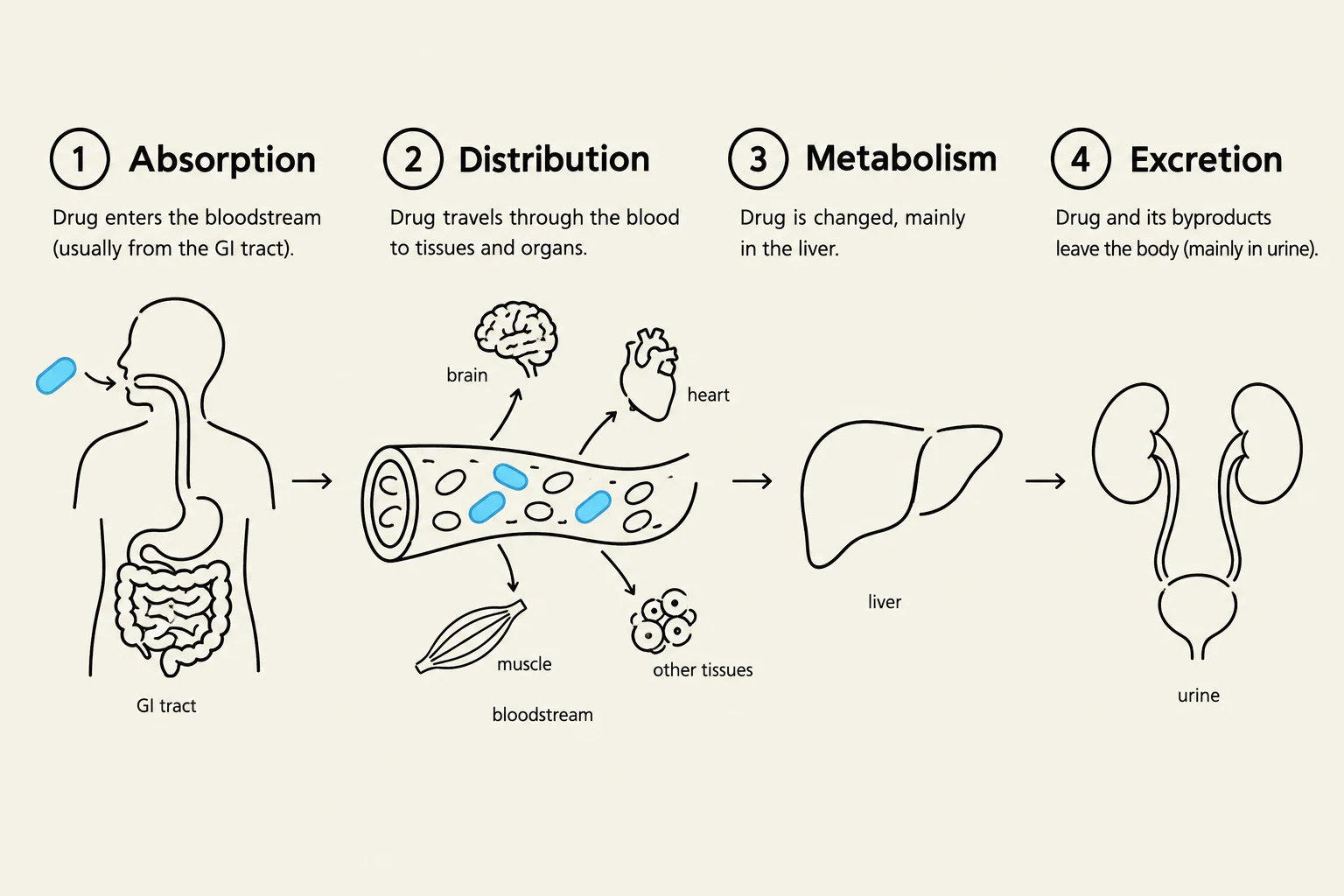
Pharmacokinetics is the study of the movement of a drug through the body. This movement is typically categorized into four distinct phases, often referred to by the acronym ADME: Absorption, Distribution, Metabolism, and Excretion.
1. Absorption
Absorption is the process by which a drug moves from its site of administration into the bloodstream. The speed and extent of absorption are influenced by the route of administration (e.g., oral, intravenous, subcutaneous), the drug's formulation, and the physiological environment, such as gastric pH.
A critical concept here is bioavailability, which refers to the percentage of the administered drug that reaches the systemic circulation in an active form. For example, drugs administered intravenously (IV) have 100% bioavailability because they bypass the absorption process and enter the blood directly. Conversely, oral drugs often have lower bioavailability due to the first-pass effect, where the drug is metabolized by the liver before it ever reaches the rest of the body.
2. Distribution
Once in the bloodstream, the drug is distributed to various tissues and organs. This movement is governed by blood flow, the drug's lipid solubility, and protein binding.
Many drugs bind to plasma proteins, such as albumin. It is essential to remember that only the free (unbound) drug is pharmacologically active and capable of producing an effect.
Clinical Alert: If a patient is taking two drugs that compete for the same protein binding sites, one drug may displace the other. This increases the concentration of "free" drug in the blood, which can lead to unexpected toxicity.
This diagram illustrates the four main pharmacokinetic processes of a drug in the body: absorption, distribution, metabolism, and excretion.
3. Metabolism (Biotransformation)
Metabolism is the chemical alteration of the drug, primarily occurring in the liver. The most significant players in this process are the cytochrome P450 (CYP450) enzyme system.
Metabolism can be influenced by other substances through two main mechanisms:
Enzyme Inducers: These substances (e.g., phenobarbital) increase the activity of metabolic enzymes. This results in faster metabolism of the drug, which can decrease its efficacy.
Enzyme Inhibitors: These substances (e.g., cimetidine or grapefruit juice) decrease enzyme activity. This slows down metabolism, leading to higher drug levels in the blood and an increased risk of toxicity.
4. Excretion
Excretion is the final removal of the drug from the body, with the kidneys being the primary organ responsible. To prevent drug accumulation and toxicity, clinicians must assess renal function. A common measure used is the estimated Glomerular Filtration Rate (eGFR). If a patient has a low eGFR, they may require lower doses or longer intervals between doses to allow for adequate clearance.
Pharmacodynamics: The Drug's Effect on the Body
While pharmacokinetics focuses on the drug's movement, pharmacodynamics focuses on the drug's mechanism of action and its physiological effects.
Receptor Theory
Most drugs exert their effects by binding to specific cellular targets called receptors. This interaction can be categorized into three main types:
Agonists: These drugs bind to a receptor and activate it, producing a biological response.
Antagonists: These drugs bind to a receptor but do not activate it; instead, they block the receptor, preventing agonists from binding and producing a response.
Partial Agonists: These elicit a moderate response even when all receptors are occupied. Because they occupy the receptor, they can also act as antagonists by blocking full agonists.
Mechanisms of Action and Effects
Drugs can produce different types of effects based on how they interact with the body:
Primary Effects: The intended therapeutic purpose of the drug (e.g., an antibiotic killing bacteria).
Secondary Effects: Side effects that are predictable but not the main goal (e.g., nausea caused by an antibiotic).
Nonspecific and Nonselective Effects: Some drugs work through general mechanisms, such as changing pH or osmotic pressure, rather than through specific receptor binding.
This diagram illustrates Receptor Theory, explaining how agonists and antagonists interact with cell receptors to trigger or block cellular responses.
Dose-Response and Clinical Safety
The relationship between the amount of drug administered and the intensity of the effect is known as the dose-response relationship.
Potency vs. Efficacy
Potency: Refers to the amount (dose) of drug required to produce a specific intensity of effect. A highly potent drug requires a very small dose to achieve a response.
Maximal Efficacy: Refers to the maximum effect a drug can produce, regardless of the dose.
The Therapeutic Index (TI) and Therapeutic Range
Safety is measured by the Therapeutic Index (TI), which is the ratio between the dose that produces toxicity and the dose that produces a therapeutic effect.
Wide TI: The drug is relatively safe; there is a large margin between the effective dose and the toxic dose.
Narrow TI: The drug is high-risk; the effective dose is very close to the toxic dose. Examples include digoxin and warfarin.
For drugs with a narrow TI, clinicians must monitor the therapeutic range by checking peak (the highest concentration in the blood) and trough (the lowest concentration, usually just before the next dose) levels.
Onset, Peak, and Duration
Onset: The time it takes for a drug to start working.
Peak: The time when the drug reaches its highest concentration in the blood.
Duration: The length of time the drug maintains a therapeutic effect.
Achieving Steady State: Dosing Strategies
To maintain a constant level of medication in the blood, clinicians use specific dosing strategies based on the drug's half-life (t1/2). The half-life is the time required for the concentration of the drug in the body to reduce by 50%.
Steady-State Concentration
Steady state is reached when the rate of drug administration equals the rate of drug elimination. This typically takes about 4 to 5 half-lives.
Loading Dose: In emergency situations where a rapid effect is needed, a large initial dose may be given to reach steady-state concentrations more quickly.
Maintenance Dosing: Once steady state is achieved, smaller, regular doses are given to replace the amount of drug being eliminated.
This graph illustrates the concept of drug concentration in the blood over time, showing the difference between a loading dose and maintenance dosing to maintain a therapeutic range.
Drug Interactions and Complications
Drugs rarely act in isolation. Interactions can occur between drugs, or between a drug and other substances like food or nutrients.
Types of Interactions
Pharmacokinetic Interactions: One drug alters the absorption, distribution, metabolism, or excretion of another. (e.g., an enzyme inhibitor increasing the toxicity of another drug).
Pharmacodynamic Interactions: Two drugs act on the same receptor or physiological system.
Additive Effect:1+1=2 (The combined effect is the sum of the individual effects).
Synergistic Effect:1+1=3 (The combined effect is greater than the sum of individual effects).
Agonistic Effect: One drug enhances the action of another.
Drug-Nutrient Interactions: Food or nutrients can alter drug absorption or metabolism (e.g., grapefruit juice inhibiting CYP450 enzymes).
Adverse Reactions and Tolerance
Side Effects: Predictable, often unavoidable secondary effects.
Adverse Drug Reactions (ADRs): Unintended, harmful responses to a medication.
Toxicity: Severe, life-threatening adverse reactions resulting from excessive drug levels.
Tolerance: A decreased responsiveness to a drug after repeated administration, requiring higher doses to achieve the same effect.
Tachyphylaxis: A rapid, sudden decrease in response to a drug after only a few doses.
Placebo Effect: A psychological phenomenon where a patient experiences a perceived improvement in condition due to the expectation of treatment rather than the drug itself.
Exam Tip: When asked to differentiate between tolerance and tachyphylaxis, remember that tachyphylaxis happens very quickly (minutes to hours), whereas tolerance develops more gradually over days or weeks.
Keep reading for free.
Create an account to finish this reading and make it part of your study routine.