


When a patient takes an antibiotic to fight an infection, the success of the treatment depends on two distinct but interconnected processes: what the body does to the drug, and what the drug does to the body. Understanding these two pillars—pharmacokinetics and pharmacodynamics—is essential for drug discovery and for ensuring that a medication reaches its target at a concentration high enough to be effective, but low enough to avoid toxicity.
Pharmacokinetics: The Journey of the Drug (ADME)
Pharmacokinetics describes the movement of a drug through the body. This is often summarized by the acronym ADME, which stands for Absorption, Distribution, Metabolism, and Excretion.
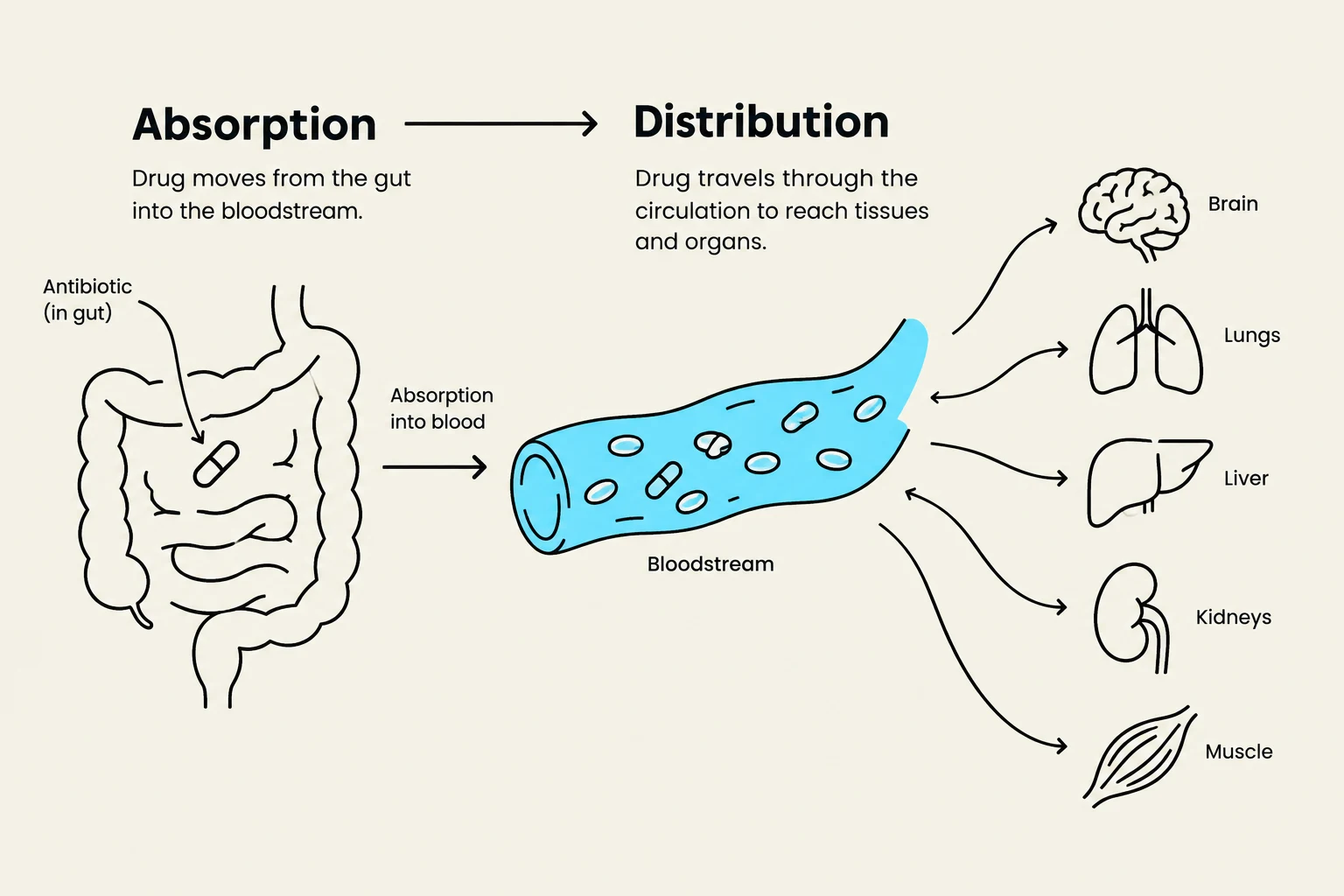
Absorption and Distribution
Absorption is the process by which a drug moves from its site of administration into the systemic circulation. For many antibiotics, this occurs via oral administration, where the drug must pass through the membranes of the gastrointestinal tract.
To reach the bloodstream, drugs must navigate various biological barriers through membrane passage. This can happen in several ways:
- Passive diffusion: Small, lipophilic compounds may pass directly through cell membranes.
- Paracellular transport: Small compounds (typically less than 200 Daltons) may pass between the cells lining the gut wall.
- Carrier-mediated transport: Some drugs "hijack" specific carrier proteins located in the cell membrane.
- Pinocytosis: A process where the cell membrane pinches off to form a vesicle, carrying the drug across the cell.
Once absorbed, the drug enters the systemic circulation and is distributed to various tissues and organs.
Keep reading for free.
Create an account to finish this reading and make it part of your study routine.
Continue reading freeAlready have an account? Log in
Updated