Pharmaceutical Aerosol and Inhaler Systems: A Comprehensive Overview
This document provides a comprehensive overview of pharmaceutical aerosol and inhaler systems, covering their fundamentals, components, and various technologies. It details the principles of aerosol dispersion, propellant selection, valve assembly mechanisms, and different inhaler types such as MDIs, DPIs, and SMIs. Th
Pharmaceutical aerosol and inhaler systems are specialized delivery mechanisms designed to administer medication directly to the respiratory tract. By targeting the lungs, these systems can provide rapid onset of action and localized treatment for airway diseases like asthma and COPD, often requiring smaller doses and resulting in fewer systemic side effects compared to oral administration. However, successful delivery is highly dependent on the physical properties of the aerosol, the technology of the device, and the technique used by the patient.
Fundamentals of Aerosol Systems
An aerosol is defined as a dispersion of liquid droplets or solid particles within a gas. In pharmaceutical applications, these systems are categorized by their phase composition and the method used to dispense the medication.
Two-Phase Systems
These are the simplest aerosol types, consisting of a solution or suspension of an active ingredient in a liquid propellant, or a mixture of a liquid propellant and a solvent. When the product exits the orifice, the rapid expansion of the propellant creates a fine spray.
Three-Phase Systems
Three-phase systems allow for the inclusion of liquids that are not miscible with propellants, such as water-based aerosols. This category also includes stabilized foams, which may require shaking before dispensing.
Compressed Gas Systems
Unlike liquefied propellant systems, compressed gas systems utilize gases such as nitrogen, carbon dioxide, or nitrous oxide to dispense products. These can be used to deliver solid streams, wet sprays, or foams.
Propellants and Valve Assemblies
The performance of an aerosol is heavily influenced by its internal pressure, which is controlled by the type and amount of propellant used.
Propellant Selection
When selecting a propellant, manufacturers must ensure acceptable toxicology, formulation compatibility, stable performance, and suitable vapor pressure.
Hydrofluoroalkanes (HFAs): Widely used in pressurized metered-dose inhalers (pMDIs), such as HFA-134a and HFA-227ea.
Hydrocarbons: Common in topical aerosols (e.g., propane, butane) but are highly flammable.
Low-Climate-Impact Alternatives: Due to the environmental impact of traditional propellants, research is focused on candidates like HFA-152a and HFO-1234ze(E).
The Valve Assembly and Components
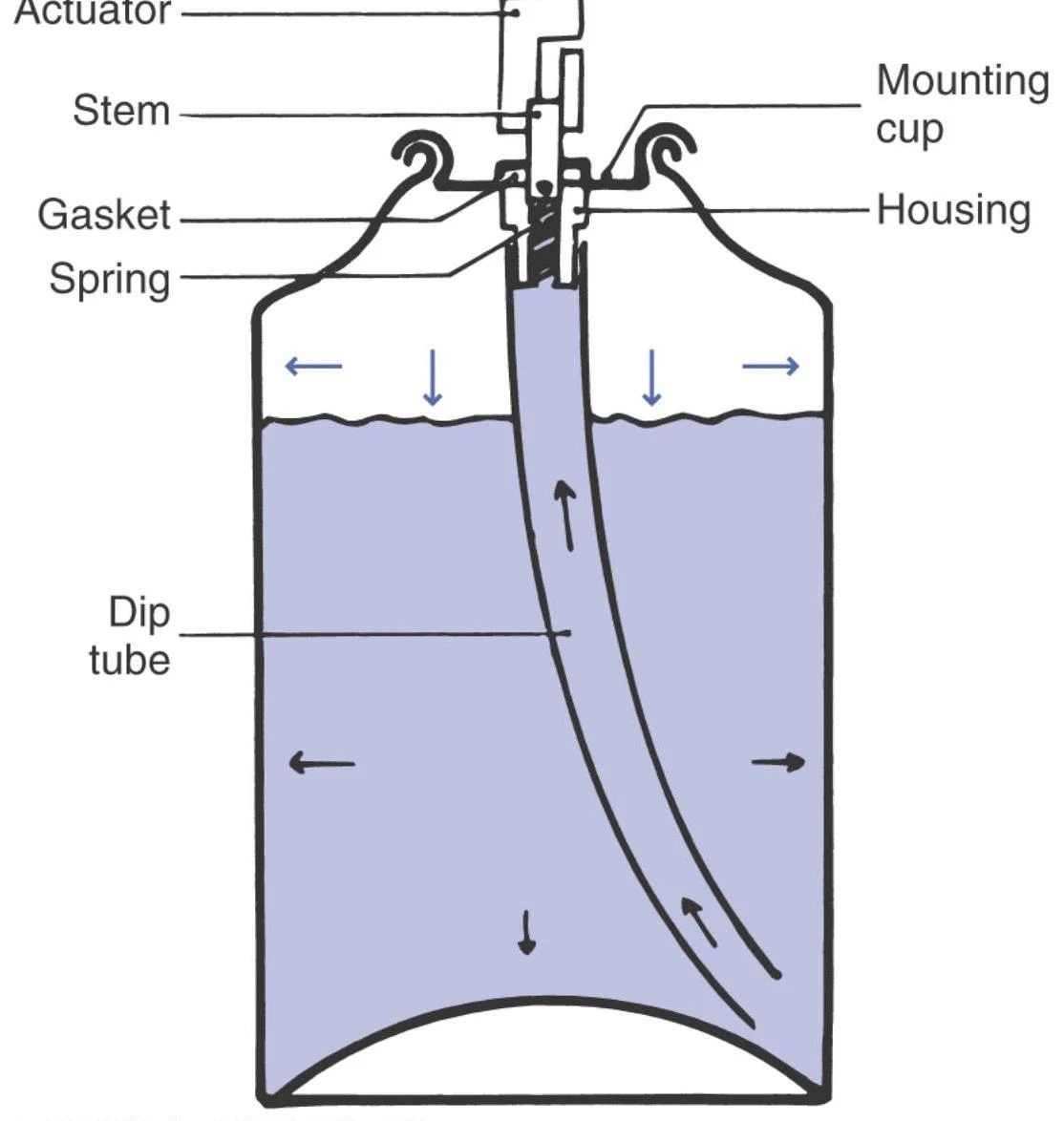
The valve assembly is the mechanical heart of the aerosol system, ensuring precise delivery and preventing leakage. A typical assembly includes a container, a valve assembly, an actuator, a stem, a gasket, a spring, and a dip tube.
In a metered-dose system, a dual valve mechanism is used to control the dose. A rubber gasket seals the valve stem at the orifice and shoulder under spring tension to prevent the flow of the concentrate liquid propellant mix when the device is closed. When the actuator is depressed, the spring action allows the valve to open, forcing the mixture through the orifice and out of the nozzle.
Diagram illustrating the components and fluid dynamics of a pump mechanism, including actuator, stem, gasket, spring, dip tube, mounting cup, and housing, with arrows indicating fluid flow.
Inhaler Technologies
The method by which a drug is dispersed into the airway varies significantly across different inhaler technologies.
Metered-Dose Inhalers (MDIs)
MDIs use a metering valve to deliver a precise, pre-measured dose of medication. They are propellant-driven, meaning the patient must coordinate a slow, steady inhalation with the actuation of the device.
Dry Powder Inhalers (DPIs)
DPIs are breath-actuated devices that do not require propellants. Instead, the patient's own inspiratory flow disperses the powder. Because they rely on lung power, patients typically need to inhale quickly, forcefully, and deeply.
Soft Mist Inhalers (SMIs)
SMIs, such as the Respimat® system, represent a propellant-free, cartridge-based technology. They utilize a mechanical spring to drive a liquid formulation through a "uniblock" nozzle.
The core of this technology is Colliding Jet Technology, where the liquid is split into two fine streams that collide inside the nozzle to create a soft, slow-moving mist.
Advantages of SMIs:
The slow-moving mist enhances lung penetration and reduces drug wastage.
They cause less drug deposition in the throat and mouth, reducing side effects.
They are more environmentally friendly as they do not use propellants.
Disadvantages of SMIs:
Stability can be affected by humidity and temperature, potentially leading to inconsistent dosing.
Digital Inhalers
Modern "smart" inhalers incorporate sensors to track actuation frequency, timing, and inhalation technique. These devices can sync with smartphone apps to assist with patient adherence and provide data for remote clinical review.
Exam Tip: While digital inhalers can track when a patient uses their device, an actuation record does not guarantee that the prescribed dose actually reached the lungs.
Particle Size and Pulmonary Deposition
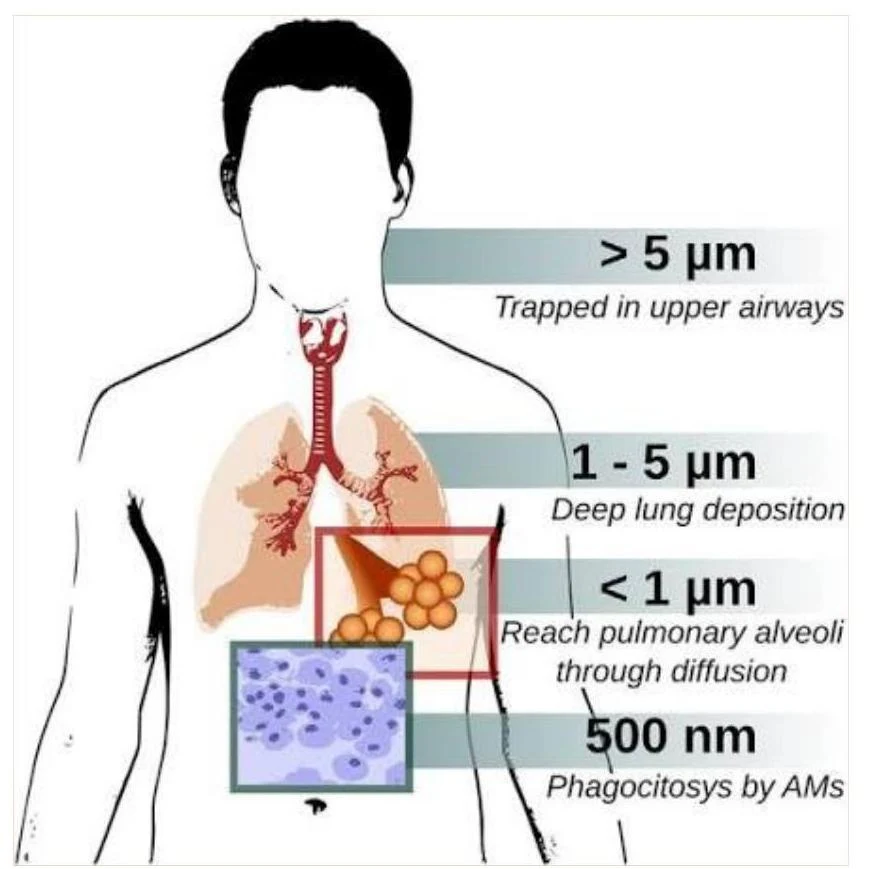
The effectiveness of any inhaler system is dictated by the aerodynamic diameter of the particles. If particles are too large, they deposit in the mouth and throat; if they are too small, they may be exhaled.
This diagram illustrates how particles of different sizes are deposited in the respiratory system. Larger particles (> 5 μm) are trapped in the upper airways, while smaller particles (1-5 μm) deposit deeper in the lungs. Particles less than 1 μm can reach the pulmonary alveoli through diffusion, and particles around 500 nm are phagocytosed by alveolar macrophages (AMs).
The target range for most inhaled medicines is approximately 1–5μm. Deposition occurs through several mechanisms:
Inertial Impaction: Occurs with larger particles (>10–15μm).
Gravitational Sedimentation: Affects particles in the 5–10μm range.
Diffusion (Brownian Motion): Primarily affects very small particles (<1μm).
This graph illustrates the deposition fraction of various airborne particles in the respiratory system as a function of their aerodynamic diameter, categorized by deposition mechanisms: diffusion, sedimentation, and inertial impaction.
Patient Counseling Essentials
Because delivery depends heavily on technique, patient education is a critical component of aerosol therapy.
Device Type
Key Technique Instruction
pMDI
Shake before use; inhale slowly and deeply while actuating; use a spacer if prescribed.
DPI
Exhale away from the device; inhale quickly, forcefully, and deeply; keep powder dry.
SMI
Prepare/prime as directed; inhale slowly and deeply while the mist is released.
Clinical Note: For patients using inhaled corticosteroids, always instruct them to rinse their mouth and spit after use to reduce the risk of local side effects.
Keep reading for free.
Create an account to finish this reading and make it part of your study routine.