Pest Management and Genetic Modification: An Evolutionary Perspective
Explore the evolutionary consequences of pest management strategies, including pesticide resistance, the pesticide treadmill, and the impact of genetically modified organisms (GMOs) on biodiversity and agricultural systems.
In the quest to protect food supplies and public health, humans have long relied on various methods to control "pests"—organisms that damage crops or spread disease. From the early use of chemical sprays to the modern era of high-tech genetic engineering, our methods have become increasingly sophisticated. However, these interventions do not exist in a vacuum. They interact with the powerful forces of evolution, often triggering unintended consequences that challenge the very stability of our agricultural systems.
The Chemical Approach: Pesticides and the Resistance Trap
Pesticides are toxic chemicals designed to eliminate specific pests. They are categorized into several types based on their origin and chemical makeup:
Botanicals: Naturally derived from plants, such as nicotine from tobacco or pyrethrin from chrysanthemums.
Chlorinated Hydrocarbons: Such as DDT, which are persistent in the environment and prone to biomagnification.
Neonicotinoids: Chemicals that have been linked to the devastation of bee populations.
Organophosphates: Highly toxic nerve agents that have lower persistence than hydrocarbons.
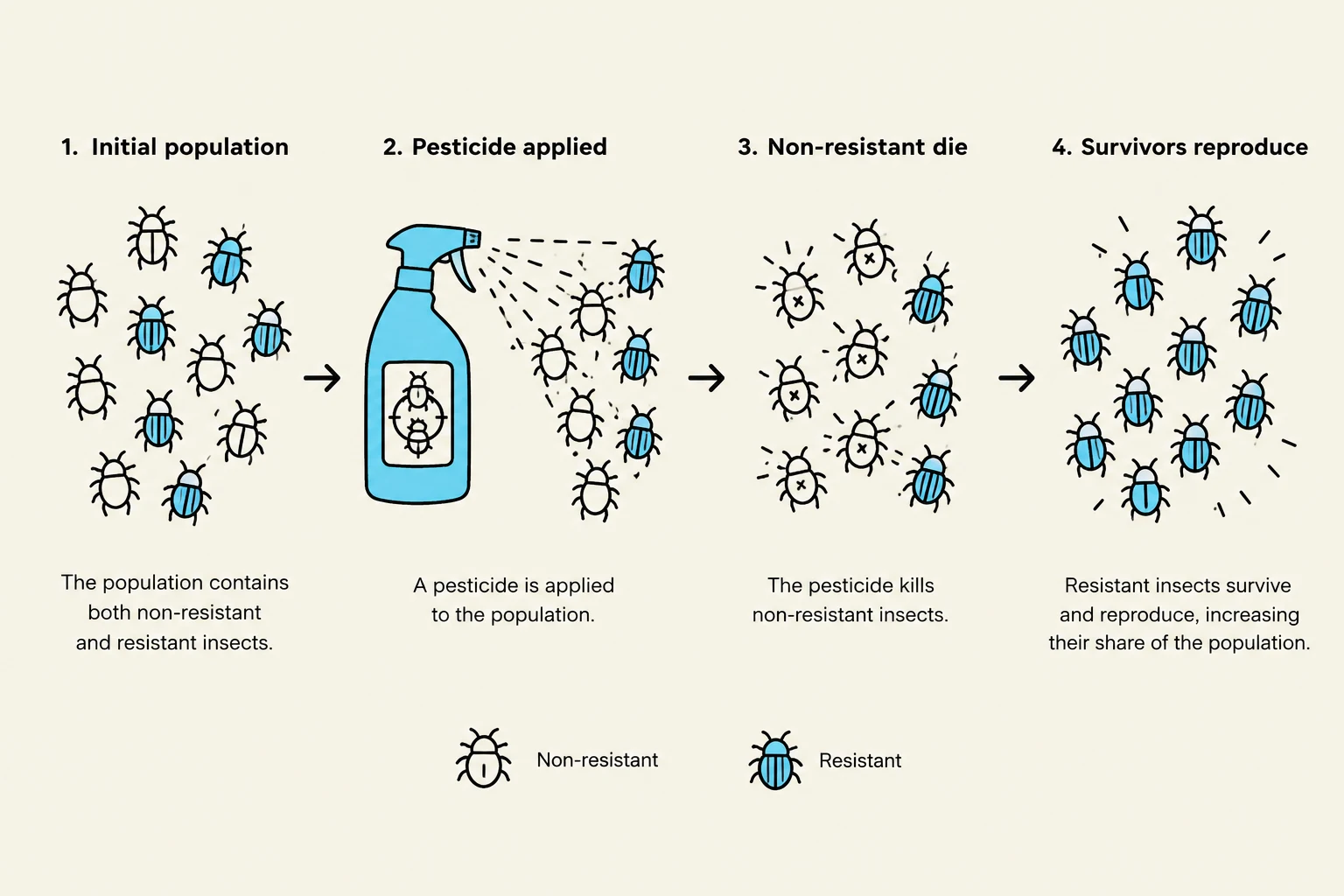
While these chemicals can be effective, their overuse triggers a biological phenomenon known as artificial selection. Within any large population of pests, there is natural genetic biodiversity—a variety of different traits among individuals. Some of these individuals may, by chance, possess a genetic mutation that makes them slightly more resistant to a specific toxin.
When a pesticide is applied, it kills the vast majority of the population, but it fails to kill the resistant individuals. These survivors then reproduce, passing their resistant genes to the next generation.
This diagram illustrates the process of natural selection, specifically how pesticide resistance can develop in insect populations over time. It shows an initial population with both resistant and non-resistant insects. After pesticide application, non-resistant insects die, while resistant insects survive and reproduce, leading to an increase in the proportion of resistant individuals in the population.
The Pesticide Treadmill
This process creates what scientists call a pesticide treadmill. This is a positive feedback loop where the solution actually accelerates the problem:
A pesticide is applied to a crop.
Artificial selection occurs; the non-resistant pests die, but the resistant ones survive.
The survivors reproduce, creating a new generation of pests that are even harder to kill.
Farmers respond by applying stronger or more frequent doses of pesticides.
The cycle repeats, requiring ever-increasing chemical inputs to achieve the same results.
Exam Tip: Remember that a "positive feedback loop" in biology doesn't mean the outcome is "good." It means the output of the system (resistant pests) enhances or amplifies the original stimulus (the need for more pesticide), driving the system further from its original state.
Genetic Modification: Engineering Defense
To break the cycle of the pesticide treadmill, scientists have turned to Genetically Modified Organisms (GMOs). Instead of spraying chemicals onto a plant, genetic modification involves inserting specific genes directly into the plant's DNA to grant it defensive traits.
Case Study 1: Bt Corn
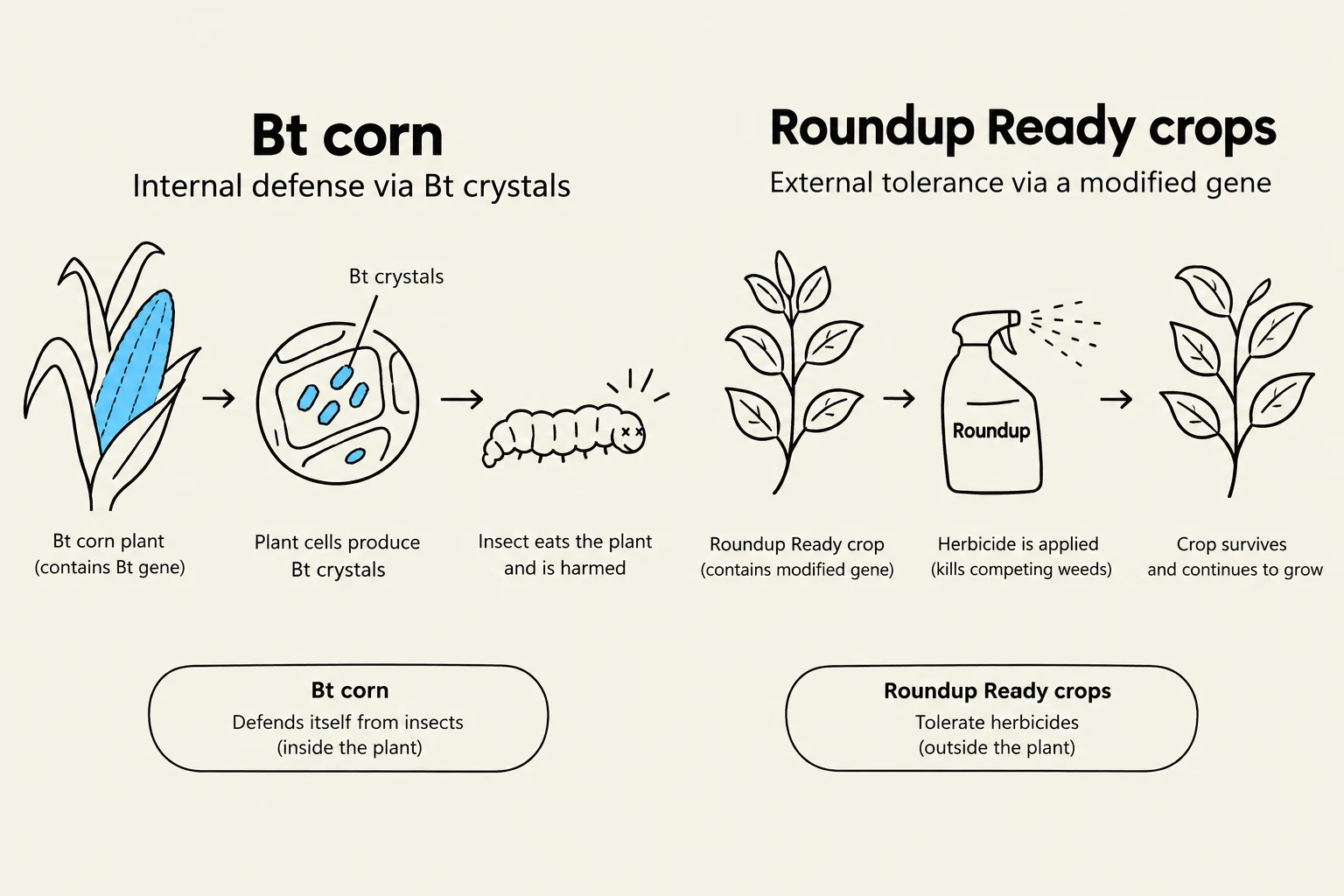
One of the most prominent examples is Bt corn. Scientists took a gene from a bacterium and inserted it into the corn genome. This gene allows the corn to produce Bt crystals, which are proteins toxic to specific insect pests. Because the corn produces its own "insecticide," the need for external chemical insecticide applications has actually decreased in some areas.
Case Study 2: Roundup Ready Crops
Another strategy involves engineering crops to withstand herbicides. Roundup Ready crops are modified to be resistant to the broad-spectrum herbicide Roundup (which contains the active ingredient glyphosate). This allows a farmer to spray an entire field with Roundup; the weeds die, but the genetically modified crops remain unharmed.
However, this has led to a new evolutionary challenge: herbicide resistance. Just as pests develop resistance to pesticides, weeds are evolving to survive the application of Roundup, effectively creating a new version of the treadmill. Furthermore, the use of glyphosate has raised significant health concerns, including links to cancer and digestive disorders.
This diagram illustrates the mechanisms of Bt corn, which defends itself from insects internally via Bt crystals, and Roundup Ready crops, which exhibit external tolerance to herbicides due to a modified gene.
The Risk of Low Genetic Diversity
While GMOs offer precision, they introduce a significant ecological risk: the loss of genetic diversity.
In a natural ecosystem, a population of plants has high genetic variation. If a new disease strikes, some individuals might have a mutation that allows them to survive, ensuring the species continues. However, GM crops are often grown as massive populations of genetically identical individuals—essentially acting as clones.
If a new pest or a specific disease emerges that can bypass the genetic modification (such as a pest that can eat Bt corn), the entire crop population becomes vulnerable. Because there is no genetic variation within the population, there are no "lucky" individuals with natural resistance to survive and restart the population. In this scenario, a single biological event could lead to a total crop failure.
Lessons from History: The Complexity of Ecosystems
The history of pest management shows that intervening in one part of an ecosystem often causes a "domino effect" elsewhere. A classic example is the use of DDT to combat malaria.
While spraying DDT successfully reduced malaria by killing mosquitoes, it caused devastating unintended consequences:
Ecological Imbalance: In Borneo, DDT killed the natural predators of the thatch-eating caterpillar, such as parasitic wasps. This led to a caterpillar overpopulation that destroyed the roofs of villagers' houses.
Biomagnification: DDT is highly persistent and accumulates in the tissues of organisms. In one instance, DDT accumulated in geckos, which were then eaten by cats. The high concentration of toxin killed the cats, which in turn allowed the rat population to explode, leading to an outbreak of the sylvatic plague.
These examples serve as a reminder that whether we use traditional chemicals or advanced genetic engineering, we are participating in a complex evolutionary dialogue with the natural world.
Keep reading for free.
Create an account to finish this reading and make it part of your study routine.