Perioperative Nursing Care: Phases, Complications, and Management
A comprehensive guide to perioperative nursing, covering the preoperative, intraoperative, and postoperative phases. It details nursing responsibilities, patient assessment, risk factors, management of complications like respiratory issues and wound healing, and interpretation of arterial blood gases.
Surgery is a complex physiological stressor that requires meticulous management to ensure patient safety and optimal recovery. Perioperative care is a continuous process divided into three distinct phases: the preoperative, intraoperative, and postoperative phases. Effective nursing management across these stages focuses on stabilizing the patient's physiological state, preventing complications like infection, and managing the body's response to surgical trauma.
The Three Phases of Surgery
Understanding the timeline of perioperative care is essential for prioritizing nursing interventions:
Preoperative Phase: Begins when the decision for surgery is made and ends when the patient is transferred to the operating room.
Intraoperative Phase: Begins once the patient enters the operating room.
Postoperative Phase: Follows the surgical procedure and focuses on recovery and complication monitoring.
Preoperative Management: Preparation and Assessment
Informed Consent
Before any procedure, the patient must provide informed consent. This is a legal document that includes a description of the procedure, the underlying disease process, the name and qualifications of the surgeon, the risks involved, the expected outcomes, and the recovery plan. Crucially, the patient must be informed of their right to refuse or withdraw consent at any time.
Nursing Alert: The physician or surgeon is responsible for obtaining informed consent. The nurse's role is to ensure the document is signed, but the consent is considered invalid if the patient is unconscious, sedated, mentally incompetent, or a minor.
Preoperative Assessment and Risk Factors
A comprehensive assessment is vital to identify factors that might impede a healthy physiologic response. Nurses must evaluate:
Medical History: Cardiovascular, respiratory, renal, liver, and endocrine diseases.
Medication History: Particular attention must be paid to anticoagulants, diuretics, corticosteroids, and benzodiazepines (such as Xanax or Valium). Some antibiotics may also interact with muscle relaxants used during anesthesia.
Lifestyle and Nutrition: Alcohol/illicit drug use, nutritional status, and daily living activities (ADLs).
Key Risk Factors: Patients at higher risk for complications include those with advanced age, obesity, malnutrition, dehydration, electrolyte imbalances, diabetes, or renal/liver dysfunction.
Nursing Responsibilities: Education and Physical Prep
Nursing interventions in this phase aim to reduce anxiety and prepare the body for the stress of surgery.
Psychological Support: Use therapeutic communication to relieve anxiety and fear, but avoid providing false reassurance.
Preoperative Education: Teaching patients how to manage their recovery before they enter surgery improves outcomes. Key topics include:
Respiratory Care: Deep breathing exercises, coughing, and the use of an incentive spirometer (e.g., Voldyne).
Incisional Care: Teaching the patient to splint the incision with a pillow while coughing to prevent pain and dehiscence.
Mobility: Leg exercises and the use of Sequential Compression Devices (SCDs).
Physical Preparation: This is guided by physician orders and hospital policy. It includes skin cleansing with antimicrobial solutions (like chlorhexidine), ensuring the patient has voided or has a catheter, and hair removal via clipping rather than shaving to minimize skin trauma.
Pharmacology: Common preoperative medications include:
Sedatives (e.g., diazepam, lorazepam) to alleviate anxiety.
Anticholinergics (e.g., atropine) to decrease secretions and prevent laryngospasms.
Opioid agonists (e.g., morphine, fentanyl) for sedation and relaxation.
Antihistamines (e.g., cimetidine) to decrease gastric acid.
Intraoperative Nursing Functions
Once the patient is in the operating room, the nurse often functions as a circulating nurse. Responsibilities include managing equipment (cardiac monitors, pulse oximeters, warming devices), ensuring IV lines are attached, and introducing the staff to the patient.
Prevention of Surgical Site Infections (SSI)
Preventing infection is a multi-phase effort:
Before Surgery: Patient education, chlorhexidine showers, and clipping hair instead of shaving.
During Surgery: Minimizing OR traffic, maintaining normal body temperature, controlling blood glucose, and ensuring correct timing of antibiotic administration.
After Surgery: Removing catheters as soon as possible and practicing strict hand hygiene.
Postoperative Care and Complications
Monitoring Physiological Stability
Postoperative nursing care focuses on the return of homeostasis across multiple systems:
Cardiovascular: Monitor vital signs, electrolytes, and ECG. Note that tachycardia is an early sign of shock.
Respiratory: Assess oxygenation via pulse oximetry, breath sounds, and respiratory rate.
Fluid Status: Monitor skin turgor, urine output, and wound drainage.
Neurological: Monitor for the return of consciousness.
Managing Respiratory Complications
Postoperative patients are at risk for several respiratory issues:
Atelectasis: Collapse of alveoli due to retained mucus. Signs include diminished lung sounds and dyspnea. Intervention: Activity, positioning, and incentive spirometry.
Pneumonia: Inflammation or infection of the alveoli. Signs include fever, chills, and productive cough. Intervention: Antibiotics and elevated head of bed (30 degrees).
Pulmonary Embolism (PE): A life-threatening blood clot in the lungs. Signs include sudden dyspnea, chest pain, and tachycardia. Intervention: Notify the physician immediately and apply oxygen.
Wound Complications and Healing
This diagram illustrates the difference between wound dehiscence, where wound edges separate, and evisceration, where internal organs protrude through the wound.
Nurses must monitor the incision for:
Dehiscence: The separation of the layers of the incisional wound.
Evisceration: The protrusion of body organs through a dehisced wound.
Clinical Tip: Surgical dressings usually remain intact for the first 24 hours. If a dressing becomes saturated with blood, the nurse should reinforce it and notify the surgeon.
Other Critical Complications
Hemorrhage and Shock: Excessive blood loss can lead to hypovolemic shock (inadequate organ perfusion due to low blood volume). Signs include hypotension, increased pulse, and cold, clammy skin.
Deep Vein Thrombosis (DVT): Inflammation of a vein associated with a clot, common in the legs. Signs include calf pain, redness, and swelling.
Nutrition Issues: Inadequate nutrition slows wound healing. Diet progression (from NPO to clear liquids to solids) should be based on the return of GI function, such as the presence of bowel sounds and the passing of flatus.
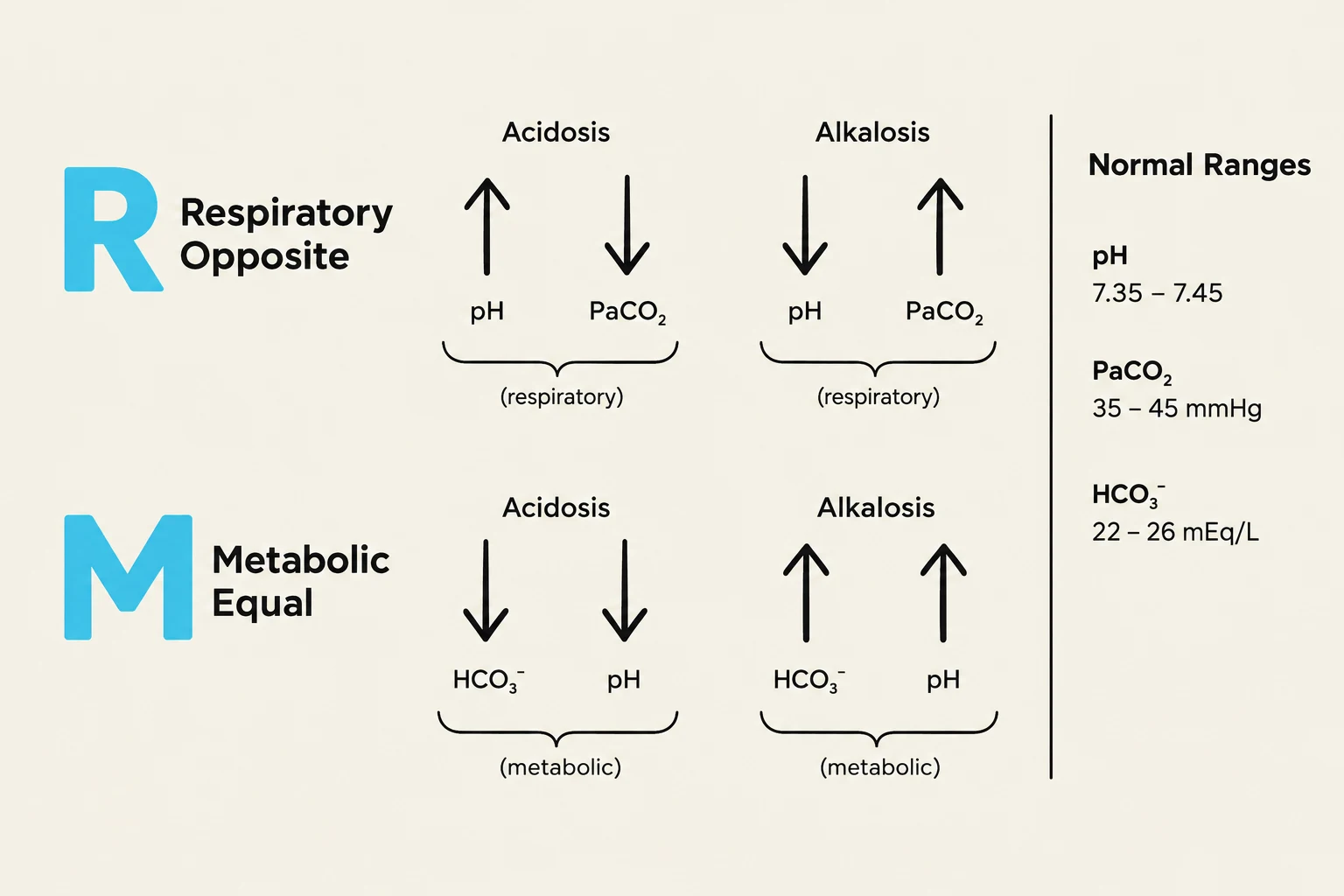
Clinical Tool: ABG Interpretation
This diagram illustrates the relationship between pH, PaCO2, and HCO3- in respiratory and metabolic acidosis and alkalosis, along with normal ranges for these values.
Postoperative patients may experience acid-base imbalances. When interpreting Arterial Blood Gases (ABGs), use the ROME mnemonic:
Respiratory Opposite: pH and PaCO2 move in opposite directions.
If pH is low (↓) and PaCO2 is high (↑), it is Respiratory Acidosis.
If pH is high (↑) and PaCO2 is low (↓), it is Respiratory Alkalosis.
Metabolic Equal: pH and HCO3 move in the same direction.
If pH is low (↓) and HCO3 is low (↓), it is Metabolic Acidosis.
If pH is high (↑) and HCO3 is high (↑), it is Metabolic Alkalosis.
Normal Reference Values:
pH: 7.35 – 7.45
PaCO2: 35 – 45 mmHg
HCO3: 22 – 26 mEq/L
SaO2: 92 – 100%
Keep reading for free.
Create an account to finish this reading and make it part of your study routine.