


Hormones are the chemical messengers of the body, responsible for coordinating complex physiological processes ranging from growth and metabolism to reproduction and stress responses. However, not all hormones "speak" to cells in the same way. The method a hormone uses to communicate depends heavily on its chemical structure—specifically, whether it is water-soluble or lipid-soluble.
Understanding these distinct pathways is essential for grasping how a tiny concentration of a hormone can trigger a massive, coordinated response across various organ systems.
The Water-Soluble Pathway: First Messengers and Second Messengers
Many hormones, including peptide hormones, eicosanoids, and catecholamines like epinephrine (E) and norepinephrine (NE), are water-soluble. Because they are hydrophilic, they cannot pass through the fatty, lipid-rich bilayer of the cell's plasma membrane. Instead, they must deliver their message from the outside, acting as a first messenger.
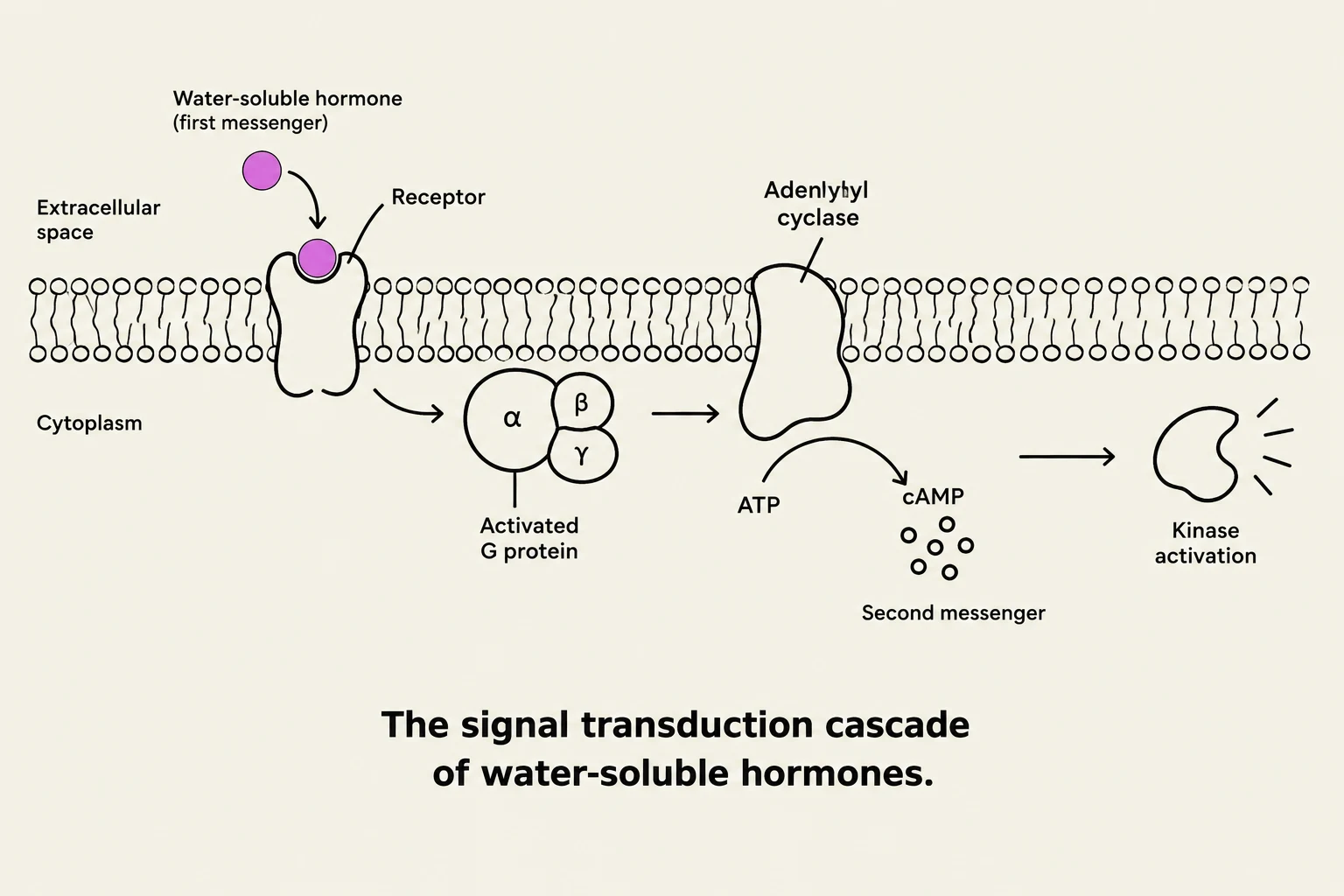
The Signal Transduction Cascade
When a water-soluble hormone reaches its target cell, it initiates a multi-step process known as a signal transduction cascade:
- Hormone-Receptor Binding: The hormone (the first messenger) binds to a specific receptor embedded in the plasma membrane, forming a hormone-receptor complex.
- G Protein Activation: This complex triggers the activation of a G protein located on the inner surface of the membrane.
- Activation of Adenylate Cyclase: The activated G protein moves along the membrane to stimulate an enzyme called adenylate cyclase.
- Second Messenger Production: Adenylate cyclase acts as a catalyst, converting ATP (adenosine triphosphate) into cAMP (cyclic adenosine monophosphate). In this context, cAMP is known as the second messenger.
- Kinase Activation: The cAMP diffuses into the cytoplasm, where it activates various kinase enzymes.
- Target Cell Response: These kinases trigger the final cellular effects, such as altering enzyme activity or opening ion channels.
Keep reading for free.
Create an account to finish this reading and make it part of your study routine.
Continue reading freeAlready have an account? Log in
Updated