Learn to identify drug classes by generic suffixes and apply a universal four-question framework (Action, Indication, Failure Mode, Your Move) to understand medications in emergency medical situations.
For many EMS students, pharmacology feels like an endless mountain of unique names, doses, and mechanisms to memorize. However, seasoned paramedics don't view drugs as individual entities; they view them as patterns. Instead of memorizing 200 different drugs, you only need to master a few dozen patterns. By understanding drug families through their generic suffixes and applying a consistent mental model to every medication you encounter, you can transform a chaotic medication list into a clear clinical picture.
The Suffix Decoder: Pattern Recognition
The FDA names drugs in classes for a reason. The last few letters of a generic name—the suffix—almost always tell you the drug's family and its physiological effect. Mastering these suffixes allows you to identify a drug's class even if you have never heard of that specific medication before.
Suffix
Drug Class
Primary Action
Examples
-olol
Beta Blockers
Slows HR and BP
Metoprolol, Atenolol
-pril
ACE Inhibitors
Lowers BP
Lisinopril, Ramipril
-sartan
ARBs
Lowers BP (fewer side effects than ACE)
Losartan
-dipine
Calcium Channel Blockers (CCBs)
Vasodilation
Amlodipine, Nifedipine
-pam / -lam
Benzodiazepines
Sedation, anti-seizure
Diazepam, Midazolam
-parin / -xaban
Anticoagulants
Blocks clotting
Heparin, Apixaban
-ase / -plase
Thrombolytics
Dissolves clots
Alteplase (tPA), Tenecteplase (TNK)
-terol
Beta-2 Agonists
Bronchodilation
Albuterol
-setron
Antiemetics
Stops nausea
Ondansetron (Zofran)
-statin
Statins
Lowers cholesterol
Atorvastatin
Exam Tip: Watch for the Exceptions!
Patterns are a starting point, not a rule. Labetalol is both a beta and an alpha blocker. Diltiazem and Verapamil are cardiac-selective CCBs that do not end in "-dipine".
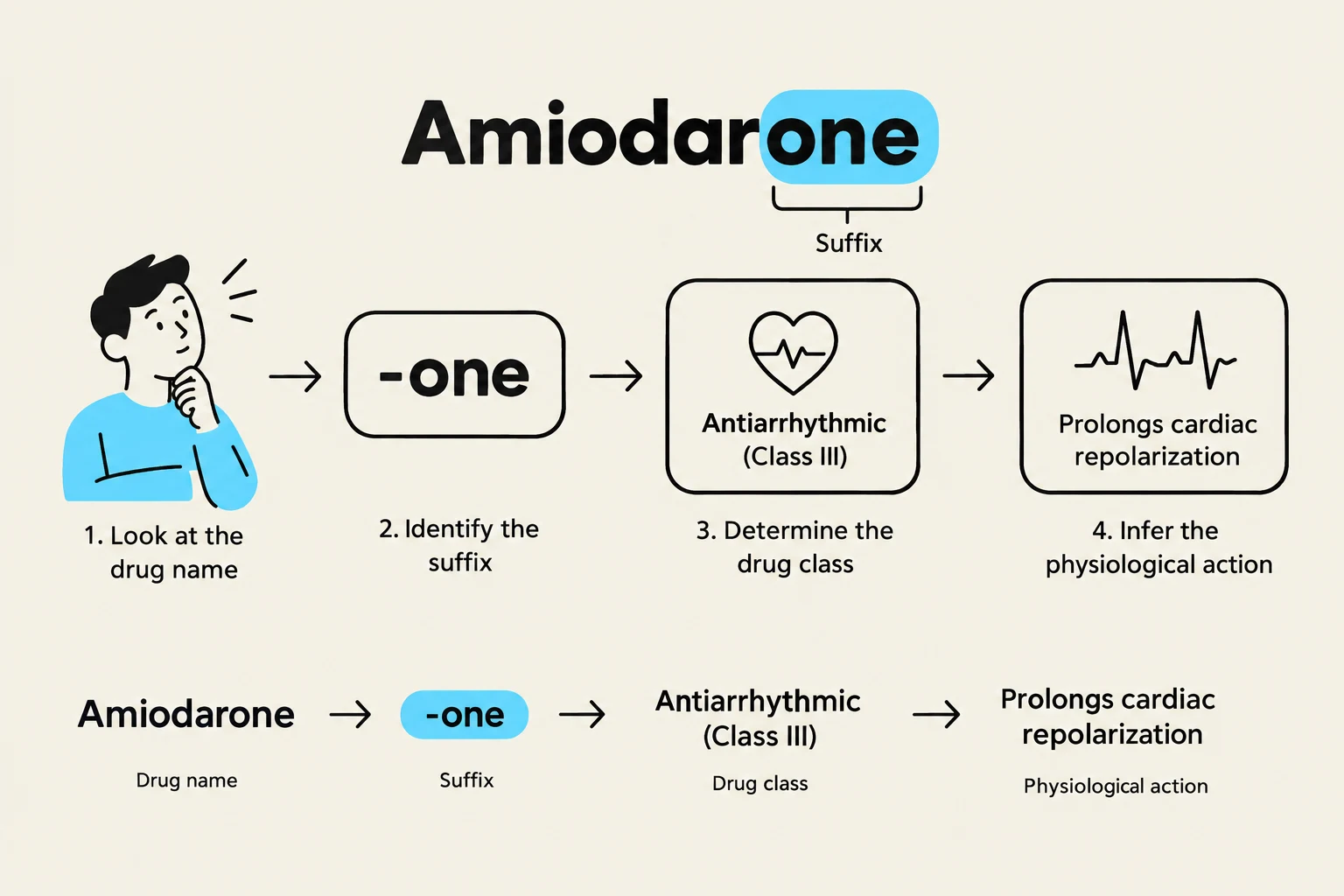
This diagram illustrates how to determine the drug class and physiological action of Amiodarone by analyzing its name and suffix.
The Universal Framework: Four Questions for Every Drug
When a patient hands you a list of 14 medications, you don't have time to look up each one. Instead, apply this four-step mental model to every drug you see:
Action: What does it do to the patient? (The mechanism)
Indication: Why are they taking it? (The diagnosis)
Failure Mode: What can go wrong? (Overdose, withdrawal, or interactions)
Your Move: How does this change your assessment or treatment?
The medication list is essentially a "diagnosis list in disguise". If you see a patient on Lasix, you are looking at a history of CHF or fluid overload. If they are on Plavix, you are looking at a history of cardiac stents or stroke.
Clinical Deep Dive: "Slows Things Down"
One of the most critical sections for paramedics is the "Slows Things Down" category. These drugs affect the heart rate (HR), blood pressure (BP), or respiratory rate (RR).
Beta Blockers (-olol)
Beta blockers block β1 receptors in the heart, which decreases heart rate, contractility, and blood pressure.
The Trauma Trap: Beta blockers can "lie" to you during a trauma assessment. Because they blunt the body's natural compensatory tachycardia, a patient in shock may maintain a normal heart rate despite significant blood loss. In these cases, do not trust the HR; rely on BP, skin signs, and mental status.
Failure Modes & Antidotes:
Overdose: Can cause profound bradycardia and hypotension.
Antidotes:Glucagon is the primary antidote for symptomatic overdose. High-dose insulin may also be used.
Withdrawal: Sudden discontinuation (e.g., Clonidine) can cause a dangerous hypertensive crisis.
Calcium Channel Blockers (-dipine, dilt, verap)
CCBs are divided into two main types:
Vessel-selective (-dipines): These act as vasodilators to lower BP.
Cardiac-selective (Diltiazem/Verapamil): These slow the heart rate and drop contractility.
Failure Modes:
Overdose: CCB overdose is one of the most lethal cardiac drug toxicities.
Antidotes:Calcium chloride or calcium gluconate are first-line for symptomatic overdose. Glucagon and high-dose insulin are also options.
This diagram illustrates the distinct mechanisms of vessel-selective and cardiac-selective CCBs (calcium channel blockers). Vessel-selective CCBs primarily cause arteriolar dilation, leading to reduced systemic vascular resistance and lower blood pressure. Cardiac-selective CCBs, on the other hand, primarily affect the heart, reducing heart rate, contractility, and AV conduction, which in turn reduces cardiac output and lowers blood pressure.
Clinical Deep Dive: "Opens Things Up"
Bronchodilators (-terol and -tropium)
Beta-2 Agonists (-terol): Such as Albuterol, these stimulate β2 receptors to cause bronchodilation. Note that "spillover" to β1 receptors can cause tachycardia.
Anticholinergics (-tropium): Such as Ipratropium, these block parasympathetic constriction.
Field Tip: Combining these (e.g., DuoNeb) provides two different mechanisms of action, which is standard for severe COPD or asthma exacerbations.
ACE Inhibitors (-pril) and ARBs (-sartan)
Both classes manage hypertension and CHF by blocking the renin-angiotensin system.
Critical Warning: ACE-Induced Angioedema
ACE inhibitors can cause a specific type of airway emergency: angioedema (swelling of the lips/tongue) without hives. This is bradykinin-mediated and may not respond to epinephrine. If a patient on Lisinopril presents with a "weird tongue," secure the airway immediately.
Clinical Deep Dive: "Stops Clotting"
The hemostasis spectrum involves three distinct goals: preventing clots, stopping clots from growing, or dissolving existing clots.
Antiplatelets (e.g., Aspirin): Prevent platelets from sticking together.
Anticoagulants (e.g., Heparin, Warfarin, Eliquis): Block the coagulation cascade.
The Trauma Rule: If a patient is on an anticoagulant (like Warfarin or Apixaban) and sustains even minor head trauma, maintain a high index of suspicion for intracranial hemorrhage (ICH). Bleeding in these patients can be delayed.
This diagram illustrates the mechanisms of antiplatelets, anticoagulants, and thrombolytics in managing blood clots. Antiplatelets prevent platelet aggregation, anticoagulants block the coagulation cascade, and thrombolytics dissolve existing clots, ultimately restoring normal blood flow.
Summary Table of Key Interventions
Scenario
First-Line / Key Action
Notes
Anaphylaxis
Epinephrine (IM)
Diphenhydramine is only an adjunct
SVT (Stable)
Adenosine
Push fast, in the closest port to the heart
Status Epilepticus
Benzodiazepines
Do not rely on home antiepileptics
Hypoglycemia
Dextrose (D10/D50)
Check sugar before calling a stroke alert
Postpartum Hemorrhage
Fundal Massage
Mechanical intervention is first-line
Disclaimer: This article is a study aid and not a field protocol. Always defer to your medical director and local protocols.
Keep reading for free.
Create an account to finish this reading and make it part of your study routine.