Explains how hemoglobin in red blood cells transports oxygen, covering its structure, loading/unloading mechanisms, the oxygen-hemoglobin dissociation curve, and factors affecting oxygen affinity like the Bohr effect, temperature, and 2,3-BPG.
While we often think of breathing as the primary way we get oxygen, the actual delivery of that oxygen to your hardworking muscle cells is a complex chemical dance occurring within your blood. While a tiny fraction of oxygen (about 1.5%) dissolves directly into the plasma, the vast majority relies on a specialized protein to act as a molecular shuttle. Understanding how this shuttle works—and how it knows when to let go of its cargo—is fundamental to understanding human physiology.
Hemoglobin Structure
The primary vehicle for oxygen transport is hemoglobin (Hb), a complex protein located within erythrocytes (red blood cells). Hemoglobin is not a single unit; rather, it is composed of four subunits. Each of these subunits contains a heme group, which features a central iron atom. This iron atom is the specific site where an oxygen molecule (O2) binds.
Because there are four subunits per hemoglobin molecule, a single Hb molecule has the capacity to carry up to four oxygen molecules simultaneously. This structural design makes hemoglobin an incredibly efficient transporter, allowing the blood to carry far more oxygen than could ever be achieved through simple dissolution in plasma.
Oxygen Loading and Unloading
The journey of an oxygen molecule can be divided into two critical phases: loading and unloading.
Loading: This occurs in the pulmonary capillaries surrounding the alveoli in the lungs. Here, the partial pressure of oxygen is high, causing oxygen to bind to deoxyhemoglobin (HHb) to form oxyhemoglobin (HbO2).
Unloading: Once the blood reaches the systemic capillaries surrounding the body's tissues, the environment changes. The oxygen must be released from the hemoglobin so it can diffuse into the cells to support metabolism.
The Oxygen-Hemoglobin Dissociation Curve
To understand how much oxygen is being carried, we look at the relationship between the partial pressure of oxygen (PO2) and the percent saturation of hemoglobin. This relationship is visualized through the oxygen-hemoglobin dissociation curve.
Unlike many other biological relationships that are linear, this curve is S-shaped (sigmoidal). This shape is a result of "cooperativity," where the binding of one oxygen molecule makes it easier for the next to bind.
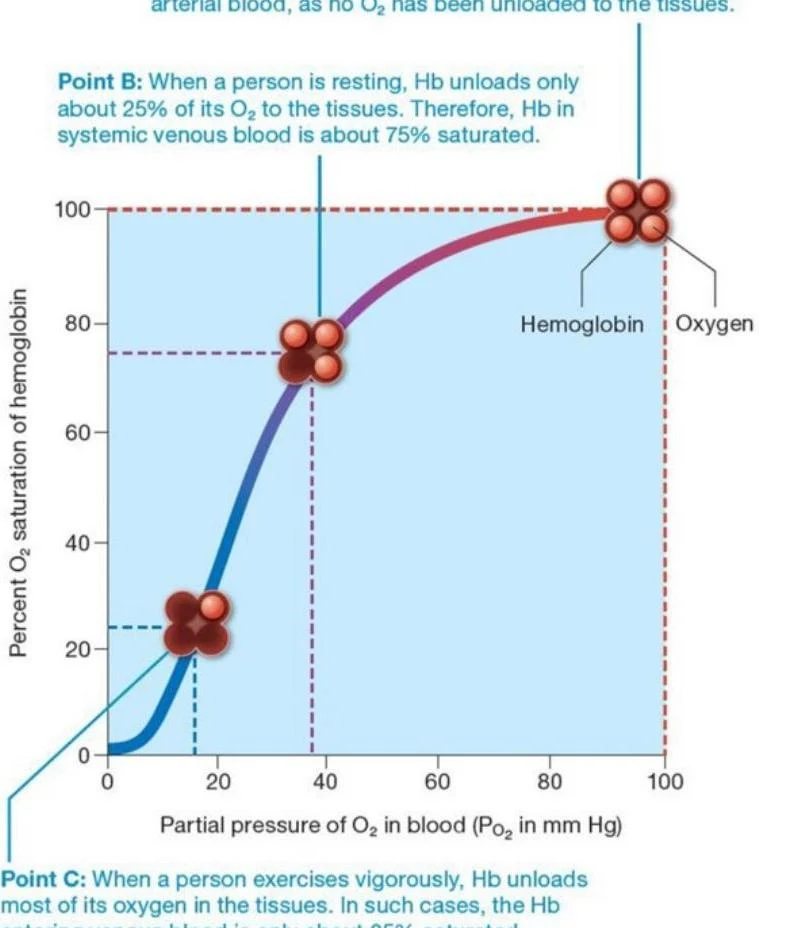
This graph illustrates the oxygen-hemoglobin dissociation curve, showing the relationship between the partial pressure of oxygen and the percentage of oxygen saturation of hemoglobin. It highlights how hemoglobin unloads oxygen to tissues under different physiological conditions, such as resting and vigorous exercise.
At high PO2 levels, such as in arterial blood (≈100 mm Hg), the curve plateaus. This means hemoglobin is nearly fully saturated (≈97−100%), ensuring a massive reserve of oxygen is being transported. However, as PO2 drops in the tissues, the curve enters a steep decline. This steepness is biologically vital: it ensures that even a small drop in local oxygen pressure results in a large release of oxygen to the tissues.
Student Note: Metabolic Demand
During rest, hemoglobin typically unloads about 25% of its oxygen, leaving about 75% saturation in venous blood. However, during vigorous exercise, the saturation in venous blood can drop to 25% or even lower. This allows the body to meet the massive increase in metabolic demand by "squeezing" more oxygen out of the hemoglobin.
Hemoglobin Affinity and Modulators
Affinity refers to the strength of the bond between hemoglobin and oxygen. If affinity is high, hemoglobin holds onto oxygen tightly; if affinity is low, hemoglobin releases oxygen more easily. Several metabolic factors can shift the dissociation curve, effectively changing this affinity to meet the body's needs.
The Bohr Effect: Acidity and PCO2
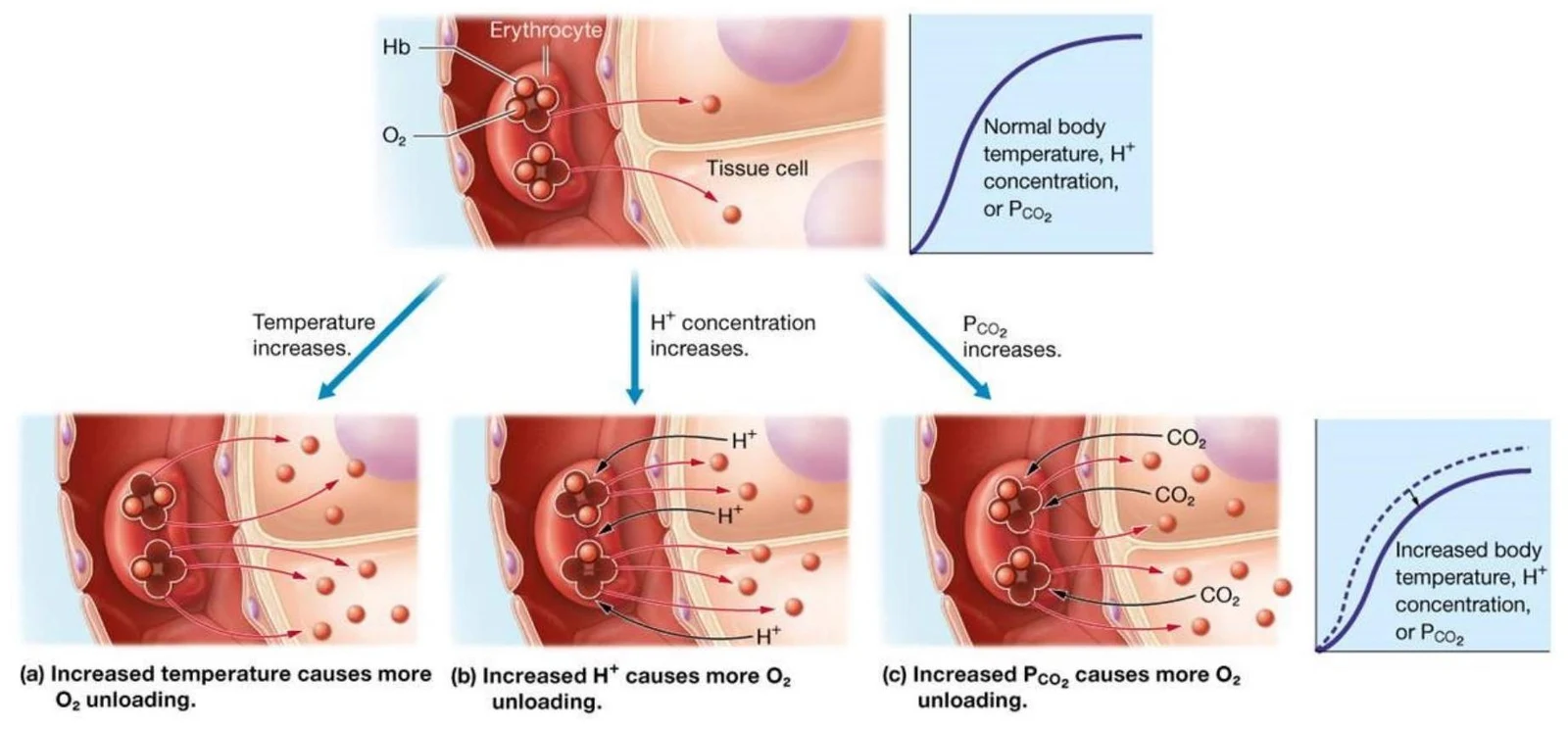
When tissues become metabolically active (such as during exercise), they produce carbon dioxide (CO2) and hydrogen ions (H+) as byproducts of cellular respiration. This increase in PCO2 and the resulting decrease in pH (increased acidity) reduces hemoglobin's affinity for oxygen. This phenomenon is known as the Bohr Effect. By lowering affinity exactly where CO2 is high, the body ensures that oxygen is unloaded precisely where it is needed most.
This diagram illustrates how increased temperature, H+ concentration, or PCO2 leads to increased oxygen unloading from hemoglobin in red blood cells to tissues.
Temperature Effects
Metabolic activity also generates heat. An increase in local temperature decreases hemoglobin's affinity for oxygen. Much like the Bohr effect, this serves a functional purpose: higher temperatures in active muscles facilitate the unloading of oxygen to support increased metabolic rates.
2,3-Bisphosphoglycerate (2,3-BPG)
Another critical regulator is 2,3-bisphosphoglycerate (2,3-BPG), a molecule produced within erythrocytes. Increased levels of 2,3-BPG reduce hemoglobin's affinity for oxygen, shifting the curve to the right and promoting unloading. This is a key mechanism for high-altitude acclimatization; as people spend more time at high elevations where oxygen is scarce, their bodies increase 2,3-BPG production to maximize the efficiency of oxygen delivery to tissues.
Exam Tip: Right vs. Left Shifts
A "Right Shift" means decreased affinity. This happens with increased CO2, increased H+ (lower pH), increased temperature, and increased 2,3-BPG. A right shift is "good" for unloading oxygen to tissues.
A "Left Shift" means increased affinity. This happens with decreased CO2, decreased H+ (higher pH), decreased temperature, and decreased 2,3-BPG. A left shift makes hemoglobin hold onto oxygen more tightly.
By integrating these chemical signals—pH, temperature, PCO2, and 2,3-BPG—the hemoglobin molecule acts as a "smart" transporter, sensing the metabolic state of the body and adjusting its oxygen delivery in real-time.
Keep reading for free.
Create an account to finish this reading and make it part of your study routine.