Explains the mechanisms of oxygen and carbon dioxide transport in the blood, including the roles of hemoglobin, plasma, and erythrocytes, and discusses the clinical correlations of hyperventilation and hypoventilation.
The survival of every cell in the human body depends on a continuous exchange of gases: the intake of oxygen (O2) for aerobic respiration and the removal of carbon dioxide (CO2), a metabolic waste product. This exchange occurs across the respiratory membrane, a microscopic barrier between the alveoli and the pulmonary capillaries. To move these gases from the lungs to the tissues and back again, the body utilizes specialized transport mechanisms involving the plasma and the red blood cells (erythrocytes).
The Physics of Gas Transport: Solubility
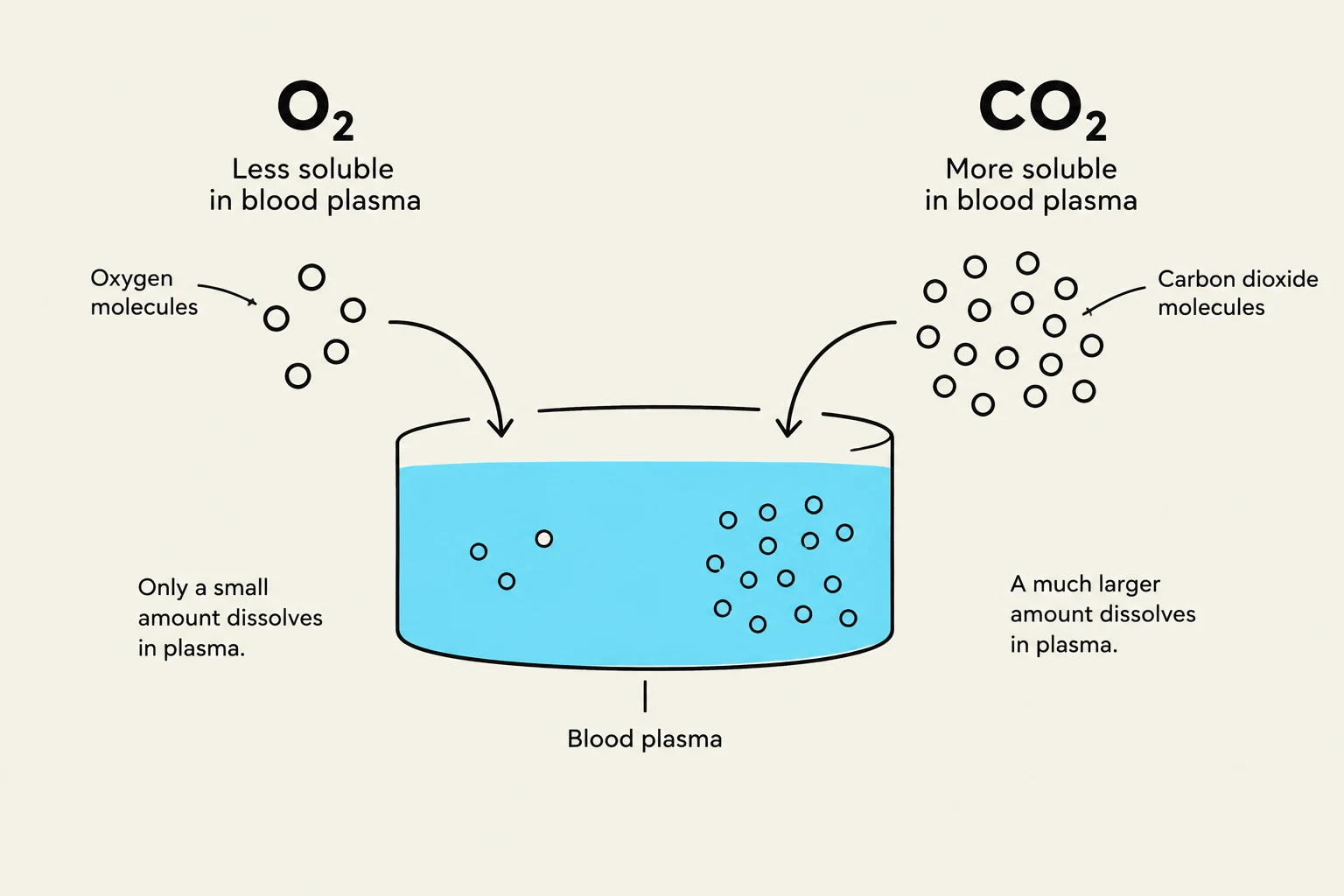
The efficiency with which a gas moves through the blood is heavily influenced by its solubility coefficient—a measure of how much of a gas can dissolve in a liquid.
Oxygen has a very low solubility coefficient of 0.024. Because it does not dissolve easily in water, less than 2% of the oxygen in your blood travels simply as dissolved gas in the plasma. This presents a physiological challenge: if we relied solely on dissolved oxygen, our blood could not carry enough to sustain life. To solve this, the body utilizes hemoglobin (Hb), a specialized protein found within erythrocytes.
Carbon dioxide, by contrast, is much more soluble, with a coefficient of 0.57. While this makes it easier to dissolve in plasma, the body still employs several sophisticated pathways to ensure rapid transport back to the lungs.
This diagram illustrates the difference in solubility between oxygen (O2) and carbon dioxide (CO2) in blood plasma. It shows that CO2 is significantly more soluble than O2, with a much larger amount dissolving in plasma compared to oxygen.
Oxygen Transport and Hemoglobin
Since most oxygen cannot travel in the plasma, it must be carried by hemoglobin inside the red blood cells. When oxygen molecules bind to the iron within the hemoglobin protein, the complex is called oxyhemoglobin (HbO2). When hemoglobin has released its oxygen to the tissues, it is referred to as deoxyhemoglobin (HHb).
The transport cycle follows a specific path:
Oxygen diffuses from the alveoli into the pulmonary capillaries.
It binds to hemoglobin in the erythrocytes.
The oxygenated blood travels through the pulmonary veins to the left side of the heart.
The heart pumps this oxygen-rich blood through the systemic circulation to reach the body's cells.
Exam Tip: Remember that the majority of oxygen (98%) is bound to hemoglobin, not dissolved in plasma. If a question asks about the primary method of O2 transport, the answer is always hemoglobin within erythrocytes.
Carbon Dioxide Transport Mechanisms
Carbon dioxide is produced by cells as they perform respiration. To prevent toxic buildup, CO2 must be transported from the systemic cells back to the alveoli via three distinct methods:
1. Dissolved in Plasma (7%)
A small portion of CO2 travels simply as a dissolved gas within the blood plasma.
2. Carbaminohemoglobin (23%)
About 23% of CO2 binds directly to the globin (protein) portion of the hemoglobin molecule. Specifically, it attaches to the amine groups (−NH2). Note that CO2 does not compete for the same binding site as oxygen; oxygen binds to the iron, while CO2 binds to the protein chains.
3. Bicarbonate Ions (70%)
The most significant method of transport is the conversion of CO2 into bicarbonate (HCO3−). This process occurs inside the erythrocytes through a chemical reaction:
CO2+H2OH2CO3⇌H2CO3⇌HCO3−+H+
In this reaction, CO2 combines with water to form carbonic acid (H2CO3), which then dissociates into bicarbonate and hydrogen ions. The bicarbonate then diffuses out of the erythrocyte into the plasma to be carried to the lungs. Once the blood reaches the pulmonary capillaries, this entire process reverses to regenerate CO2 so it can be exhaled.
This diagram illustrates the three primary ways carbon dioxide (CO2) is transported in the blood: dissolved in plasma (7%), bound to hemoglobin as carbaminohemoglobin (23%), and as bicarbonate ions in the plasma (70%).
Clinical Correlations: Ventilation and Blood Chemistry
The balance of O2 and CO2 in the blood is maintained by the rate and depth of breathing, known as ventilation. When this balance is disrupted, it significantly alters blood chemistry.
Hyperventilation
Hyperventilation occurs when the breathing rate or depth is increased above the body's metabolic demand. This causes PCO2 levels in the alveoli to drop, creating a steeper gradient that pulls even more CO2 out of the blood.
Result: Blood PCO2 drops below normal (hypocapnia).
Consequences: This can lead to vasoconstriction (especially in the brain), respiratory alkalosis, dizziness, numbness, or even loss of consciousness.
Hypoventilation
Hypoventilation is breathing that is too slow (bradypnea) or too shallow (hypopnea) to meet metabolic needs. This leads to an accumulation of CO2 in the alveoli, reducing the gradient that allows CO2 to leave the blood.
Result: Blood PCO2 increases (hypercapnia) and blood PO2 decreases (hypoxemia).
Consequences: High CO2 levels increase $H^+$ concentration, potentially leading to respiratory acidosis. Symptoms include lethargy, headache, and cyanosis (a bluish skin tint due to low oxygen).
Summary Table: Ventilation Effects
Condition
Breathing State
Alveolar PO2
Alveolar PCO2
Blood Condition
Hyperventilation
Excessive
Increases
Decreases
Hypocapnia / Alkalosis
Hypoventilation
Insufficient
Decreases
Increases
Hypercapnia / Acidosis
Keep reading for free.
Create an account to finish this reading and make it part of your study routine.