Overview of Tooth Designation Systems in Dentistry
This content explains the various tooth designation systems used in clinical dentistry, including the Universal Numbering System, International Numbering System (ISO), and Palmer Notation. It covers the organization of the mouth into arches and quadrants, and the distinctions between primary and permanent dentitions.
In clinical dentistry, precision is paramount. When a clinician discusses a specific tooth, they must use a standardized language to ensure that every member of the dental team—from the dentist to the hygienist—understands exactly which tooth is being referenced. This shared language is provided by tooth designation systems, which allow for accurate charting, treatment planning, and communication. To master these systems, one must first understand the fundamental organization of the mouth, including the different dentitions, arches, and quadrants.
Arch and Tooth Position
Before applying a numbering system, you must understand how the mouth is organized spatially. The tooth-bearing part of each jaw is known as the alveolar process, and each process is considered a dental arch. There are two primary arches: the maxillary arch (upper jaw) and the mandibular arch (lower jaw).
The midline serves as the central dividing line for each arch, splitting it into right and left halves. Teeth are further categorized by their distance from this midline:
Anterior teeth: Incisors and canines, which are closest to the midline.
Posterior teeth: Premolars and molars, which are farthest from the midline.
Each arch is divided into two quadrants: the maxillary right, maxillary left, mandibular left, and mandibular right. It is a critical clinical rule to remember that when you are facing a patient, the patient's right side is on your left.
Diagram illustrating the division of human dentition into four quadrants: Quadrant 1 (Upper Right), Quadrant 2 (Upper Left), Quadrant 3 (Lower Left), and Quadrant 4 (Lower Right), separated by the midline.
Primary and Permanent Dentition
A person experiences two distinct dentitions over their lifetime: the primary (deciduous) dentition and the permanent dentition.
Primary Dentition
Often called "baby teeth," the primary dentition is the first to develop. It consists of 20 teeth total: 8 incisors, 4 canines, and 8 molars. Notably, there are no premolars in the primary dentition. Primary teeth are vital for guiding permanent tooth eruption, maintaining space, and supporting speech and mastication.
Permanent Dentition
The permanent dentition develops second and typically consists of 32 teeth, including the third molars. It includes 8 incisors, 4 canines, 8 premolars, and 12 molars.
A key distinction in permanent dentition is the concept of succedaneous versus nonsuccedaneous teeth:
Succedaneous teeth: Permanent anterior teeth and premolars that replace their primary predecessors.
Nonsuccedaneous teeth: Permanent molars, which erupt distal to the primary dentition and do not replace any primary teeth.
Exam Tip: If a question asks which teeth do not replace primary teeth, the answer is the permanent molars. They are "nonsuccedaneous".
Tooth Designation Systems
There are three primary systems used to identify teeth. The choice of system often depends on the geographic location or the dental specialty involved.
1. Universal Numbering System
This is the most common system used in the United States.
Permanent Dentition: Uses digits 1 through 32. Numbering begins at the maxillary right third molar and moves clockwise around the mouth, ending at the mandibular right third molar.
Primary Dentition: Uses capital letters A through T. Numbering begins at the maxillary right second molar and moves clockwise, ending at the mandibular right second molar.
2. International Numbering System (ISO)
The International Numbering System is a two-digit code used for global or electronic communication. The first digit represents the quadrant, and the second digit represents the tooth's position within that quadrant.
Permanent Dentition Quadrants:
Quadrant 1: Maxillary right
Quadrant 2: Maxillary left
Quadrant 3: Mandibular left
Quadrant 4: Mandibular right
Tooth position: Numbers 1 through 8 start at the midline and move distally.
Primary Dentition Quadrants:
Quadrant 5: Maxillary right
Quadrant 6: Maxillary left
Quadrant 7: Mandibular left
Quadrant 8: Mandibular right
Tooth position: Numbers 1 through 5 start at the midline and move distally.
This illustration shows the permanent maxillary right central incisor and various methods for labeling it, including Universal (ADA), Palmer (ISO), FDI (ISO), and Zsigmondy (Primary) systems.
3. Palmer Notation
The Palmer notation is frequently used in orthodontics because it provides a highly visual "map" of the dentition. It utilizes right-angle brackets to indicate the specific quadrant and arch. Permanent teeth in this system use numbers similar to the International system, while primary teeth may use letters or numbers depending on the specific convention used.
Summary of Designation Methods
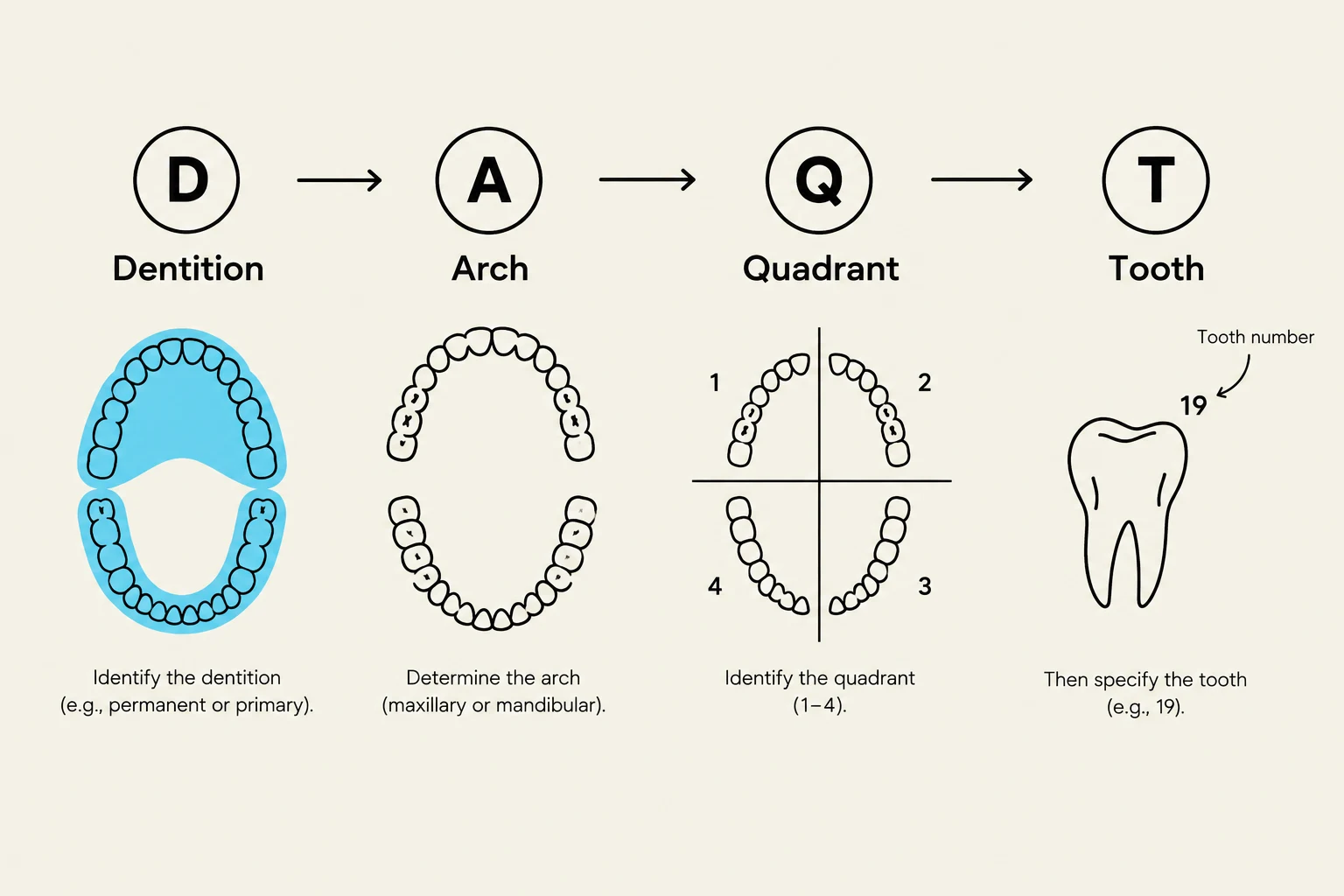
To avoid errors, clinicians often use the D-A-Q-T method to ensure all necessary information is captured when describing a tooth:
Dentition (Primary or Permanent)
Arch (Maxillary or Mandibular)
Quadrant (Right or Left)
Type/Position (e.g., First Molar)
Clinical Caution: When using the International system, always speak the digits separately. For example, tooth 11 should be spoken as "one-one," not "eleven".
This diagram illustrates the process of identifying a tooth using the Universal Numbering System, starting from dentition type, arch, quadrant, and finally the specific tooth number.
Keep reading for free.
Create an account to finish this reading and make it part of your study routine.