


The muscular system is a complex network of tissues responsible for nearly all movement within the human body, ranging from the subtle expressions of the face to the powerful contractions required for locomotion. This system is broadly categorized into two divisions: the axial division, which supports the body's central axis, and the appendicular division, which facilitates the movement of the limbs. By understanding how muscles attach to the skeleton, how they are organized into functional groups, and how they contract, we can gain a comprehensive view of human physiology.
Muscle Attachments and Structure
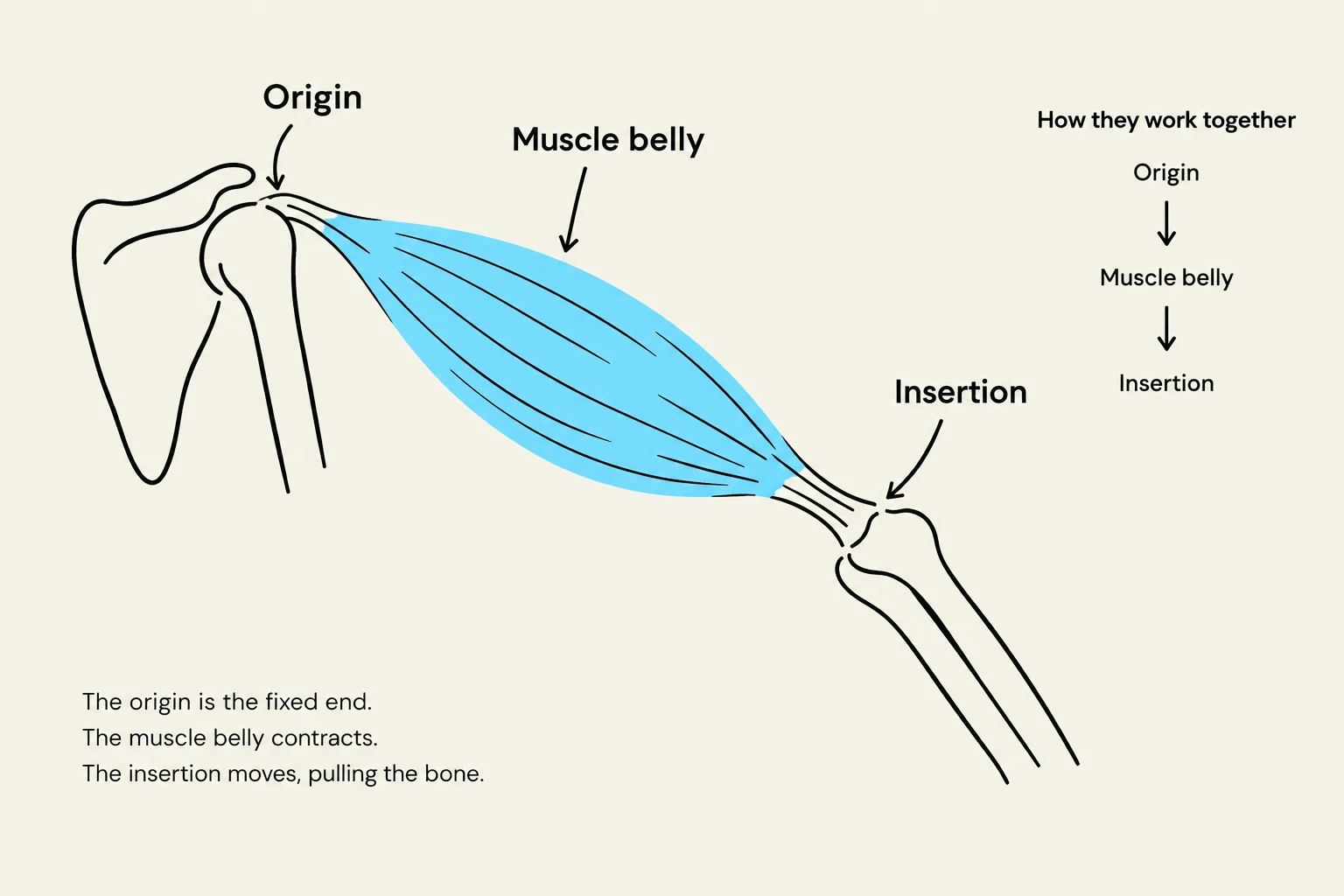
To produce movement, skeletal muscles must be anchored to the skeletal system. This is achieved through specific attachment sites.
- Origin: The attachment site that remains relatively stationary during a movement; it is typically the more proximal attachment.
- Insertion: The attachment site on the bone that moves when the muscle contracts; it is typically the more distal attachment.
- Belly: The fleshy portion of the muscle located between the tendons.
The naming of muscles is not arbitrary; it often follows a logical system based on seven key characteristics: action, location, attachment, fiber orientation, shape, size, or the number of origins (heads).
Muscle Actions and Contractions
Muscles rarely act in isolation. Instead, they work in functional groups to coordinate smooth and precise movements.
Functional Groups
- Agonist (Prime Mover): The muscle that provides the main force for a specific movement. For example, during elbow flexion, the biceps brachii acts as the agonist.
- Antagonist: The muscle that opposes the action of the agonist. In the elbow flexion example, the triceps brachii serves as the antagonist.
- Synergist: These muscles assist the agonist by adding extra force or reducing unnecessary movements.

Keep reading for free.
Create an account to finish this reading and make it part of your study routine.
Continue reading freeAlready have an account? Log in
Updated