Overview of the Human Nervous and Endocrine Systems
This guide provides a comprehensive overview of the human nervous and endocrine systems, detailing their structures, functions, and the mechanisms of communication and regulation within the body. It covers neural pathways, action potentials, synaptic transmission, the organization of the central and peripheral nervous
The human body relies on two primary communication systems to maintain homeostasis and respond to the environment: the nervous system and the endocrine system. While the nervous system acts like a high-speed fiber-optic network, using electrical impulses to provide rapid, targeted responses, the endocrine system functions more like a broadcast system, releasing chemical messengers called hormones into the bloodstream to coordinate slower, longer-lasting adjustments across the entire body. Understanding how these systems integrate is essential to grasping how we move, think, and regulate our internal chemistry.
The Building Blocks of Neural Communication
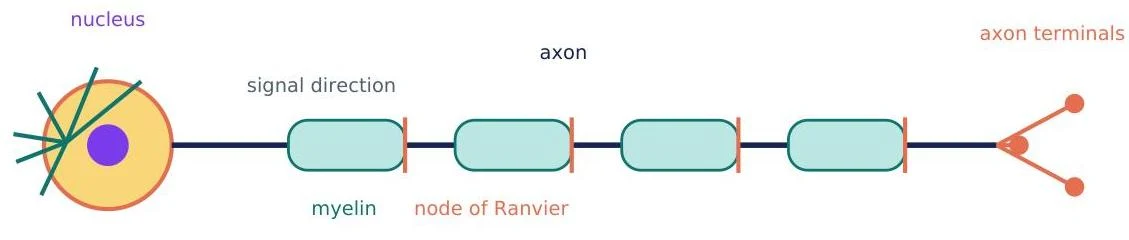
At the heart of the nervous system is the neuron, a specialized cell designed to transmit information. A typical neuron consists of several key parts: dendrites receive incoming signals, the soma (cell body) integrates that information, the axon carries the signal away, and axon terminals communicate with the next cell.
Diagram of a neuron showing the nucleus, axon, myelin sheath, nodes of Ranvier, and axon terminals.
Action Potentials and Synaptic Transmission
Communication within a single neuron occurs via an action potential, an "all-or-nothing" electrical impulse. When a stimulus reaches a specific threshold, voltage-gated Na+ channels open, allowing sodium to rush into the cell. This causes depolarization (the inside becomes less negative). To reset the cell, K+ channels open, allowing potassium to exit, which is known as repolarization.
When the signal reaches the end of the axon, it must cross a gap called the synapse to reach the next cell. This is achieved through synaptic communication: the action potential triggers the release of chemical neurotransmitters (such as glutamate for excitation or acetylcholine at muscles) from vesicles into the synaptic cleft.
Exam Tip: Remember the ion movement for action potentials: Na+ in = depolarization; K+ out = repolarization.
Organization of the Nervous System
The nervous system is divided into two main branches: the Central Nervous System (CNS) and the Peripheral Nervous System (PNS).
CNS: Comprised of the brain and spinal cord, acting as the "central command".
PNS: Includes all nervous tissue outside the CNS, such as cranial nerves, spinal nerves, and ganglia.
The PNS is further subdivided into the somatic nervous system, which controls voluntary skeletal muscle and conscious sensation, and the autonomic nervous system (ANS), which regulates involuntary functions like heart rate and digestion. The ANS is split into two opposing divisions:
Sympathetic Division: Prepares the body for "fight-or-flight" (e.g., increased heart rate, dilated airways).
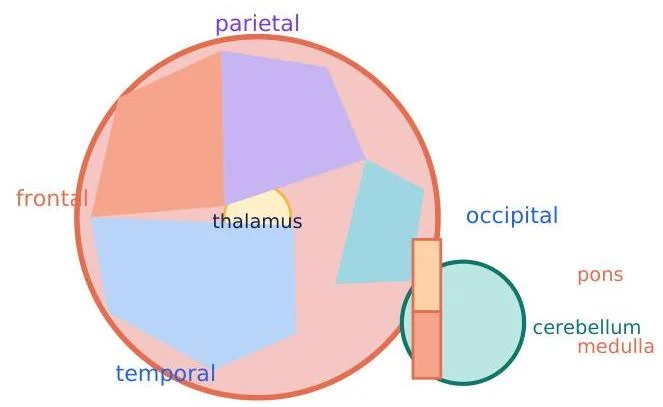
The brain is organized into several functional regions. The cerebral lobes handle different tasks: the frontal lobe manages planning and movement; the parietal lobe processes sensation; the occipital lobe handles vision; and the temporal lobe manages hearing and memory. Deep within the brain, the thalamus acts as a relay station, while the hypothalamus serves as the master regulator of homeostasis and the link to the endocrine system.
Diagram of the human brain lobes and some key structures like the thalamus, pons, cerebellum, and medulla.
The brainstem (midbrain, pons, and medulla oblongata) connects the brain to the spinal cord. The medulla is particularly vital for survival, controlling breathing and heart rate. The spinal cord is protected by three layers of membranes called meninges (dura, arachnoid, and pia mater) and is cushioned by cerebrospinal fluid (CSF), which circulates through the ventricles and the subarachnoid space.
The Special Senses
Our interaction with the world is mediated by special senses. The eye uses the cornea to bend light onto the retina, where photoreceptors (rods and cones) convert light into neural signals. The ear captures sound through the auricle and auditory canal, vibrating the ossicles in the middle ear to eventually stimulate the cochlea in the inner ear.
The Endocrine System: Chemical Regulation
While the nervous system uses electricity, the endocrine system uses hormones—chemical messengers released by glands into the blood. These hormones can be steroids (lipid-soluble, like cortisol), proteins/peptides (amino-acid chains, like insulin), or amines (derived from single amino acids, like epinephrine).
The Hypothalamic-Pituitary Axis
The hypothalamus and pituitary gland form the "endocrine command center". The hypothalamus monitors internal conditions and sends releasing or inhibiting hormones to the anterior pituitary, which then produces its own hormones (like GH, TSH, and ACTH). The posterior pituitary does not make its own hormones but rather stores and releases hormones produced by the hypothalamus, such as ADH (for water conservation) and oxytocin (for uterine contractions).
Homeostatic Feedback Loops
Most endocrine functions are regulated via negative feedback loops, where the result of a process inhibits the original stimulus to maintain stability. For example:
Blood Glucose Regulation: When glucose is high, pancreatic beta cells release insulin to lower it; when low, alpha cells release glucagon to raise it.
Calcium Homeostasis: If blood calcium is low, the parathyroid glands release PTH to increase it; if calcium is high, the thyroid may release calcitonin to help lower it.
Note on Positive Feedback: Unlike negative feedback, positive feedback amplifies a stimulus. A classic example is oxytocin during labor, where contractions trigger even more oxytocin release until birth occurs.
Summary of Key Endocrine Glands
Gland
Primary Hormone(s)
Major Function
Thyroid
T3, T4
Increases metabolic activity
Adrenal Cortex
Cortisol, Aldosterone
Stress response and salt/water balance
Adrenal Medulla
Epinephrine
Rapid "fight-or-flight" response
Pancreas
Insulin, Glucagon
Regulates blood glucose levels
Pineal Gland
Melatonin
Regulates sleep-wake cycles
Keep reading for free.
Create an account to finish this reading and make it part of your study routine.