Overview of Respiratory Physiology and Lung Pressures
This content explains the complex physiological process of respiration, including its five stages, the functions of the respiratory system, the mechanics of ventilation driven by pressure gradients and Boyle's Law, and the pressures within the thoracic cavity that maintain lung inflation. It also covers the muscles of
Respiration is often misunderstood as merely the act of breathing. In reality, it is a complex, multi-step physiological process designed to facilitate the exchange of O2 and CO2 between the external environment and the body's internal tissues. This process requires the seamless integration of the respiratory and cardiovascular systems to ensure that every cell receives the oxygen necessary for life while efficiently removing metabolic waste products.
The Five Stages of Respiration
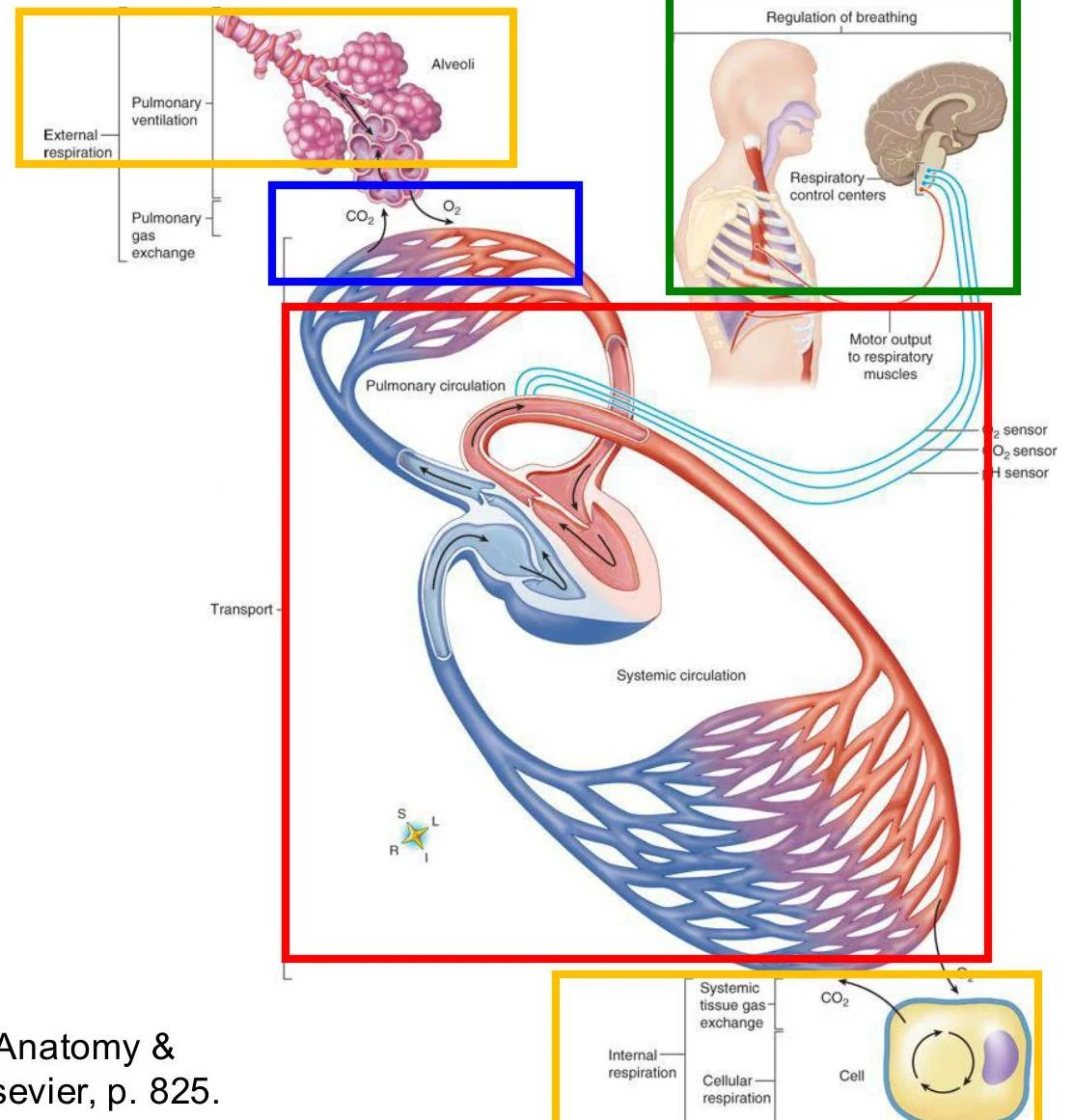
To understand how oxygen reaches a working muscle, we must view respiration as a continuous chain of five distinct stages:
Pulmonary Ventilation: The mechanical movement of air into and out of the lungs. This "bulk flow" process supplies O2 to the alveoli and removes CO2 from them.
External Gas Exchange: The process of diffusion where O2 moves from the air in the alveoli across the alveolar membrane and into the blood.
Gas Transport: The cardiovascular system acts as a delivery vehicle, transporting O2 from the lungs to the systemic tissues and returning metabolic CO2 back to the lungs.
Internal Gas Exchange: The exchange of gases between the systemic capillaries and the individual cells of the body via diffusion.
Cellular Respiration: The final metabolic stage where cells utilize O2 to produce energy (ATP), generating CO2 as a byproduct.
Diagram illustrating the human respiratory system, including pulmonary and systemic circulation, gas exchange in the alveoli and tissues, and the regulation of breathing by the brainstem.Fig 36-1, Patton & Thibodeau, Anatomy & Physiology, 9th Edn.
Functions of the Respiratory System
While gas exchange is the primary driver, the respiratory system is highly versatile and performs several other vital roles:
Acid-Base Balance: It helps regulate blood pH in coordination with the kidneys by controlling CO2 levels.
Air Conditioning: The system filters, warms, and humidifies inhaled air to protect the delicate lung tissue.
Protection and Sensation: It provides a defense against microbes and facilitates the sense of smell.
Communication and Thermoregulation: It assists in speech and helps regulate body temperature.
The Mechanics of Ventilation
Ventilation is defined as the exchange of air between the atmosphere and the alveoli. This movement is driven by bulk flow, which occurs when air moves from a region of high pressure to a region of low pressure.
The rate of airflow (F) is determined by the pressure difference (ΔP) between the alveoli and the atmosphere, divided by the resistance (R) of the airways:
F=RΔPF=RPalv−Patm
Boyle's Law and Lung Volume
The relationship between the volume of the lungs and the pressure within them is governed by Boyle's Law, which states that at a constant temperature, the volume of a gas varies inversely with its absolute pressure:
Inspiration: As the volume of the lung increases, the pressure inside decreases.
Expiration: As the volume of the lung decreases, the pressure inside increases.
Lung Pressures and Stability
To understand how the lungs stay inflated, we must examine the relationship between different pressures within the thoracic cavity.
Key Pressure Definitions
Atmospheric Pressure (Patm): The pressure of the air outside the body (standardized at 760 mmHg).
Alveolar Pressure (Palv): The pressure inside the alveoli.
Intrapleural Pressure (Pip): The pressure within the pleural cavity (the space between the lungs and the chest wall).
Transpulmonary Pressure (Ptp): The difference between alveolar and intrapleural pressure.
Ptp=Palv−Pip
The Role of the Pleura
The lungs are enveloped by the pleurae, consisting of an outer parietal pleura (lining the chest wall) and an inner visceral pleura (attached to the lung). Between these layers lies the pleural cavity, a slit-like potential space filled with a thin film of pleural fluid.
This fluid acts much like a film between two plates of glass: it allows the surfaces to slide against each other easily, but strongly resists separation. Because the fluid is non-compressible, even a tiny increase in the volume of this space creates a subatmospheric (negative) intrapleural pressure.
Exam Tip: A positive transpulmonary pressure (Ptp) is essential to keep the lungs open and oppose their natural elastic recoil. If Ptp becomes zero, the lung will assume its smallest possible size.
Clinical Correlations: Pneumothorax and Effusion
If the balance of these pressures is disrupted, serious medical conditions can arise:
Pneumothorax: Occurs when air enters the pleural cavity, causing the lung to collapse.
Pleural Effusion: Occurs when excess fluid accumulates in the pleural space.
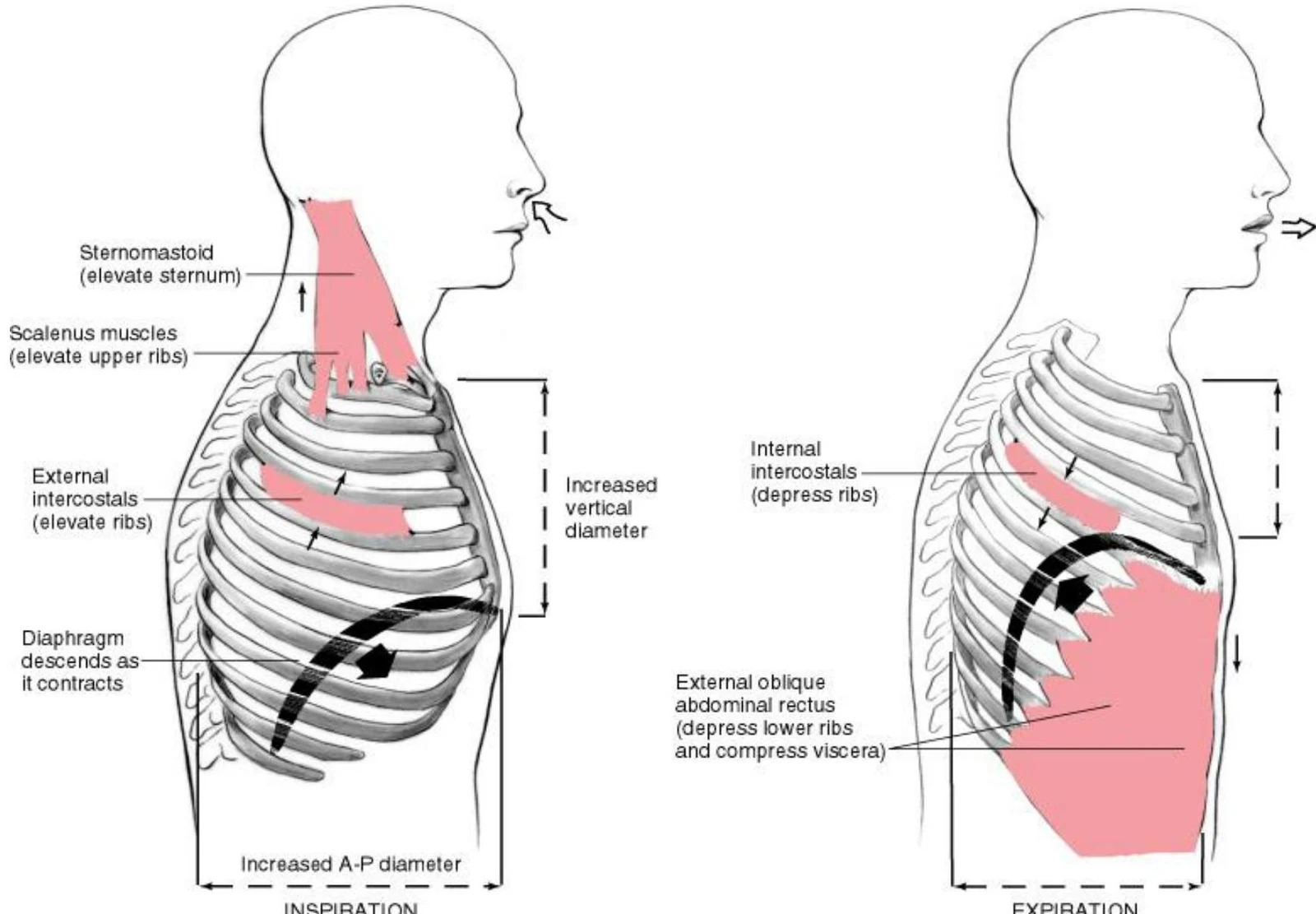
Muscles of Respiration
Breathing is not a uniform process; the muscles involved change depending on the body's metabolic demands.
Breathing Type
Inspiration (Active)
Expiration (Passive/Active)
Restful Breathing
Diaphragm contraction
Passive: Lung elastic recoil and relaxed diaphragm
Deeper Breathing (e.g., walking)
Diaphragm + External intercostals
Lung elastic recoil + Internal intercostals
Forceful Breathing (e.g., gym)
Diaphragm, External intercostals, Sternocleidomastoid, Pectoralis minor
Diagram illustrating the mechanics of inspiration and expiration, highlighting the roles of various muscles and the diaphragm in changing thoracic volume.
Chemical Control of Breathing
While the mechanical aspects of breathing are vital, the process is also regulated by chemical signals to ensure homeostasis. The body monitors levels of O2, CO2, and pH to adjust the rate and depth of ventilation, ensuring that the chemical composition of the blood remains within narrow, life-sustaining limits.
Keep reading for free.
Create an account to finish this reading and make it part of your study routine.