Overt and Covert Attention: Understanding Visual Focus
This article explains the concepts of overt and covert attention, distinguishing between attention that involves eye movements and attention that does not. It also discusses pre-cueing effects and the Posner Cueing Task used to study these mechanisms.
When you are reading this article, your eyes are constantly making tiny, rapid movements to scan the lines of text. However, there are moments when you might hear a faint noise to your left and "feel" your attention shift toward that sound without actually turning your head or moving your eyes. This distinction—between attention that moves the eyes and attention that stays internal—is the foundation of how we understand cognitive focus. In psychology, we categorize these two processes as overt and covert attention.
Comparison of overt and covert attention mechanisms.
Defining the Two Modes of Attention
To understand how the brain processes the world, we must first distinguish between the physical movement of the eyes and the mental allocation of resources.
Overt Attention
Overt attention refers to the process where we direct our attention to a specific object or location by physically moving our eyes toward it. This involves a coordinated sequence of eye movements known as saccades. When you look directly at a person speaking to you, you are engaging in overt attention. The goal is to bring the stimulus into the center of your fovea (the part of the retina with the highest visual acuity) to ensure the clearest possible image.
Covert Attention
Covert attention, often described as "looking out of the corner of your eye," involves shifting your mental focus to a location in your visual field without moving your eyes. Even though your gaze remains fixed on a central point, your brain is actively processing information from a peripheral location. For example, if you are watching a movie and notice a small movement in the background of a scene without turning your eyes toward it, you are using covert attention.
Exam Tip: A common way to test for covert attention in laboratory settings is to ask a participant to stare at a central fixation cross while a target appears in the periphery. If their reaction time is faster when they are "expecting" a peripheral target, it proves they were attending covertly to that area.
The Role of Pre-Cueing Effects
One of the most important ways researchers study these mechanisms is through the use of cues. A cue is a signal—such as an arrow, a flash of light, or a sound—that tells the observer where a target is likely to appear. The effectiveness of these cues depends heavily on whether they trigger overt or covert shifts.
Spatial Cueing and Validity
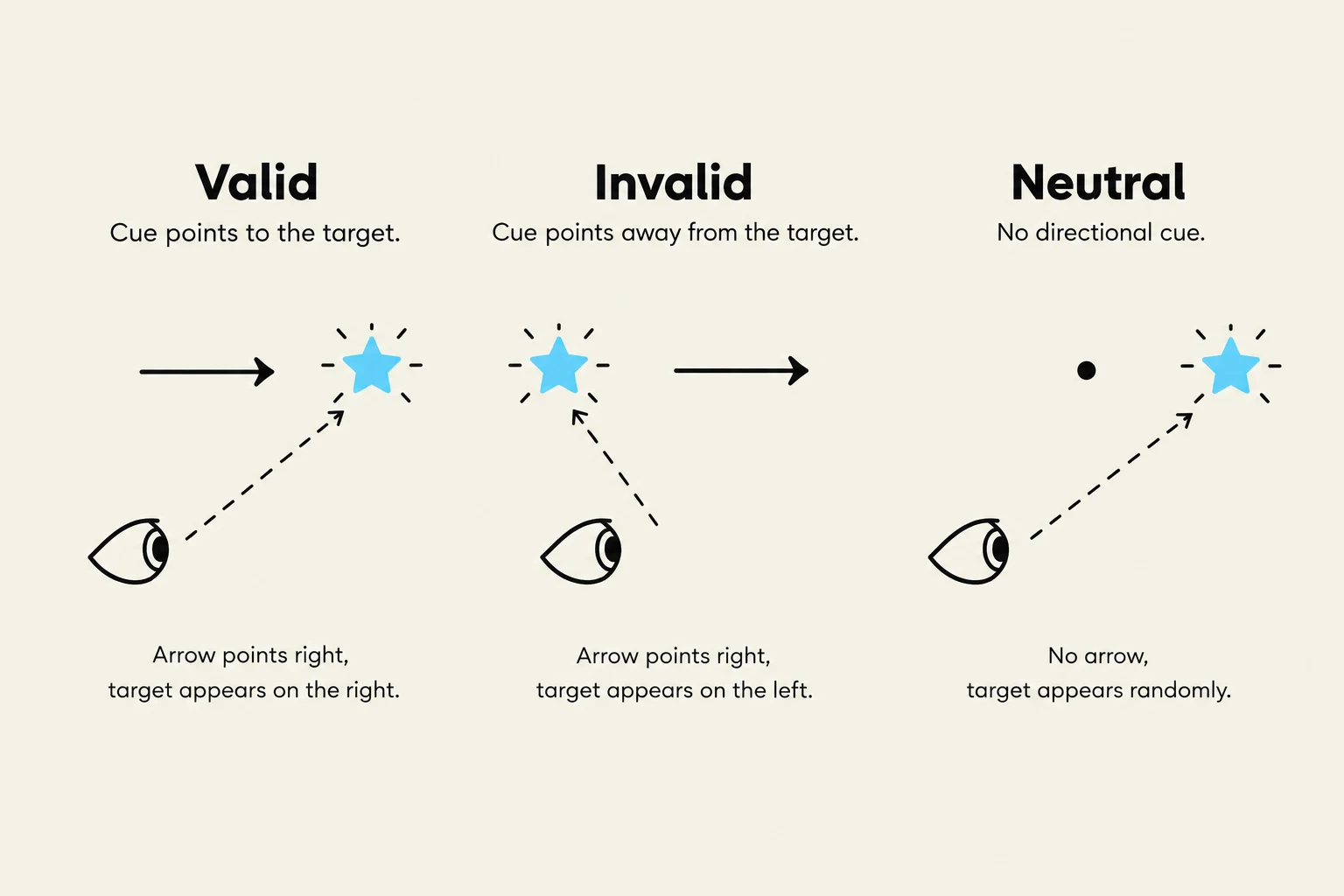
This diagram illustrates three types of cues: valid, invalid, and neutral, in relation to a target stimulus. A valid cue directs attention to the target's location. An invalid cue misdirects attention. A neutral cue provides no directional information.
In many experiments, a cue is presented before the actual target. The relationship between the cue and the target determines the "validity" of the trial:
Valid Cue: The cue points to the exact location where the target eventually appears.
Invalid Cue: The cue points to a location, but the target appears somewhere else.
Neutral Cue: The cue provides no directional information (e.g., a single dot in the center of the screen).
When a cue is valid, we see a pre-cueing effect, where reaction times are significantly faster because the brain has already "primed" the relevant neural pathways.
The Posner Cueing Task
A classic method used to measure these effects is the Posner Cueing Task. In this task, researchers can manipulate whether the cue is peripheral (appearing at the edge of the vision) or central (appearing in the middle).
Central Cues: These often trigger overt attention. Because the cue is in the center, the participant may feel the need to move their eyes toward the location of the upcoming target.
Peripheral Cues: These are excellent tools for studying covert attention. Since the cue appears at the side, the researcher can instruct the participant to keep their eyes fixed on the center, forcing the brain to shift its "attentional spotlight" covertly to the side.
Comparing the Mechanisms
While overt and covert attention are closely linked, they rely on different neurological "strategies."
Feature
Overt Attention
Covert Attention
Eye Movement
Required (Saccades)
None (Gaze remains fixed)
Primary Goal
High-resolution visual input
Rapid detection of peripheral stimuli
Mechanism
Physical repositioning of the eyes
Mental shifting of the "attentional spotlight"
Typical Cue
Central or direct
Peripheral or indirect
The "Attentional Spotlight" Metaphor
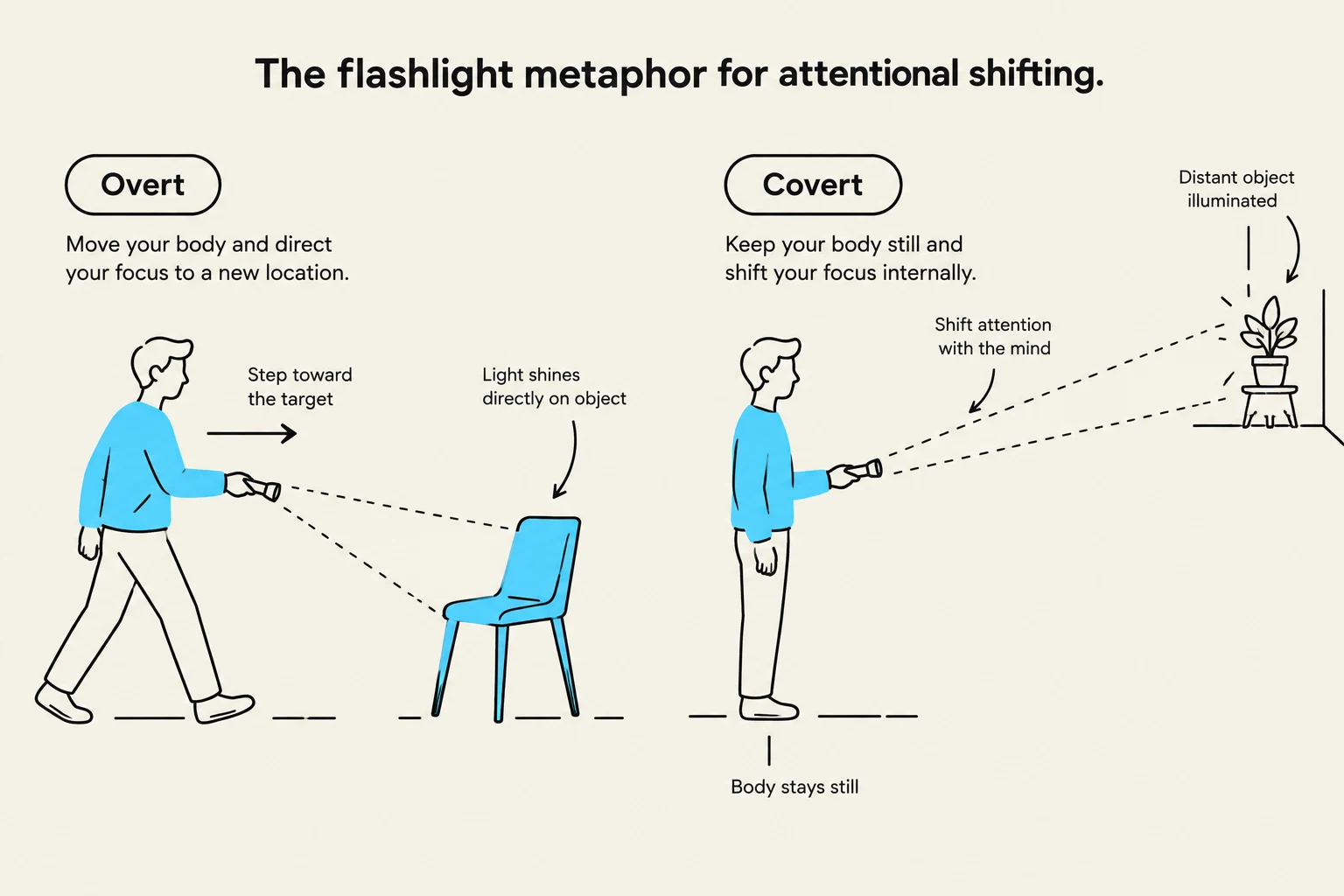
The image illustrates the flashlight metaphor for attentional shifting, differentiating between overt attention (moving the body and focus) and covert attention (shifting focus internally while the body remains still).
To visualize this, imagine you are in a dark room with a flashlight.
Overt attention is like physically walking across the room to point the flashlight at a new object.
Covert attention is like standing perfectly still but somehow widening the beam or shifting the light's focus to a corner without moving your body.
Summary for Students
Understanding the distinction between overt and covert attention is essential for grasping how the brain manages limited cognitive resources.
Overt = Eyes move + Attention moves.
Covert = Eyes stay + Attention moves.
Pre-cueing = Using signals to prepare the brain, which improves speed if the signal is valid.
When studying for exams, remember that covert attention allows us to monitor our environment for threats or changes without the time-consuming process of moving our eyes, providing a vital survival advantage in a fast-changing world.
Keep reading for free.
Create an account to finish this reading and make it part of your study routine.