An exploration of human history before written records, covering the Paleolithic, Mesolithic, and Neolithic ages, prehistoric art, and the transition to early civilizations.
The study of human history begins long before the invention of the written word. This era, known as prehistory, encompasses the vast stretch of time when human societies existed without written records. Because there are no texts to read, historians and archaeologists must reconstruct the lives, beliefs, and technologies of our ancestors by examining the physical artifacts and art they left behind. By analyzing these remnants, we can trace the evolution of human intelligence, from the first sharpened stones to the complex social structures of early civilizations.
The Three Ages of Prehistory
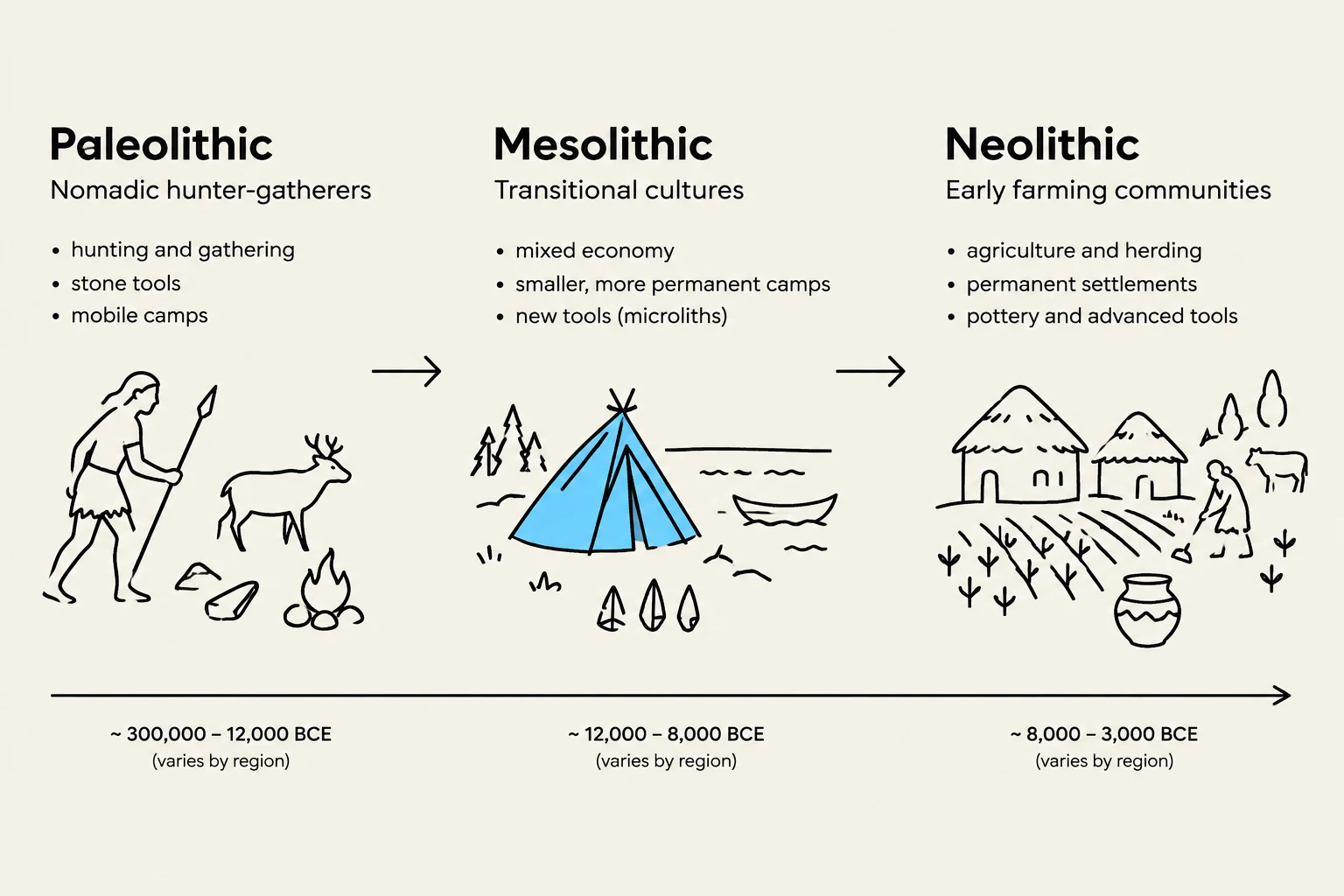
Prehistory is traditionally divided into three distinct stages based on the tools used and the way humans interacted with their environment: the Paleolithic, the Mesolithic, and the Neolithic.
The Paleolithic Age (Old Stone Age)
Spanning from approximately 3,000,000 BCE to 10,000 BCE, the Paleolithic era was defined by nomadic hunter-gatherer lifestyles. During this time, humans relied heavily on stone tools, which represent our earliest technology. These tools were not just objects; they were expressions of problem-solving behavior and human intelligence, allowing our ancestors to manipulate nature for survival.
One of the most transformative developments in the Paleolithic was the mastery of fire. Fire provided warmth, protection from predators, and the ability to cook food—a factor many scientists believe contributed to the increase in human brain size. Furthermore, fire facilitated social development by creating central gathering points for communal life.
The Mesolithic Age (Middle Stone Age)
The Mesolithic period (ca. 10,000 – 8000 BCE) serves as a transitional phase between the nomadic life of the Paleolithic and the settled life of the Neolithic.
The Neolithic Age (New Stone Age)
The Neolithic period (ca. 8000 – 2000 BCE) marked a massive shift in the human experience: the development of agriculture. Instead of wandering in search of food, humans began to plant crops and domesticate animals, allowing for permanent settlements. This food security allowed societies to grow more complex, leading to specialized labor and the creation of new stone tools specifically designed for plowing, planting, and harvesting.
This illustration depicts the progression of human history through three major periods: Paleolithic (nomadic hunter-gatherers), Mesolithic (transitional cultures), and Neolithic (early farming communities), highlighting key characteristics and approximate timeframes for each era.
Exam Tip: When distinguishing between these eras, focus on the relationship to food. Paleolithic = Hunting/Gathering; Mesolithic = Transition; Neolithic = Agriculture/Settlement.
Prehistoric Art and Expression
Even without writing, prehistoric humans were deeply expressive. Their art provides a window into their spiritual and social worlds.
Cave Painting and Naturalism
Many Paleolithic cultures practiced cave painting, leaving images on the walls of shelters. While the exact purpose of these paintings is debated—ranging from simple expression to religious rituals or communication—they often depict animals that were central to survival, such as mammoths or bison.
Some of these works exhibit a high degree of naturalism, where the artist attempts to depict animals with realistic proportions and lifelike qualities. Famous examples can be found in the Lascaux Caves in France, which feature impressive depictions of bulls and horses.
Venus Figurines
In contrast to the naturalism of cave paintings, many small sculptures known as "Venus figurines" utilize highly stylized imagery. Found throughout Northern Europe and Asia, these small, portable figures (often only 3–5 inches tall) typically feature exaggerated reproductive characteristics, such as enlarged breasts and hips. Because they lack facial detail and emphasize fertility, archaeologists believe they likely served as symbols of fertility or personal votive charms for nomadic people.
The Rise of Monuments and Civilization
As humans settled into Neolithic life, their relationship with the Earth changed. They became aware of seasonal cycles, leading to religions centered on the sun, moon, and stars.
Megaliths and Stonehenge
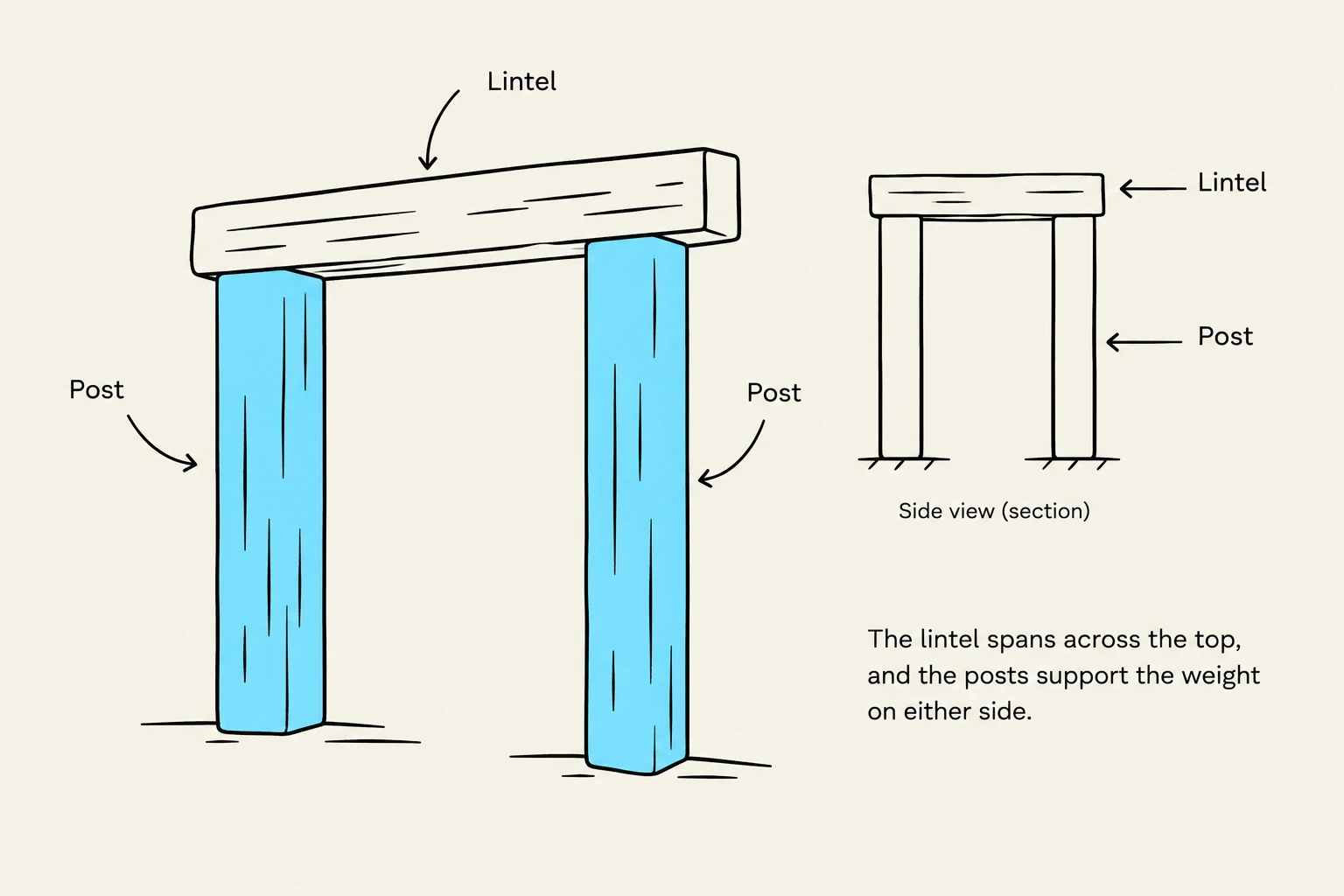
The Neolithic period saw the construction of massive stone monuments using megaliths. One of the most famous examples is Stonehenge in England. Stonehenge was built using a technique called post-and-lintel construction, where vertical posts support horizontal beams (lintels).
Diagram illustrating a lintel supported by posts, with a side view showing the structural components.
Archaeologists believe these structures may have served as celestial observatories to track the solstices or as sites for funerary rituals.
The Transition to Civilization
The shift from prehistoric cultures to "civilization" is marked by several key developments: the organization of government, urban living, and, most importantly, the invention of writing.
Early civilizations, such as those in Mesopotamia, Egypt, India, and China, emerged in river valleys. These societies moved beyond the Stone Age into the Bronze Age through the mastery of metallurgy. The invention of writing systems—such as Sumerian cuneiform, Egyptian hieroglyphs, and Chinese pictographs—allowed humans to record laws, trade, and even personal complaints, effectively ending the era of prehistory.
This illustration depicts the progression from the use of stone tools for hunting and scraping, to agriculture involving crop cultivation and animal domestication, leading to permanent settlements with larger populations and complex social structures.
Key Terminology Check:
Relief: A sculpture where forms project from a flat background.
Sculpture-in-the-round: A 3D figure viewable from all 360 degrees.
Polytheism: The worship of multiple gods.
Keep reading for free.
Create an account to finish this reading and make it part of your study routine.