


In any professional setting—whether it is a local pharmacy or a global corporation—success is not merely the result of technical expertise or financial capital. Instead, it is driven by the complex interplay of people, their behaviors, and the structures that govern them. To navigate this complexity, professionals rely on the field of Organizational Behavior (OB).
Understanding Organizational Behavior
Organizational Behavior is defined as the systematic and scientific analysis of individuals, groups, and organizations. The primary objective of OB is to understand, predict, and influence human behavior. By applying these scientific principles, organizations aim to improve individual performance, which in turn drives the overall success and functioning of the entire entity.
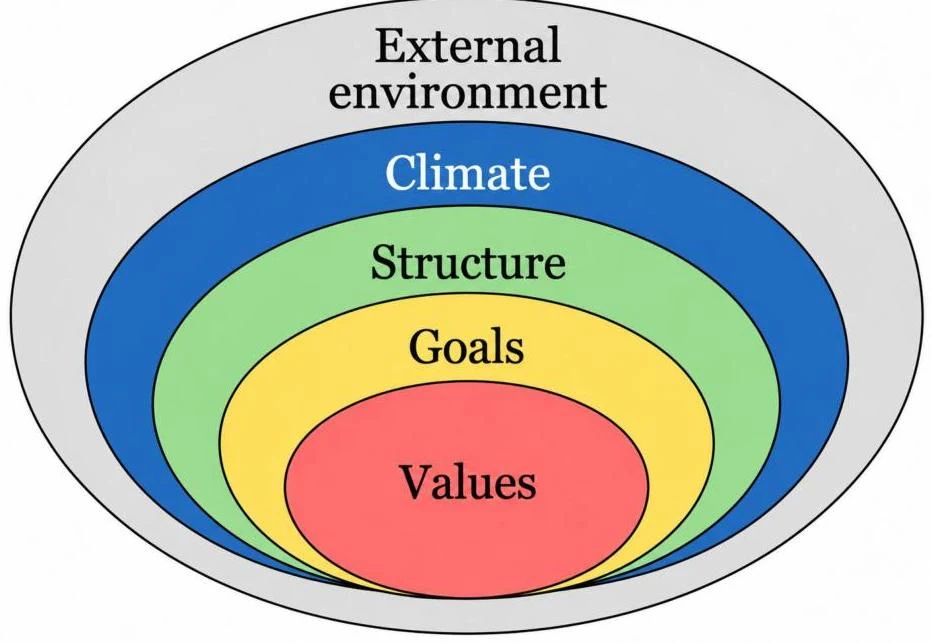
To visualize how these elements interact, one can view the organization as a series of nested layers, where individual actions are influenced by group dynamics, which are in turn shaped by the broader organizational environment.
The Essence of Organizational Culture
If you have ever walked into a workplace and immediately felt, "This is how things are done around here," you have experienced organizational culture. Culture is the system of shared meanings, beliefs, and norms held by members that distinguishes one organization from another.
The strength of a culture is determined by two factors: how intensely the values are held and how widely they are accepted by the members.
- Strong Culture: Values are intensely held and widely accepted across the organization.
- Weak Culture: Characterized by vagueness, ambiguity, and inconsistency in how values are applied.
Keep reading for free.
Create an account to finish this reading and make it part of your study routine.
Continue reading freeAlready have an account? Log in
Updated