This article explores the mechanisms of biological change, from inheritance to species interactions, and how these forces shape the distribution of life on Earth. It covers variation, inheritance, speciation, ecological niches (fundamental and realized), generalist vs. specialist species, and various species interactio
In the study of ecology, we view the natural world as a complex, interconnected web where everything affects everything else. To understand how ecosystems function, we must look beyond individual organisms and examine how they vary, how they reproduce, and how they interact with one another and their environment. This article explores the mechanisms of biological change—from the microscopic level of inheritance to the macroscopic level of species interactions—and how these forces shape the distribution of life on Earth.
The Foundations of Change: Variation and Inheritance
At the heart of biological evolution are two fundamental principles: variation and inheritance. Within any given population, individuals are not identical; they possess different traits. When these organisms reproduce, they pass these traits onto their offspring through the process of inheritance.
This process is the engine of natural selection. Because organisms produce more offspring than can possibly survive, there is an inherent struggle for existence. On average, individuals whose specific traits make them better suited to their particular environmental conditions will survive and reproduce more successfully than their competitors. Over many generations, these advantageous traits become more common in the population.
Speciation
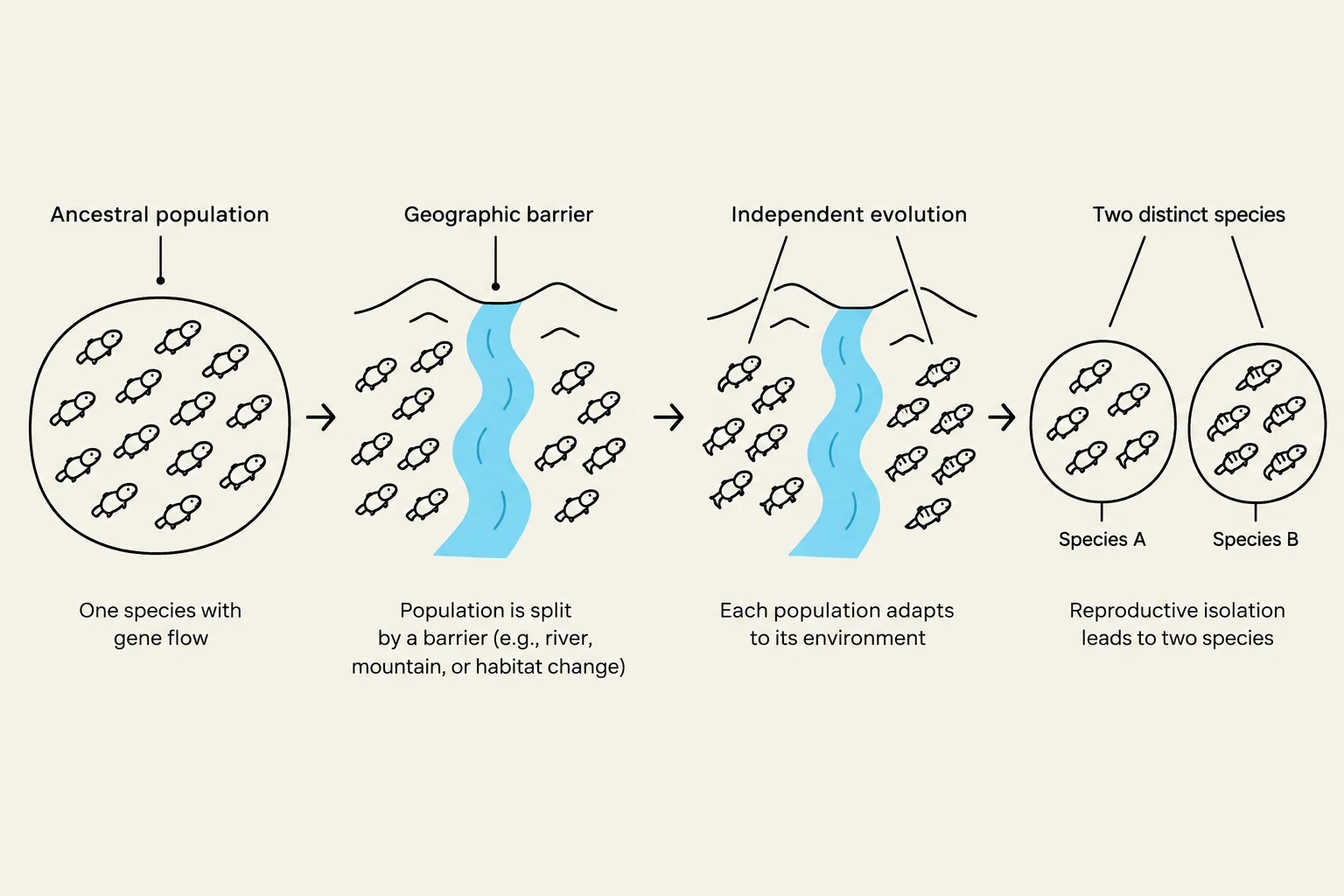
When populations are subjected to different environmental pressures or become isolated, they may undergo speciation. This occurs when members of a population become sufficiently different from their ancestors due to changes in fitness and genetic shifts driven by the need to survive in new or changing environments.
This diagram illustrates allopatric speciation, where a geographic barrier divides a population, leading to independent evolution and eventually the formation of two distinct species.
The Ecological Niche: Where Life Exists
Every species occupies a specific "role" or "space" within its environment, known as its ecological niche. A niche is defined not just by a physical location, but by the range of environmental conditions (like temperature or pH) and resources (like food or nesting sites) a species requires to thrive.
To understand how species coexist, ecologists distinguish between two types of niches:
Fundamental Niche: This represents the full theoretical range of environmental conditions and resources under which a species could potentially survive and reproduce in the absence of competition or predation.
Realized Niche: This is the actual space and set of conditions a species does occupy in the real world, after accounting for the presence of competitors, predators, and other limiting factors.
Exam Tip: If a question asks why a species is not found in a habitat where it should theoretically thrive, look for the "realized niche" concept. The species might have the physiological tolerance for that area (fundamental niche), but competition or predation is preventing it from living there (realized niche).
Generalists vs. Specialists
The breadth of a niche determines a species' survival strategy:
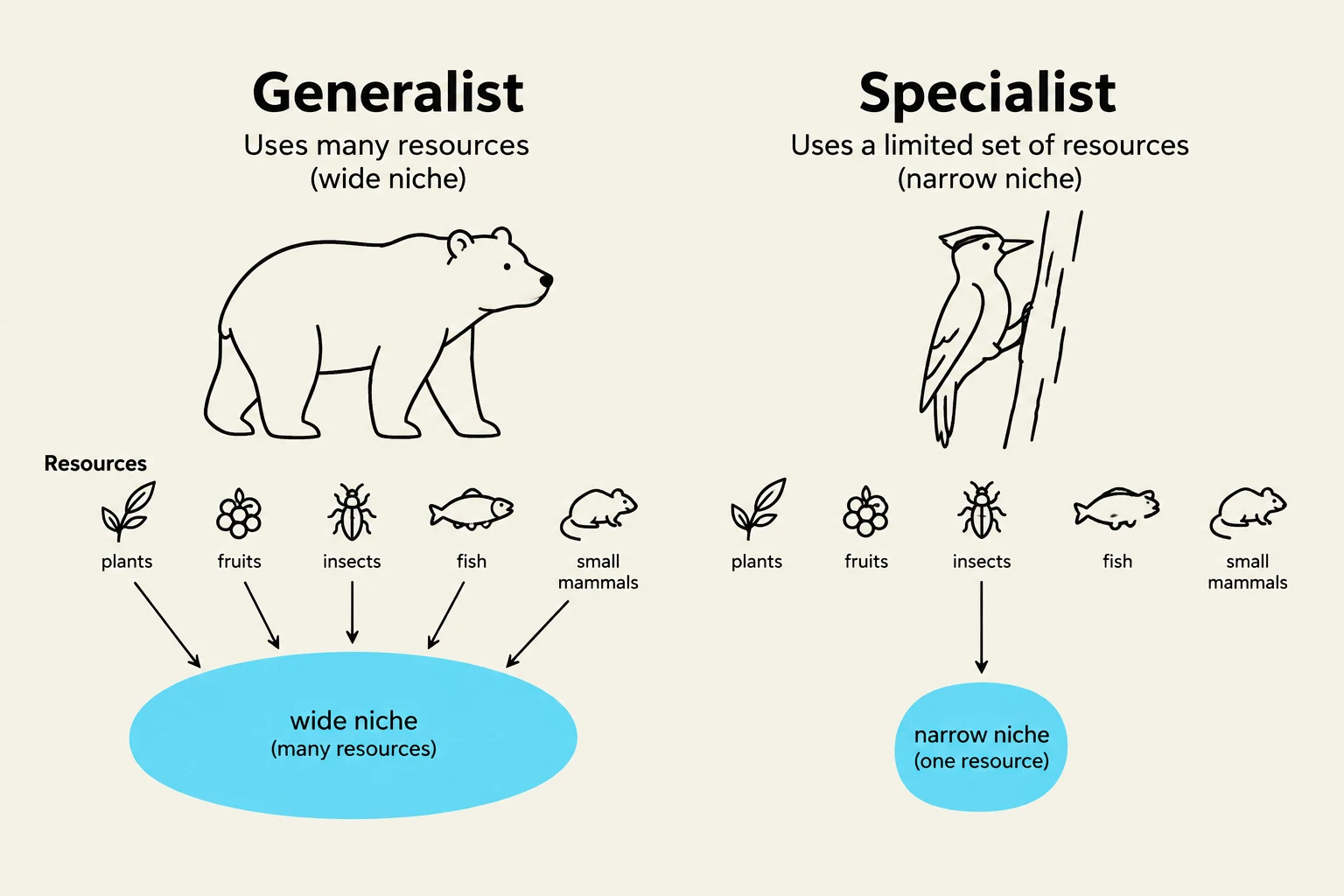
Generalist Species: These are highly adaptable organisms that can survive in a broad range of niches and utilize a wide variety of resources.
Specialist Species: These organisms have narrow niches and a limited range of tolerance for environmental changes. While specialists are often highly efficient in stable environments, they are more vulnerable to extinction if their specific habitat or food source changes.
This diagram illustrates the difference between generalist and specialist species in terms of their resource utilization and niche breadth. Generalists consume a wide variety of resources, occupying a broad niche, while specialists focus on a limited set of resources, resulting in a narrow niche.
Species Interactions: The Web of Life
No organism lives in isolation. The structure and function of a community are defined by how different populations interact. These interactions can be categorized by how they affect the fitness of the participants, often using a mathematical shorthand: (+), (−), or $(0)$.
Competition: The Struggle for Resources
Competition occurs when organisms vie for limited resources, such as food, water, or territory. This interaction is considered (−/−) because both parties are negatively impacted by the energy spent competing or the reduction in resource availability.
Intraspecific Competition: This occurs between members of the same species. For example, territorial animals defending a specific area from others of their own kind are engaging in intraspecific competition.
Interspecific Competition: This occurs between members of different species.
Symbiosis and Other Interactions
Beyond competition, species interact in ways that can be mutually beneficial, one-sided, or even predatory.
Predation (+/−): An interaction where one organism (the predator) consumes another (the prey).
Mutualism (+/+): A type of symbiotic relationship where both species benefit from the interaction. Symbiosis generally refers to close, long-term biological interactions between two different species.
Commensalism (+/0): An interaction where one species benefits while the other is neither helped nor harmed.
Interaction Type
Species A
Species B
Description
Competition
$-$
$-$
Both species are negatively affected by limited resources.
Predation
$+$
$-$
One species benefits (predator), one is harmed (prey).
Mutualism
$+$
$+$
Both species benefit from the relationship.
Commensalism
$+$
0
One species benefits, the other is unaffected.
By understanding these variations and interactions, ecologists can better predict how changes in the environment—such as noise pollution or habitat loss—will ripple through an entire ecosystem.
Keep reading for free.
Create an account to finish this reading and make it part of your study routine.