Organic Chemistry: Oxidation and Halogenation Mechanisms
Explore the mechanisms of oxidation and halogenation reactions in organic chemistry, focusing on reagents like Osmium tetroxide, Potassium permanganate, Bromine, and Chlorine. Understand how these reagents affect stereochemistry and regiochemistry in organic transformations.
In organic chemistry, understanding how to transform one functional group into another is the cornerstone of synthesis. This article focuses on the mechanisms of oxidation and halogenation, specifically exploring how reagents like Osmium tetroxide (OsO4), Potassium permanganate (KMnO4), Bromine (Br2), and Chlorine (Cl2) interact with alkenes and other organic substrates. By mastering these specific reagents, students can predict the stereochemistry and regiochemistry of complex organic transformations.
Dihydroxylation: OsO4 and NaHSO3
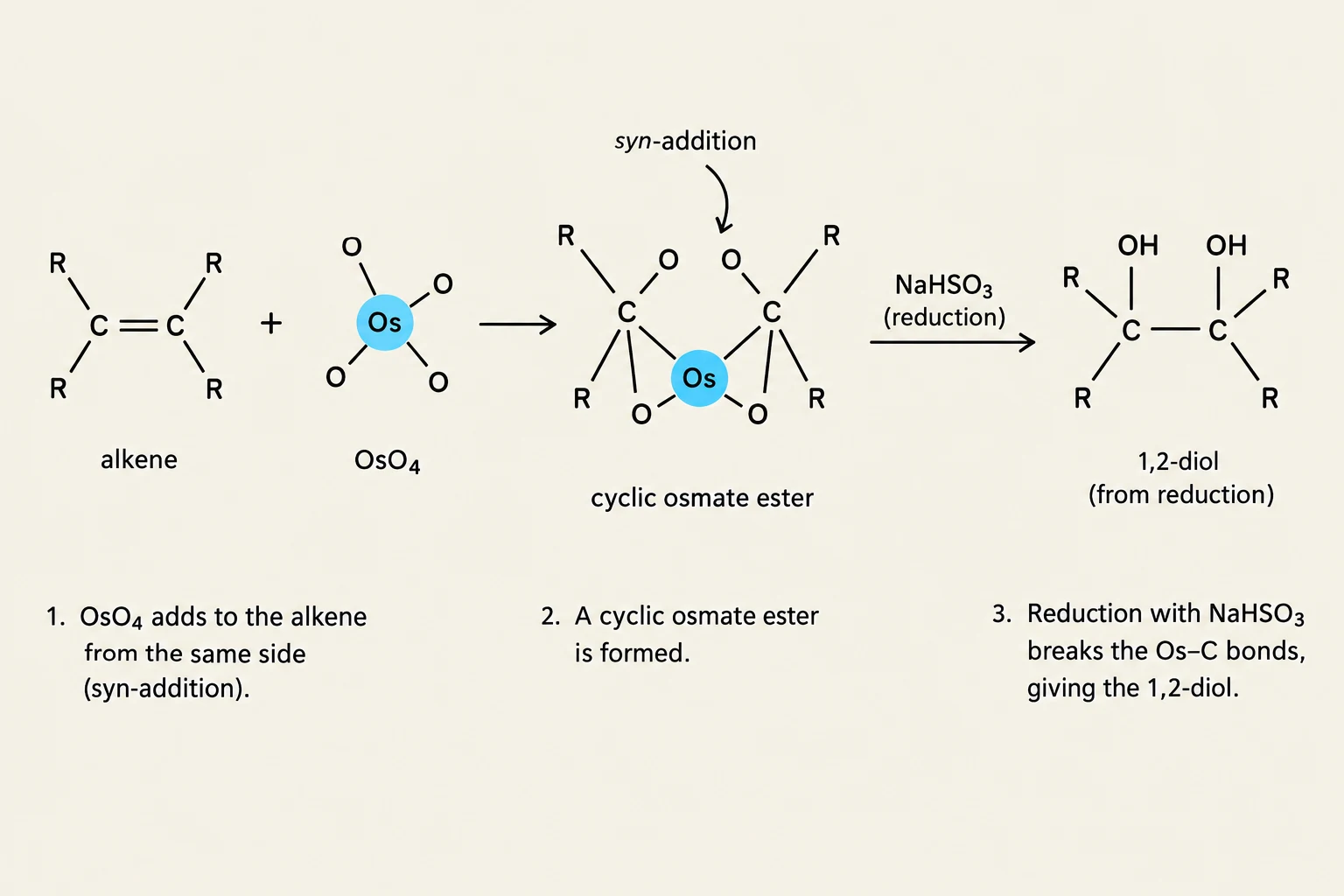
One of the most precise ways to functionalize an alkene is through dihydroxylation, which adds two hydroxyl (−OH) groups across a double bond. Osmium tetroxide (OsO4) is a premier reagent for this task because it performs a syn-addition, meaning both oxygen atoms attach to the same face of the alkene.
The reaction typically proceeds in two steps. First, the OsO4 reacts with the alkene to form a cyclic osmate ester. Second, a reducing agent, such as sodium bisulfite (NaHSO3), is used to cleave this ester and release the cis-diol product.
This diagram illustrates the syn-addition reaction of an alkene with osmium tetroxide (OsO4) to form a cyclic osmate ester, which is then reduced with sodium bisulfite (NaHSO3) to yield a 1,2-diol.
Exam Tip: When you see OsO4 followed by NaHSO3 in a reaction sequence, immediately think "cis-diol." The stereochemistry is almost always syn.
Strong Oxidation: KMnO4
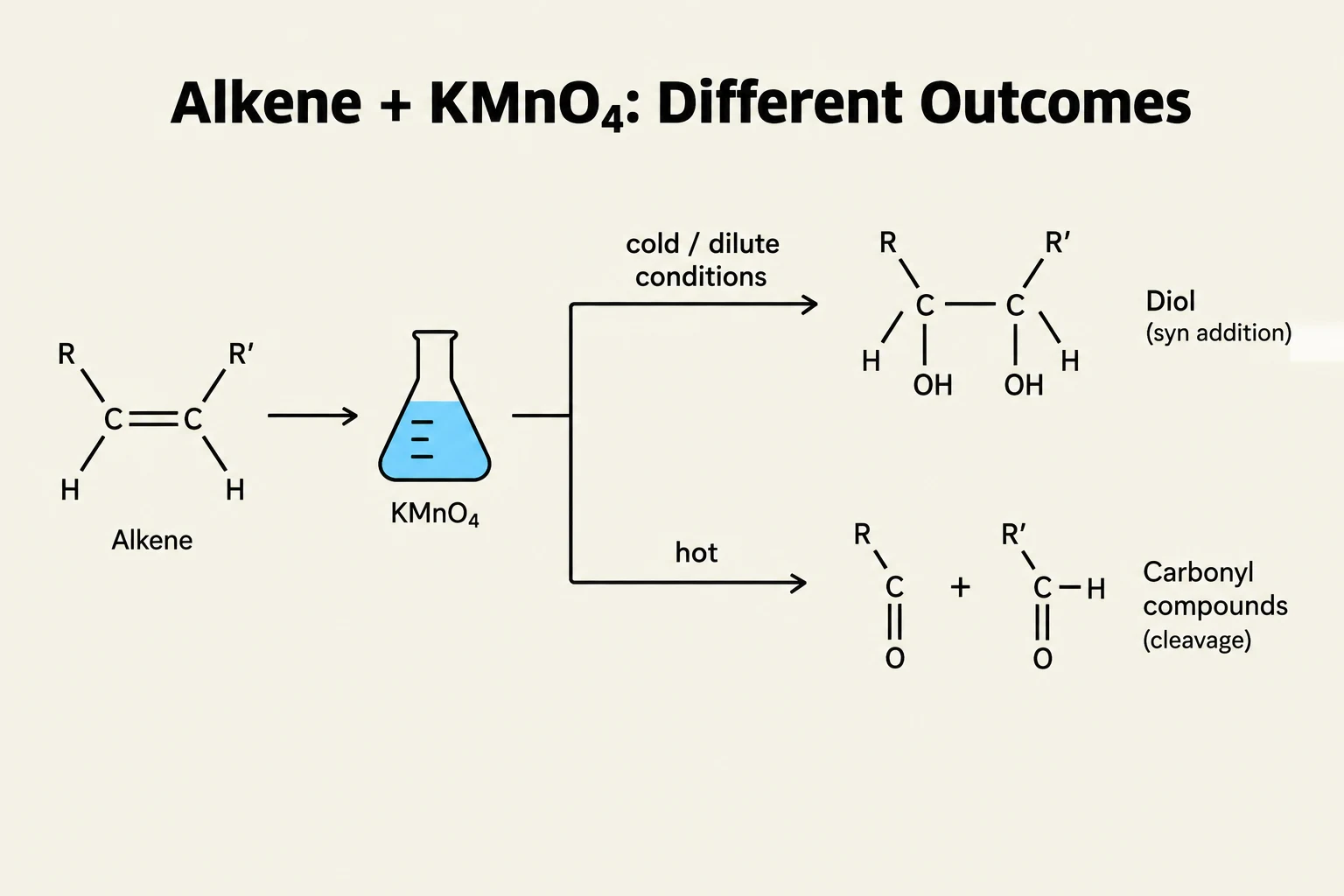
Potassium permanganate (KMnO4) is a much more powerful oxidizing agent than OsO4. Depending on the reaction conditions (temperature, pH, and concentration), KMnO4 can yield different results when reacting with alkenes.
Cold, Dilute KMnO4: Similar to OsO4, cold and basic KMnO4 can perform a syn-dihydroxylation to produce a diol.
Hot, Concentrated KMnO4: Under harsher conditions, the reagent will cause oxidative cleavage of the carbon-carbon double bond. This breaks the molecule apart, often resulting in carboxylic acids, ketones, or CO2 depending on the substitution of the original alkene.
This diagram illustrates the different outcomes of the reaction between an alkene and potassium permanganate (KMnO4) under varying conditions. Under cold, dilute conditions, a diol is formed via syn addition. Under hot conditions, carbonyl compounds are formed through cleavage.
Halogenation: Br2 and Cl2
Halogenation is a fundamental reaction used to introduce halogens into organic molecules. When reacting with alkenes, reagents like Bromine (Br2) and Chlorine (Cl2) undergo electrophilic addition.
Unlike the syn-addition seen with OsO4, halogenation typically results in anti-addition. The mechanism involves the formation of a cyclic halonium ion (such as a bromonium ion), which is then attacked by a nucleophile (like a halide ion or water) from the opposite side of the ring.
The general reaction for bromine can be represented as:
\text{R}_2\text{C=CR}_2 + \text{Br}_2 &\rightarrow \text{R}_2\text{C(Br)-C(Br)R}_2
\end{aligned}$$

## Summary of Key Reagents
To succeed in organic synthesis problems, it is vital to distinguish between these reagents based on their selectivity and the stereochemistry they induce.
| Reagent | Typical Product | Stereochemistry | Notes |
| --- | --- | --- | --- |
| $\text{OsO}_4 / \text{NaHSO}_3$ | *cis*-diol | *syn*-addition | Mild, highly selective |
| $\text{KMnO}_4$ (cold) | diol | *syn*-addition | Less selective than $\text{OsO}_4$ |
| $\text{KMnO}_4$ (hot) | Cleavage products | N/A | Breaks C=C bond |
| $\text{Br}_2$ or $\text{Cl}_2$ | Vicinal dihalide | *anti*-addition | Forms cyclic halonium ion |
By recognizing these patterns, you can navigate complex multi-step syntheses, such as those involving oxymercuration-demercuration or hydroboration-oxidation, which are often paired with these oxidation and halogenation steps in advanced organic chemistry curricula.
$$$
$$$
Keep reading for free.
Create an account to finish this reading and make it part of your study routine.