Organic Chemistry: Nomenclature and Conformational Analysis
Learn the fundamentals of IUPAC nomenclature for naming organic compounds and explore conformational analysis, including Newman projections and chair conformations, to understand molecular stability and spatial arrangements.
Organic chemistry is often described as a visual language. To speak it fluently, you must be able to translate between two-dimensional names and three-dimensional structures. This article explores the two pillars of molecular identification and stability: IUPAC Nomenclature, which provides a standardized way to name molecules, and Conformational Analysis, which allows us to predict how molecules move and how stable they are in space.
1. The Rules of Nomenclature
The International Union of Pure and Applied Chemistry (IUPAC) provides a systematic method for naming organic compounds. Instead of relying on common names, IUPAC rules ensure that every unique structure has a unique name.
The Step-by-Step Process
To name an alkane or substituted hydrocarbon, follow these fundamental steps:
Identify the Parent Chain: Find the longest continuous carbon chain. This determines the base name (e.g., heptane for 7 carbons, undecane for 11).
Number the Chain: Number the carbons in the parent chain starting from the end that gives the substituents (the groups attached to the main chain) the lowest possible locants (numbers).
Identify Substituents: Name the groups attached to the parent. These include alkyl groups (like methyl or ethyl) and halogens (like bromo or chloro).
Assemble the Name: List the substituents in alphabetical order, preceded by their position number and a hyphen. If a substituent appears more than once, use prefixes like di-, tri-, or tetra- (note that these prefixes do not count for alphabetization).
Exam Tip: When drawing a structure from a name, such as 4-ethyl-2,2-dimethylheptane, always draw the parent chain first to ensure you have the correct number of carbons before adding the branches.
2. Carbon Properties and Physical Trends
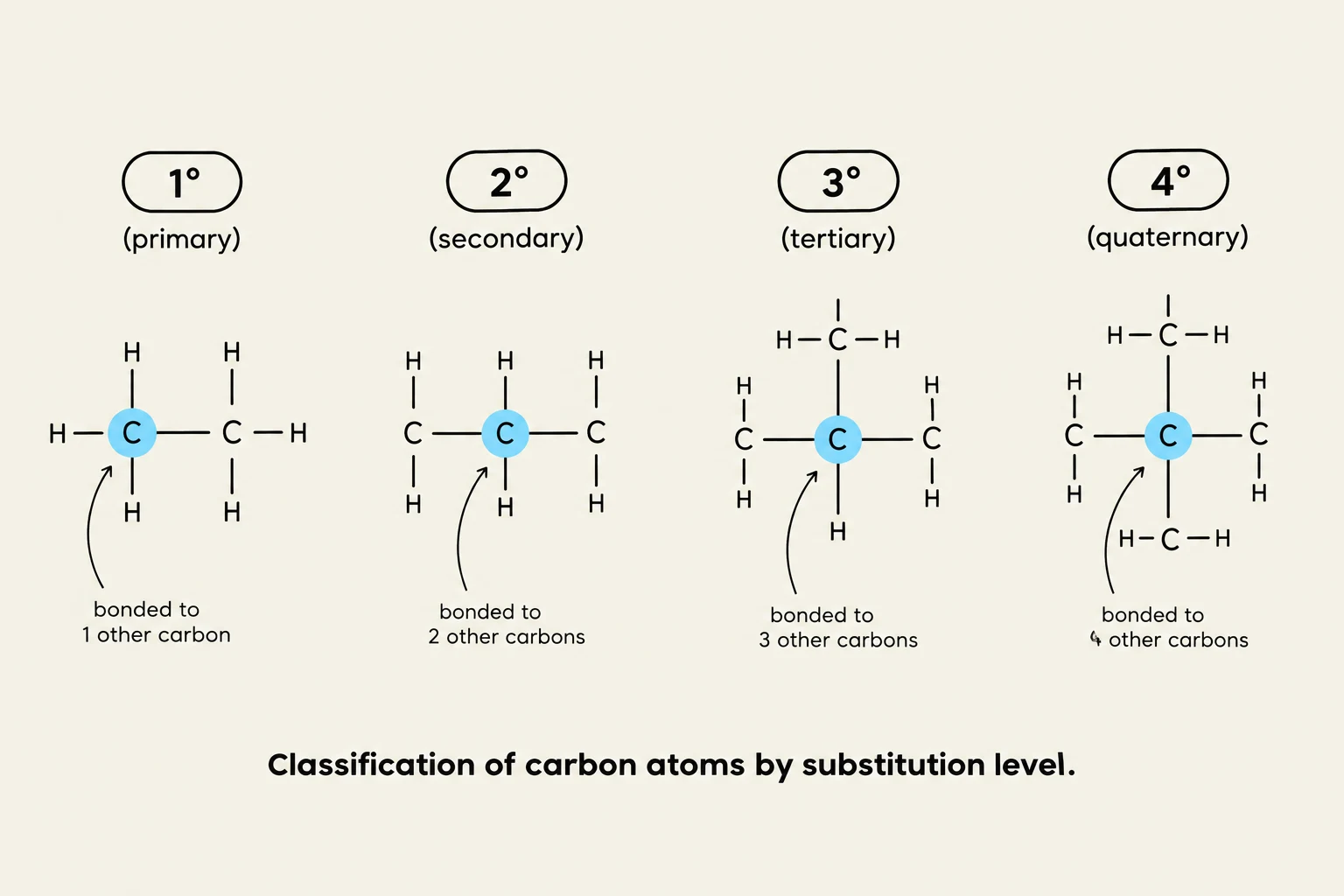
Classification of carbon atoms by substitution level, illustrating primary, secondary, tertiary, and quaternary carbon atoms based on the number of other carbon atoms they are bonded to.
Understanding the "personality" of a carbon atom is vital for predicting how a molecule will react. We classify carbons based on how many other carbon atoms they are directly bonded to:
Primary (1∘): Bonded to one other carbon.
Secondary (2∘): Bonded to two other carbons.
Tertiary (3∘): Bonded to three other carbons.
Quaternary (4∘): Bonded to four other carbons.
This classification is essential when analyzing complex molecules like cortisol. Furthermore, these structural features influence physical properties. For instance, the length of a carbon chain and the presence of branching significantly impact boiling points; generally, as the surface area of a molecule increases, the intermolecular forces strengthen, leading to higher boiling points.
3. Conformational Analysis: Newman Projections
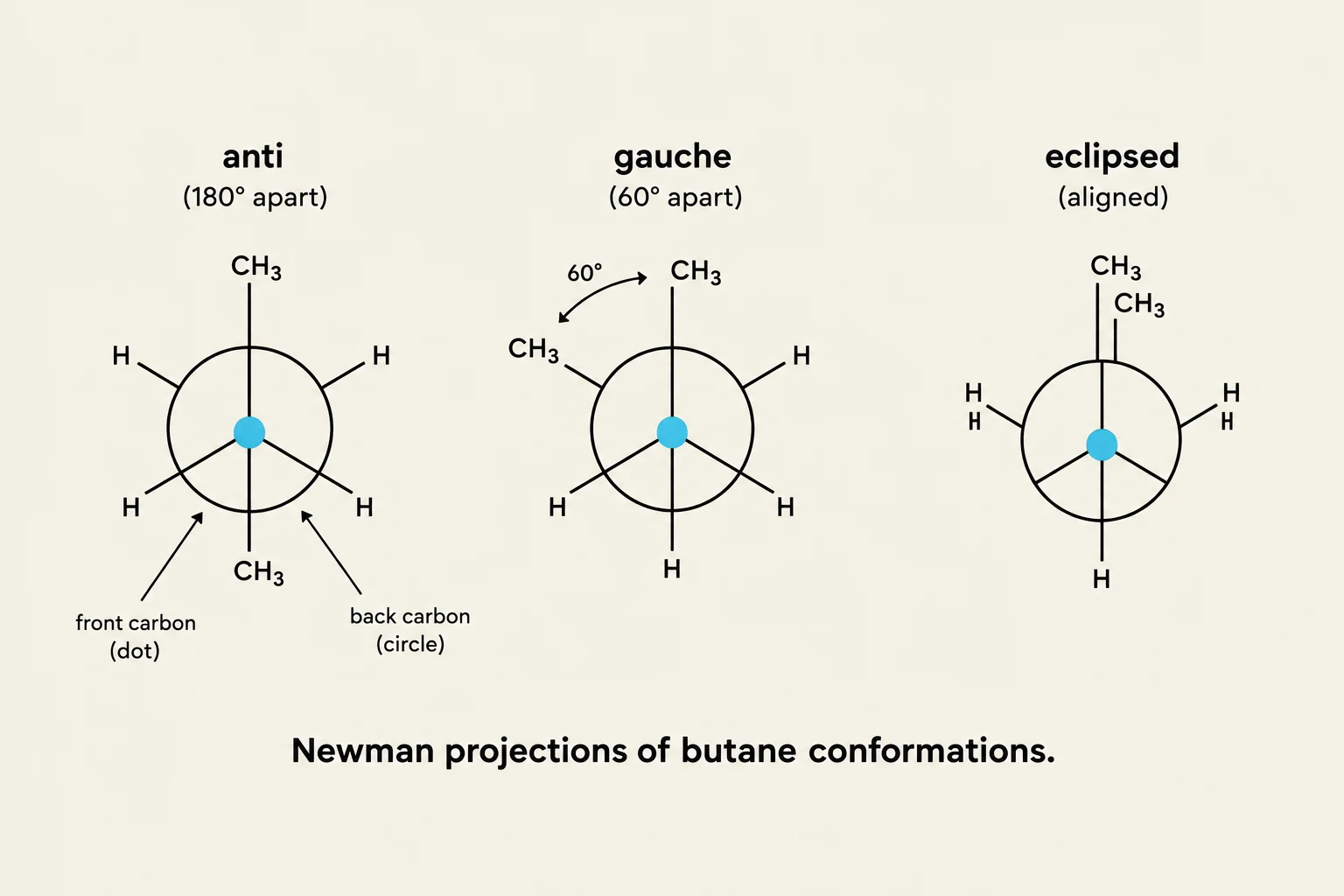
Newman projections of butane conformations, illustrating anti, gauche, and eclipsed arrangements.
Molecules are not rigid; they rotate around single (σ) bonds. Conformational analysis is the study of these different spatial arrangements, known as conformers.
Visualizing Rotation
To study rotation, we use a Newman Projection. This view looks directly down a specific carbon-carbon bond (for example, the C2-C3 bond). In this projection, the front carbon is represented by a dot, and the back carbon is represented by a large circle.
Stability and Relationships
The stability of a conformer depends on the dihedral angle (the angle between bonds on adjacent carbons). We categorize these relationships into three main types:
Anti Relationship: The largest substituents are 180∘ apart. This is the most stable conformation because it minimizes steric repulsion.
Gauche Relationship: Substituents are 60∘ apart. While not as strained as eclipsed forms, they experience steric strain because the groups are close enough to repel each other.
Eclipsed Conformation: The atoms or groups are aligned directly behind one another. This is the highest energy state due to maximum torsional strain and steric repulsion.
The Energy Profile
We can map these rotations using a Newman Projection Energy Graph. On this graph:
The y-axis represents potential energy.
The x-axis represents the dihedral angle of rotation.
The peaks of the graph correspond to the high-energy eclipsed states, while the valleys correspond to the low-energy anti or gauche states.
4. The Chair Challenge: Cyclic Conformations
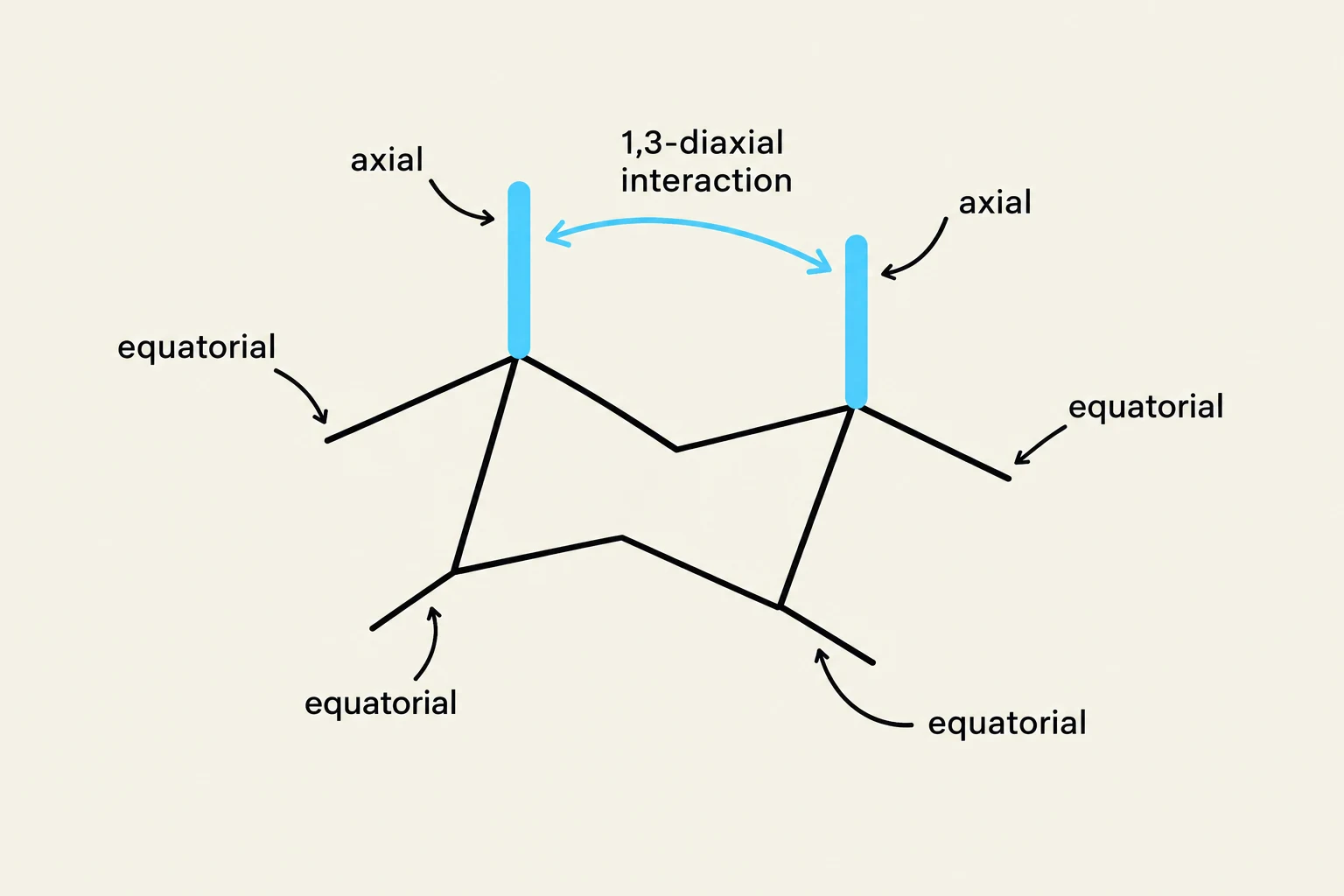
A diagram illustrating the 1,3-diaxial interaction in a cyclohexane chair conformation, showing axial and equatorial positions.
When we move from open chains to rings, such as cyclohexane, the rules of stability change. Cyclohexane does not exist as a flat hexagon; instead, it adopts a chair conformation to minimize angle and torsional strain.
Axial vs. Equatorial
In a chair conformation, the substituents attached to the ring can occupy two distinct environments:
Axial: These bonds point vertically up or down, perpendicular to the average plane of the ring.
Equatorial: These bonds point outward around the "equator" of the ring.
Predicting Stability
The most important rule for the "Chair Challenge" is this: Bulky substituents prefer the equatorial position.
When a large group is in the axial position, it bumps into other axial hydrogens on the same side of the ring. This phenomenon is known as 1,3-diaxial interaction. To find the most stable chair conformation for a given molecule, you must draw both possible chair flips and identify which one places the largest groups in the equatorial positions to minimize this steric repulsion.
Summary Table: Conformational Stability
Conformation
Steric/Torsional Strain
Relative Energy
Anti
Minimal
Lowest
Gauche
Moderate (Steric)
Intermediate
Eclipsed
Maximum
Highest
Keep reading for free.
Create an account to finish this reading and make it part of your study routine.