This guide explains the operational steps for a manual steam sterilizer, focusing on pre-operation checks, startup sequences, understanding heat-up versus sterilization times, temperature regulation, and post-sterilization procedures like exhaust and drying.
The Tuttnauer 2540M is a manual steam sterilizer designed to ensure the sterility of medical and dental instruments through controlled heat and pressure. Because this is a manual unit, the operator is responsible for managing the transition between heating, sterilization, and drying phases. Proper operation requires a disciplined approach to monitoring water levels, temperature, and steam pressure to ensure both instrument safety and operator protection.
Pre-Operation: Water Levels and Setup
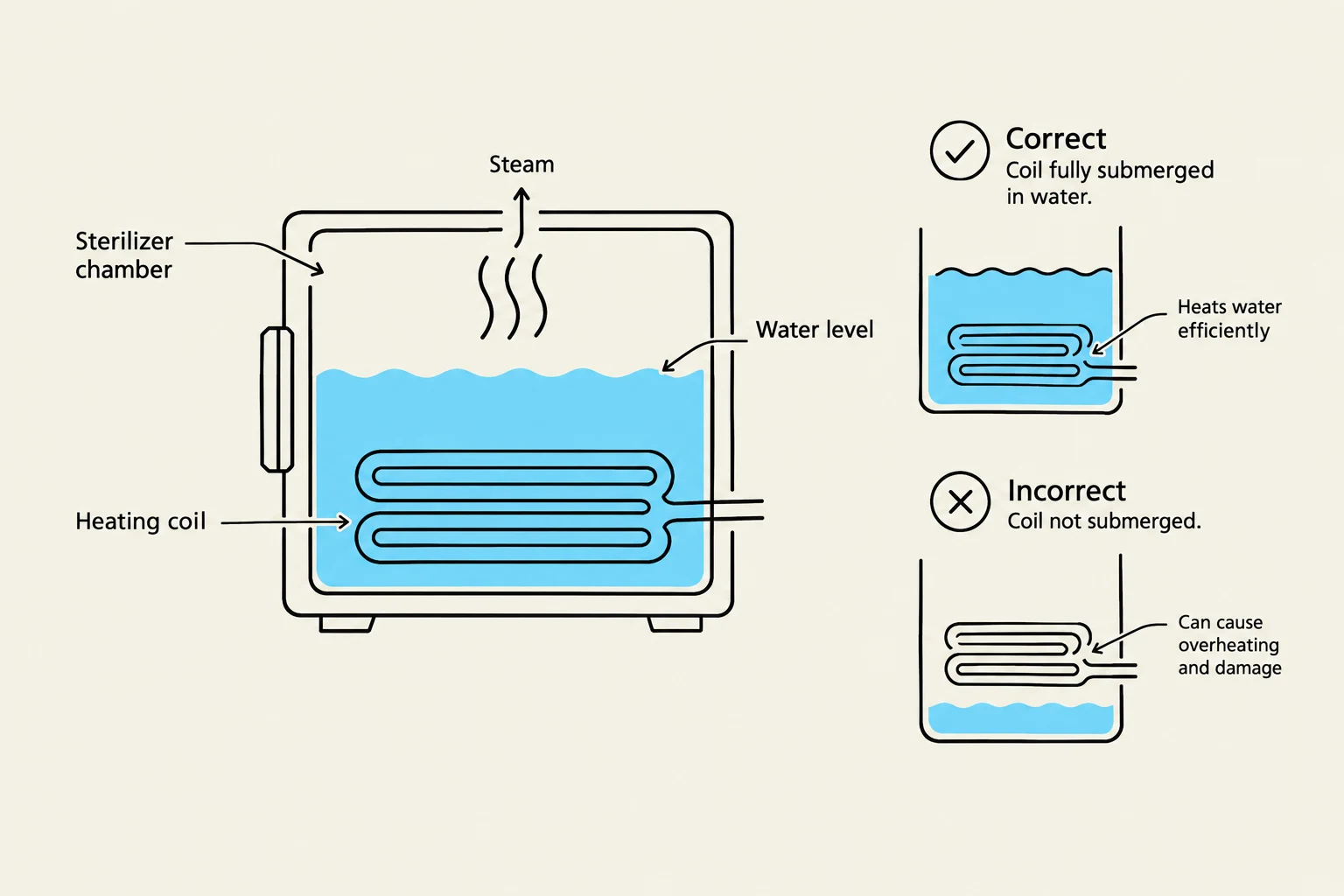
Before engaging any electrical components, the most critical step is verifying the water level within the chamber. The sterilizer utilizes a heating coil to generate steam, and this coil must be properly submerged to function correctly.
If the water level is too low, the heating element may be exposed to air, which can lead to overheating and permanent damage to the unit. Conversely, the unit must be placed on a level surface to ensure that the water distribution is even and that the pressure builds consistently.
Critical Safety Check: Always verify that the water level is sufficient to cover the heating coil before turning on the "Heat" switch. Running the unit "dry" can destroy the heating element.
Diagram illustrating the correct and incorrect submersion of a heating coil in a sterilizer chamber for efficient water heating and to prevent overheating and damage.
The Startup Sequence and Heating Phase
Once the water level is confirmed and the unit is plugged into a reliable power source, the operator can begin the startup sequence using the control interface.
Power Switch: Turn this on to activate the unit's electrical system. The power light should illuminate to confirm the unit is receiving electricity.
Heat Switch: This engages the heating element. Once activated, the element begins raising the temperature of the water to create steam.
Timer: In a manual sterilizer, the timer is a single control used for multiple stages. During the initial phase, the timer is used to manage the "heat-up" period.
It is important to distinguish between a "cold start" and a "hot start." A cold start (starting with room-temperature water) will take significantly longer to reach the target temperature than a hot start.
Understanding Heat-Up Time vs. Sterilization Time
One of the most common errors in operating a manual sterilizer is confusing the time it takes to reach temperature with the actual sterilization duration.
The Heat-Up Phase
The heat-up phase is the period during which the water is being heated to the desired temperature. During this time, the operator must monitor the temperature gauge. The timer is used here to estimate how long the heating process will take, but the sterilization cycle does not officially begin until the target temperature is achieved.
The Sterilization Phase
Once the unit reaches the desired temperature, the operator must immediately reset or adjust the timer to the specific sterilization time required for the load. This duration is not a "one size fits all" setting; it must be determined by the Instructions for Use (IFU) provided by the instrument manufacturer.
The IFU will specify:
The required temperature.
The required duration of exposure.
The specific sterilization method (e.g., gravity displacement).
Diagram illustrating the two-step process of a steam sterilizer, including heat-up and sterilization phases, with associated temperature and pressure parameters.
Exam Tip: If a question asks when the sterilization timer should be set, the answer is: Only after the unit has reached the desired temperature specified by the IFU.
Temperature Regulation and Cycling
The Tuttnauer 2540M maintains its target temperature through a temperature-cycling mechanism. The unit does not provide constant heat; instead, it operates on a threshold system:
When the temperature drops below a specific set point, the heating element turns on.
When the temperature reaches the target set point, the heating element turns off.
This cycling is why you may see the "heat" light flicker on and off during a successful cycle. During this phase, the operator should perform a visual inspection of the unit to ensure there are no steam leaks around the door seals or valves.
Exhaust, Pressure, and Drying
Once the sterilization timer reaches zero, the cycle is complete, but the instruments are not yet ready for handling. The chamber is still under high steam pressure.
The Exhaust Phase
The operator must move the control to the exhaust position. This allows the steam to vent out of the unit. The operator must wait until the pressure gauge reads zero before attempting to interact with the door.
Pressure Safety and the Door Lock
The Tuttnauer 2540M features a mechanical safety mechanism to prevent accidental exposure to high-pressure steam. A pressure-sensitive door lock uses the internal steam pressure to push a pin into the door handle.
As long as there is internal pressure, the pin is engaged, and the door cannot be opened manually. Only when the pressure has fully dissipated to zero will the pin retract, allowing the door to be opened safely.
The Drying Phase
After the door is opened and the instruments are removed, the drying switch may be used to remove any residual moisture from the load. This ensures that the instruments are dry and ready for sterile storage.
Warning: Never attempt to force the door open if it feels stuck. A stuck door is a sign that the internal steam pressure has not yet been fully exhausted.
Keep reading for free.
Create an account to finish this reading and make it part of your study routine.