One-Dimensional Elastic Collisions with a Stationary Target
Explore the physics of one-dimensional elastic collisions involving a stationary target. This article details the conservation laws of momentum and kinetic energy, and analyzes how different mass ratios affect the final velocities of colliding objects.
In the study of classical mechanics, collisions are fundamental interactions where objects exert forces on each other for a relatively short period. When analyzing these interactions, we often distinguish between different types of collisions based on how energy is handled. One of the most mathematically elegant scenarios is the one-dimensional elastic collision involving a stationary target. This article explores the physics behind these interactions, the conservation laws that govern them, and how varying mass ratios dictate the final velocities of the objects involved.
Understanding One-Dimensional Elastic Collisions
A collision is considered "elastic" if both total momentum and total kinetic energy are conserved during the interaction. In a one-dimensional collision, all motion occurs along a single straight line.
To solve these problems, we rely on two primary conservation laws. First, the conservation of momentum states that if no net external force acts on a system (an "inertial system"), the total momentum remains constant:
m1v1+m2v2=m1v1′+m2v2′
Second, for elastic collisions specifically, the kinetic energy is also conserved:
21m1v12+21m2v22=21m1v1′2+21m2v2′2
In contrast, if the objects stick together after impact, the collision is "completely inelastic," and kinetic energy is not conserved, though momentum still is.
The Stationary Target Scenario
A common physics problem involves a moving mass (m1) striking a second mass (m2) that is initially at rest (v2=0). This is known as a stationary target scenario.
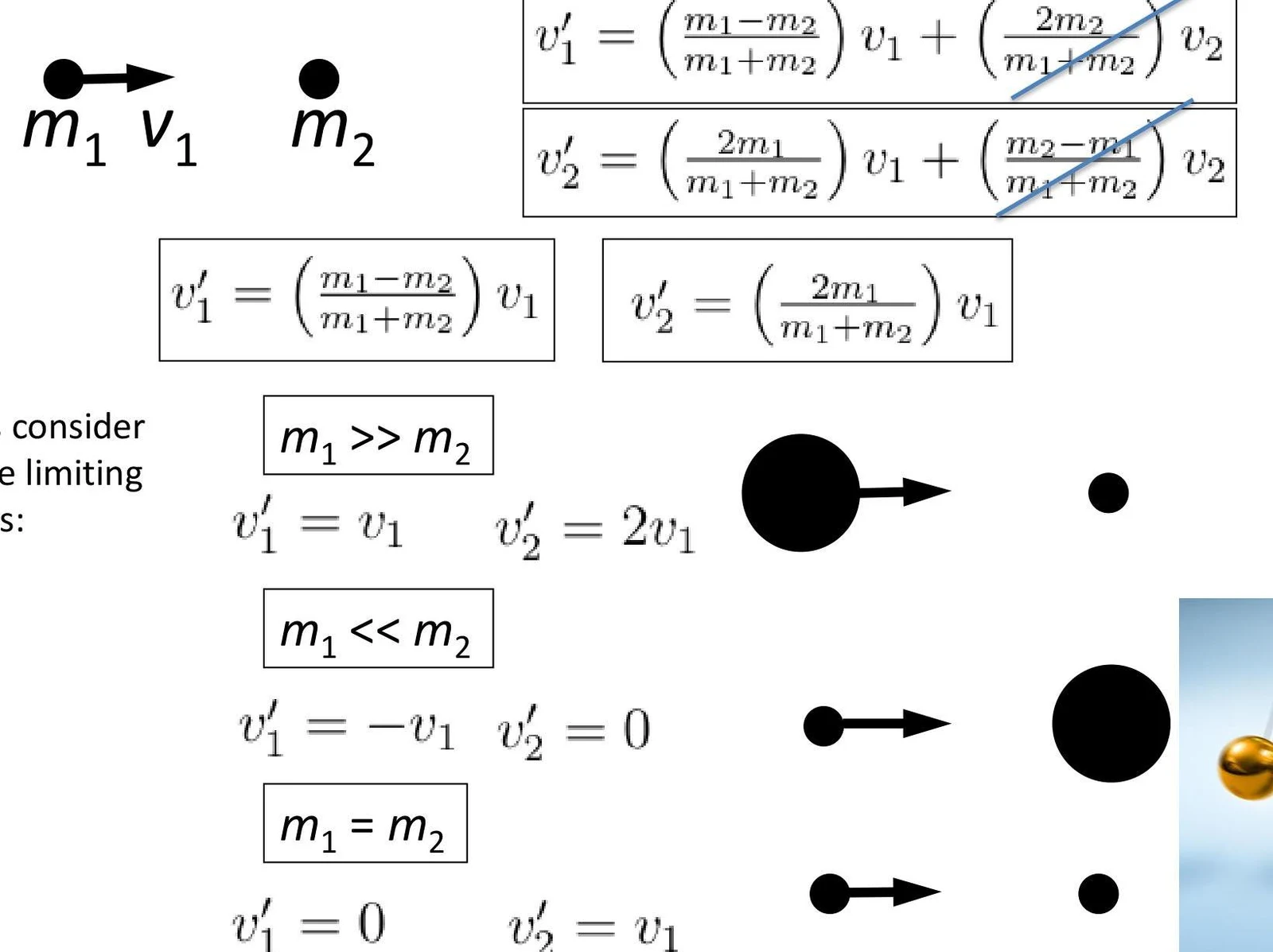
This diagram illustrates the final velocities of two colliding objects based on their masses and initial velocities, showing different scenarios for mass ratios.
When we apply the conservation laws to this specific case, the general equations for final velocities simplify significantly:
v1′=(m1+m2m1−m2)v1v2′=(m1+m22m1)v1
In these equations, v1 is the initial velocity of the first mass, while v1′ and v2′ are the final velocities of the first and second masses, respectively.
Analyzing Mass Ratio Scenarios
The outcome of the collision—whether the first mass keeps moving forward, bounces backward, or stops entirely—depends heavily on the ratio of the two masses. We can examine three limiting cases to understand this behavior:
1. Heavy Projectile (m1≫m2)
When a very large mass hits a very small mass (like a bowling ball hitting a marble), the heavy mass continues almost unaffected, while the small mass is propelled forward at twice the initial speed:
v1′≈v1
v2′≈2v1
2. Heavy Target (m1≪m2)
When a very small mass hits a very large, stationary mass (like a ball hitting a wall), the small mass bounces back with its original speed in the opposite direction, and the large mass remains nearly stationary:
v1′≈−v1
v2′≈0
3. Equal Masses (m1=m2)
In the special case where both masses are identical, the moving mass comes to a complete stop, transferring all its momentum and energy to the target:
v1′=0
v2′=v1
Exam Tip: If you encounter a problem where a moving object hits an identical stationary object and the first object stops dead, you are looking at a one-dimensional elastic collision between equal masses.
Worked Example: The Ballistic Pendulum
To see these principles in action, consider the "Ballistic Pendulum" problem, which combines momentum conservation with energy conservation.
Problem: A bullet of mass m=0.010 kg is fired into a wooden block of mass M=2.00 kg suspended by a cord. The bullet embeds itself in the block, and the system swings upward to a maximum height of h=0.120 m. Find the initial speed of the bullet (vi).
Step 1: Find the post-collision speed (V) using Energy Conservation.
After the collision, the kinetic energy of the block-bullet system is converted into gravitational potential energy as it swings up:
21(m+M)V2=(m+M)gh
Solving for V:
V=2gh=2⋅9.80⋅0.120≈1.534 m/s
Step 2: Find the initial bullet speed (vi) using Momentum Conservation.
The collision itself is perfectly inelastic because the bullet sticks to the block. We use the conservation of momentum for the moment of impact:
mvi=(m+M)Vvi=mm+MV=0.0100.010+2.00⋅1.534≈308 m/s
This demonstrates how we can use different conservation laws at different stages of a physical process to solve for unknown variables.
Keep reading for free.
Create an account to finish this reading and make it part of your study routine.