Explores the chemical senses of smell (olfaction) and taste (gustation), detailing their neural pathways and the fundamental electrochemical mechanism of action potentials in neurons.
How do we perceive the aroma of freshly baked bread or the sharp tang of a lemon? These experiences are the result of complex chemical sensing processes that translate molecular signals into electrical impulses. This article explores the two primary chemical senses—olfaction (smell) and gustation (taste)—and the fundamental electrochemical mechanism known as the action potential that allows our nervous system to communicate these sensations to the brain.
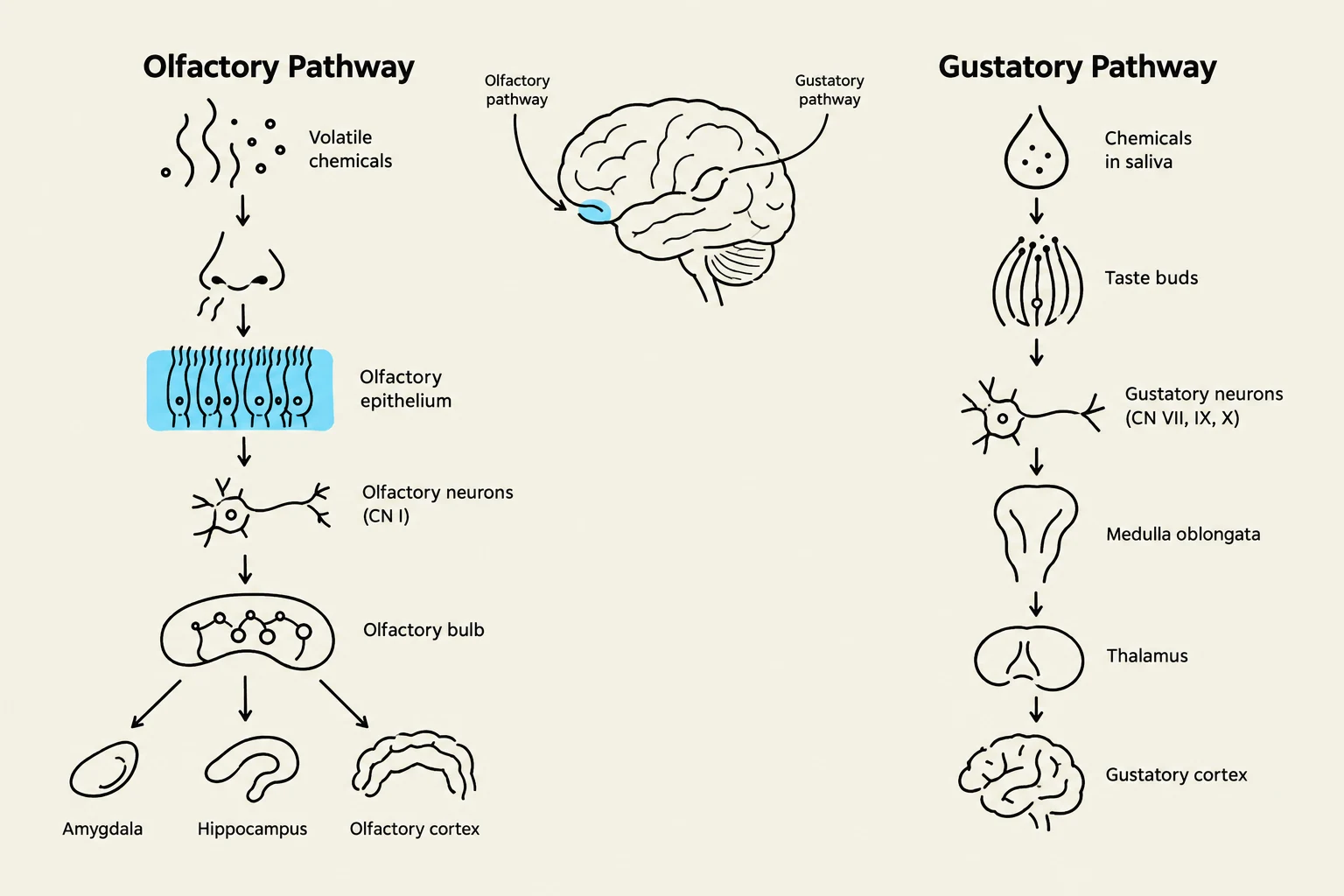
Diagram illustrating the olfactory and gustatory pathways in the human brain, detailing the neural signals from the nose and tongue to various brain regions.
The Chemical Senses: Olfaction and Gustation
Both smell and taste are classified as chemical senses because they rely on detecting chemicals dissolved in a medium. For olfaction, these are volatile chemicals dissolved in the nasal mucus; for gustation, these are chemicals dissolved in saliva.
Olfaction (Smell)
The process of smelling begins when volatile chemicals reach the olfactory epithelium. Here, specialized olfactory receptor cells detect the chemicals and release neurotransmitters to olfactory neurons. These neurons transmit the signal via Cranial Nerve I (CN I) to the olfactory bulb.
Unlike many other sensory pathways that must pass through the thalamus before reaching the cortex, olfaction has a direct connection to brain regions involved in deep-seated survival and cognitive functions:
The Amygdala: A deep brain region responsible for processing emotions, fear, and survival responses.
The Hippocampus: A seahorse-shaped structure in the temporal lobe essential for learning, memory formation, and spatial navigation.
The Olfactory Cortex: The final destination for processing the identity of the scent.
Gustation (Taste)
Taste perception occurs when chemicals interact with gustatory receptor cells located within taste buds. These receptor cells contain gustatory hairs that house chemical receptor channels. Once triggered, the receptor cells release neurotransmitters that induce action potentials in gustatory neurons.
The pathway for taste is more complex in terms of cranial nerve involvement. Three specific cranial nerves carry gustatory information to the brain:
CN VII (Facial Nerve): Handles taste for the front two-thirds of the tongue.
CN IX (Glossopharyngeal Nerve): Handles taste for the back of the tongue.
CN X (Vagus Nerve): Handles taste sensation at the back of the throat.
These signals travel to the medulla oblongata (part of the brainstem), then to the thalamus, and finally to the gustatory cortex for conscious perception.
Exam Tip: Remember the distinction in pathways! Olfaction bypasses the thalamus to hit the amygdala and hippocampus directly, whereas gustation follows a more traditional route through the medulla and thalamus to the cortex.
The Language of Neurons: Action Potentials
For any sensory information to move from a receptor to the brain, the neuron must generate an electrical signal called an action potential. This is an "all-or-none" response; once a specific electrical threshold is met, the neuron fires.
The Phases of a Neuron Potential
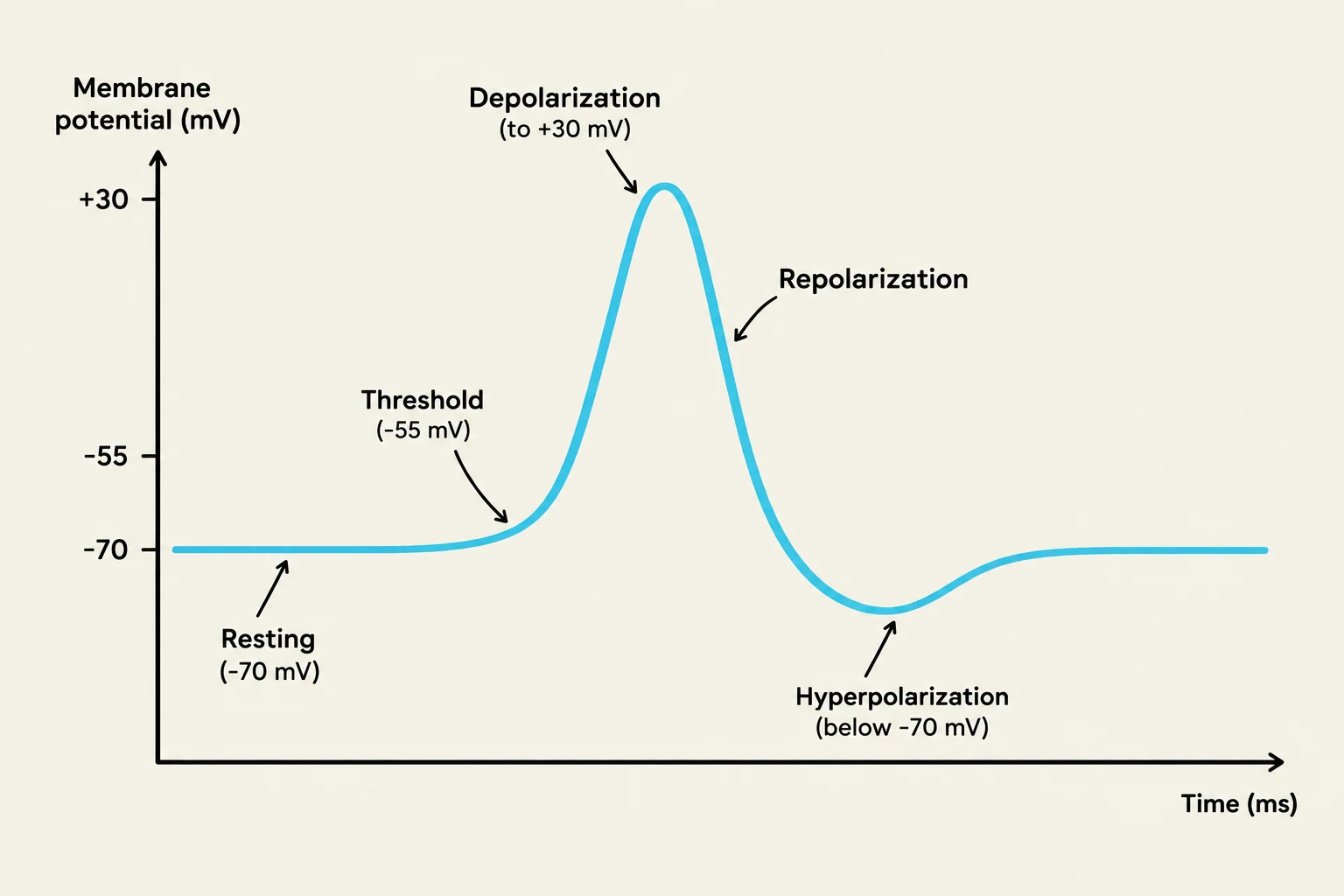
This graph illustrates the changes in membrane potential during an action potential, showing the resting state, threshold, depolarization, repolarization, and hyperpolarization phases.
The movement of ions across the cell membrane creates changes in voltage that define the different stages of neuronal signaling:
Resting Potential: When a neuron is not actively sending a signal, it maintains a stable, negative internal voltage, typically measured at −70 mV.
Threshold Potential: As a stimulus (like a chemical binding to a receptor) occurs, the inside of the neuron becomes more positive. If the voltage reaches approximately −55 mV, the threshold is met, and an action potential is triggered.
Depolarization: This is the "rising" phase of the action potential. Voltage-gated sodium (Na+) channels open, causing a massive influx of Na+ ions into the cell. This makes the interior of the neuron rapidly more positive, reaching up to +30 mV.
Repolarization: To reset the charge, Na+ channels inactivate and voltage-gated potassium (K+) channels open. K+ ions flow out of the cell (efflux), making the internal environment more negative again.
Hyperpolarization: Often, the K+ channels stay open slightly too long, or Cl− ions move into the cell, causing the membrane potential to become even more negative than the resting state (e.g., −90 mV).
Restoring Equilibrium
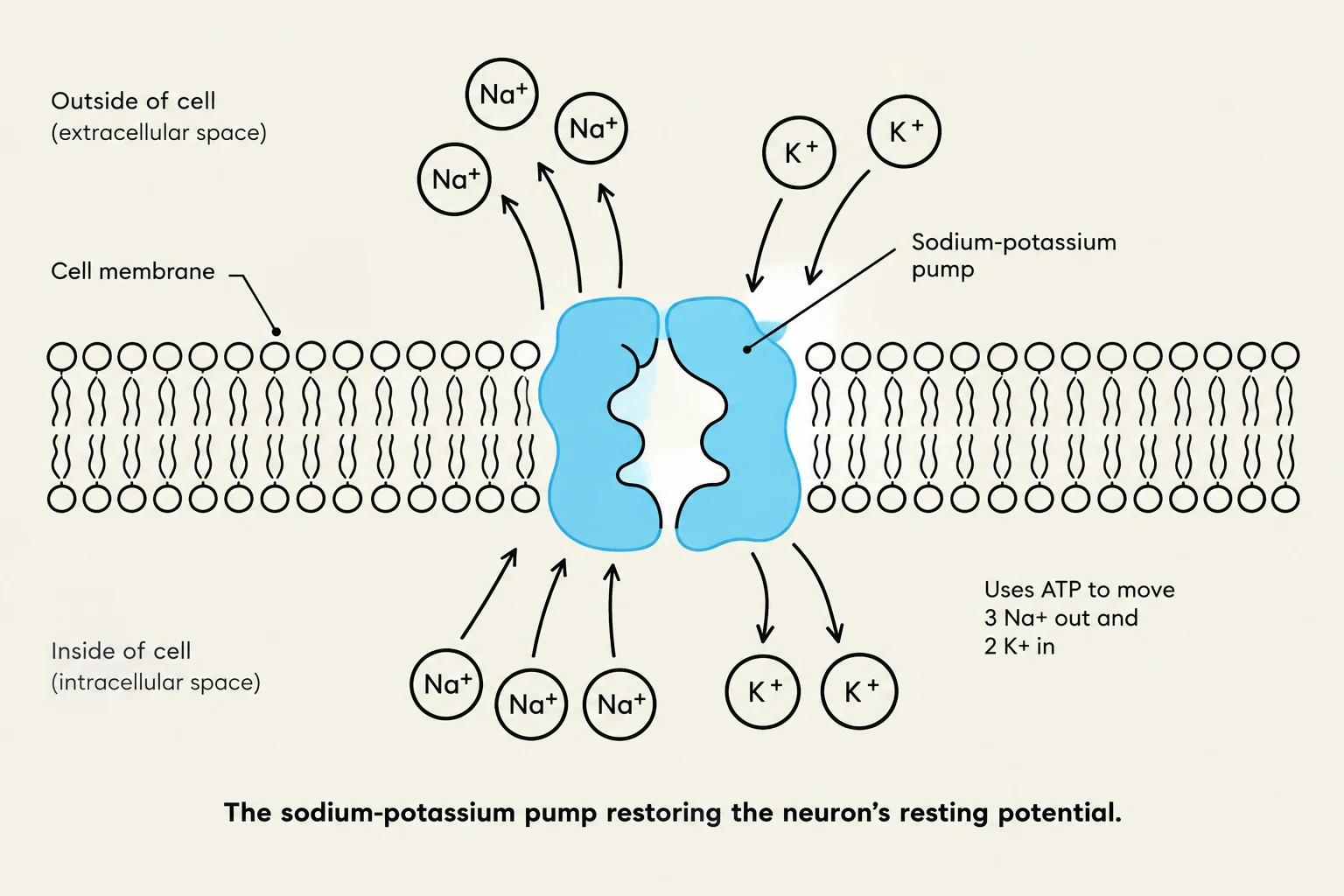
The sodium-potassium pump restores the neuron's resting potential by moving sodium ions out of the cell and potassium ions into the cell, utilizing ATP.
To ensure the neuron can fire again, the cell must return to its original resting state. This is achieved through the sodium-potassium pump. This active transport mechanism works to reset the electrochemical gradients by moving ions against their concentration gradients:
\text{Net movement} = & \text{3 Na}^+ \text{ ions OUT} \\
& \text{2 K}^+ \text{ ions IN}
\end{aligned}$$
This process restores the $-70\text{ mV}$ resting potential, preparing the neuron for the next sensory stimulus.
| Phase | Primary Ion Movement | Voltage Change |
| --- | --- | --- |
| **Resting** | N/A | $-70\text{ mV}$ |
| **Threshold** | Stimulus-driven | $\approx -55\text{ mV}$ |
| **Depolarization** | $\text{Na}^+$ influx (in) | Up to $+30\text{ mV}$ |
| **Repolarization** | $\text{K}^+$ efflux (out) | Returning to negative |
| **Hyperpolarization** | $\text{K}^+$ efflux / $\text{Cl}^-$ influx | Below $-70\text{ mV}$ |
*Table 1: Summary of Action Potential Phases (based on)*
## Summary of Sensory Pathways
The integration of these concepts allows us to navigate our environment. A chemical molecule hits a **sensory receptor cell** (olfactory or gustatory), triggering a change in voltage. This change moves the neuron from its **resting potential** to its **threshold potential**, initiating an **action potential** via **depolarization** and **repolarization**. This electrical signal then travels through specific **cranial nerves** to reach the specialized processing centers of the brain, such as the **olfactory cortex** or the **gustatory cortex**.
$$$
$$$
Keep reading for free.
Create an account to finish this reading and make it part of your study routine.