Observational vs. Experimental Studies: Research Design Fundamentals
This guide explains the core differences between observational and experimental research studies, focusing on their methodologies, strengths, and limitations in establishing causation versus correlation.
In the world of statistics and scientific research, the way we gather data determines the strength of the conclusions we can draw. If you want to know if a new medicine works, or if you simply want to know how many people in a city take that medicine, you are asking two fundamentally different questions. The distinction lies in the researcher's level of involvement: are you merely watching from the sidelines, or are you actively intervening to change the outcome?
Understanding the difference between observational studies and experimental studies is the first step in mastering experimental design and avoiding common pitfalls like bias and confounding variables.
Observational Studies: The Art of Watching
An observational study is a method where researchers observe and measure specific variables without attempting to influence or modify the subjects being studied. In these studies, the researcher is a passive observer. They collect data on existing conditions, behaviors, or characteristics as they occur naturally in the world.
For example, if a researcher wants to study the relationship between smoking and lung capacity, they might follow a group of people who already smoke and a group of people who do not. The researcher does not tell anyone to smoke; they simply record the existing habits and the resulting lung health.
Key Characteristics of Observational Studies
No Intervention: The researcher does not apply a "treatment" to the subjects.
Natural Settings: Data is often collected in real-world environments.
Correlation, Not Causation: Because the researcher cannot control for all other variables, these studies can show that two things are related (correlation), but they cannot prove that one caused the other.
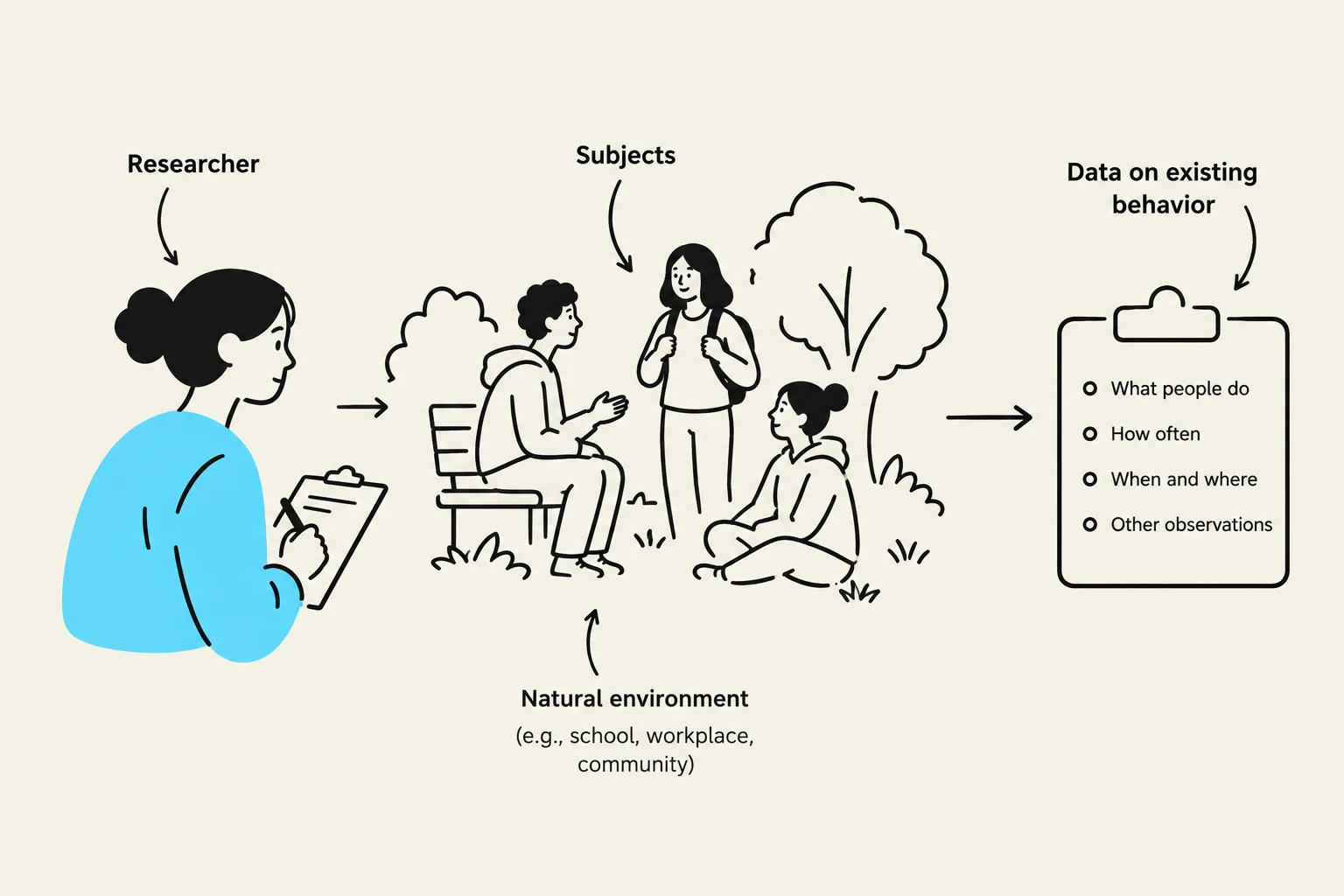
This diagram illustrates a research process where a researcher observes subjects in their natural environment to collect data on existing behavior, noting what people do, how often, when and where, and other observations.
Exam Tip: If a question asks you to identify a study type, look for keywords like "observed," "surveyed," "recorded," or "monitored." If no action was taken to change a subject's status, it is an observational study.
Experimental Studies: The Power of Intervention
In contrast to observational studies, an experimental study involves the deliberate application of a treatment to a group of subjects to observe the effect. This is the "gold standard" for establishing cause-and-effect relationships.
In a well-designed experiment, the researcher actively manipulates one variable (the independent variable or treatment) to see how it affects another variable (the dependent variable or response).
The Components of a Controlled Experiment
To make an experiment scientifically valid, researchers typically use several key tools:
Treatment: The specific condition applied to the subjects (e.g., a new drug, a specific diet, or a teaching method).
Control Group: A group of subjects that does not receive the treatment. They often receive a placebo (a harmless substance like a sugar pill) to provide a baseline for comparison.
Random Assignment: This is the process of assigning subjects to either the treatment group or the control group by chance. This helps ensure that the groups are as similar as possible before the treatment is applied, which minimizes the influence of "lurking" or confounding variables.
This diagram illustrates a randomized controlled trial design, showing how subjects are randomly assigned to either an experimental group receiving a new treatment or a control group receiving a standard condition.
Why the Distinction Matters: Causation vs. Correlation
The most critical reason to distinguish between these two methods is the ability to claim causation.
In an observational study, you might find that people who eat breakfast every morning have higher test scores. However, you cannot conclude that breakfast causes higher scores. It might be that people who eat breakfast also have more stable sleep schedules, or higher socioeconomic status, or more parental involvement. These are "confounding variables"—extra factors that might be influencing both the breakfast habit and the test scores.
In an experimental study, because you use random assignment, those confounding variables (like sleep or wealth) should be distributed roughly equally between your treatment group and your control group. Therefore, if the breakfast-eating group performs significantly better, you can much more confidently claim that the breakfast itself caused the improvement.
Summary Table
Feature
Observational Study
Experimental Study
Researcher's Role
Passive observer
Active intervener
Treatment Applied?
No
Yes
Random Assignment?
No
Yes (essential for control)
Primary Goal
Find associations/correlations
Establish cause-and-effect
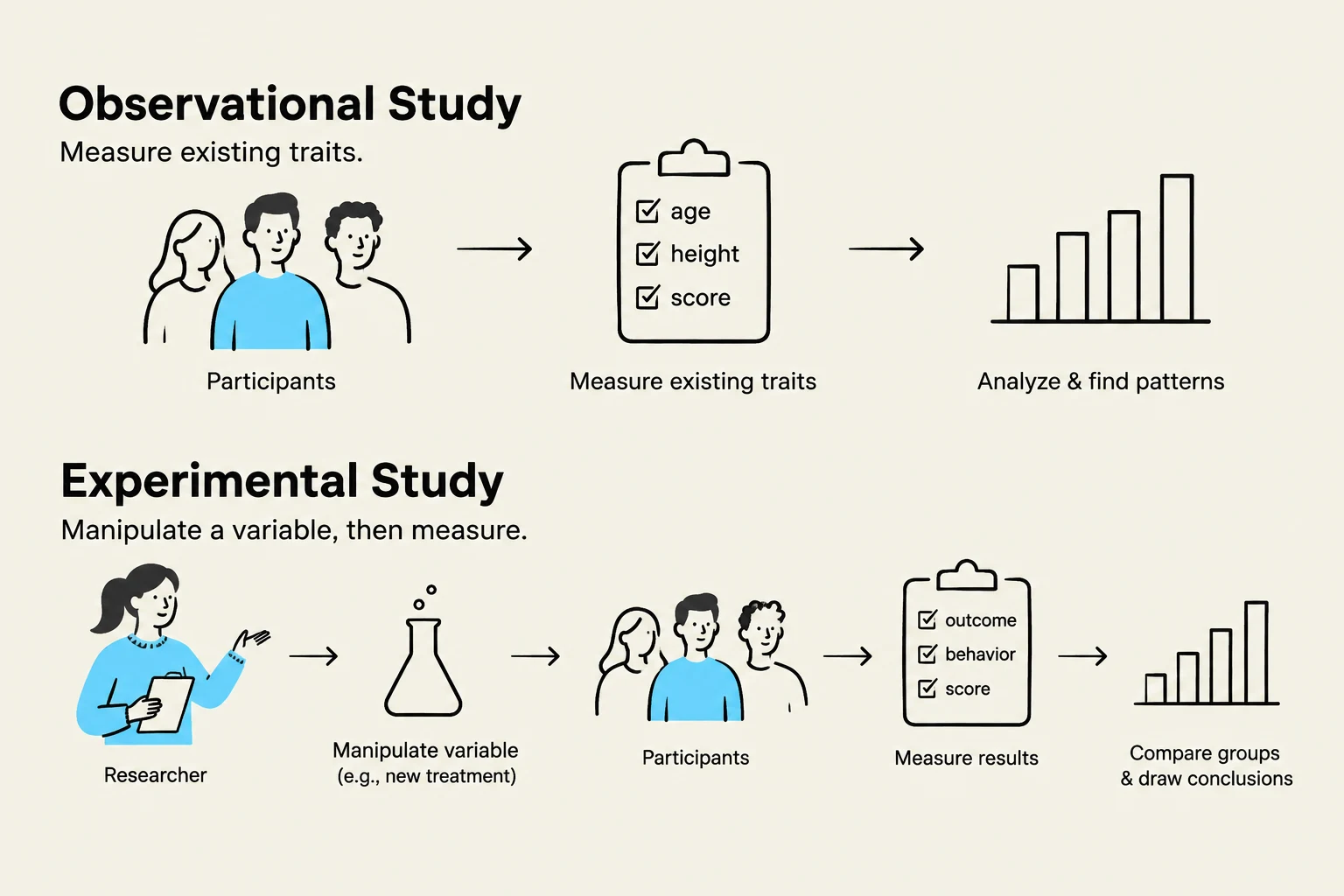
This illustration compares observational and experimental studies, outlining their respective methodologies and outcomes.
Critical Thinking Check: Always ask yourself: "Did the researcher assign the subjects to a group, or did the subjects choose their own group?" If they chose (e.g., smokers vs. non-smokers), it is observational. If the researcher assigned them (e.g., Group A gets the pill, Group B gets the placebo), it is experimental.
Conclusion
Choosing between an observational and an experimental design involves a trade-off between control and ethics. While experiments provide the strongest evidence for causation, they are not always possible or ethical (for example, you cannot ethically force people to smoke to see if it causes cancer). In such cases, observational studies provide vital information, even if they cannot definitively prove cause and effect.
Keep reading for free.
Create an account to finish this reading and make it part of your study routine.