This content explores the nursing process applied to drug therapy, including safe medication administration, the ten rights, and core pharmacological terminology. It also covers the fundamental pillars of pharmacology: pharmaceutics, pharmacokinetics, pharmacodynamics, and pharmacotherapeutics.
For nursing professionals, pharmacology is more than just memorizing drug names; it is the science of understanding how substances interact with living organisms to produce therapeutic effects. To provide safe and effective care, nurses must integrate pharmacological knowledge with the systematic framework of the nursing process. This integration ensures that medication administration is not merely a mechanical task, but a continuous cycle of assessment, intervention, and evaluation designed to optimize patient outcomes.
The Core Pillars of Pharmacology
Before applying the nursing process, it is essential to distinguish between the four fundamental scientific disciplines that govern how drugs work:
Pharmaceutics: The science of preparing and dispensing drugs, including the design of various dosage forms like tablets, capsules, or liquids.
Pharmacokinetics: The study of "what the body does to the drug." This involves the movement of the drug through the body via absorption, distribution, metabolism, and excretion (ADME).
Pharmacodynamics: The study of "what the drug does to the body," focusing on the biochemical and physiological interactions at the cellular level.
Pharmacotherapeutics: The clinical application of drugs to prevent or treat pathological conditions.
Exam Tip: If a question asks about the mechanism of action (how a drug changes a cell), it is referring to pharmacodynamics. If it asks about half-life or liver metabolism, it is referring to pharmacokinetics.
The Nursing Process in Drug Therapy
Nurses apply a five-step cyclical process to manage medication therapy safely. This process ensures that care is patient-centered and evidence-based.
1. Assessment and Nursing Diagnosis
The process begins with Assessment, the systematic collection and analysis of patient data. Before administering any drug, a nurse must assess relevant vital signs, lab values, and patient history. From this data, the nurse formulates Nursing Diagnoses to communicate potential risks. For example, if a patient experiences dizziness after taking an antihypertensive, the nurse might identify a "Risk for injury (falls) related to antihypertensive-induced hypotension".
2. Planning and Outcome Criteria
During Planning, the nurse develops realistic, measurable goals. These goals are defined by Outcome Criteria, which are concrete descriptions of what the patient should achieve. For instance, if administering pain medication, an outcome criterion might be: "Patient will report a pain score of 3/10 or less within 30 minutes of administration".
3. Implementation and the Ten Rights
Implementation is the actual execution of nursing actions, such as administering the medication or providing patient education. To prevent medication errors—preventable events that lead to inappropriate use or patient harm—nurses must adhere to the "Ten Rights" of medication administration:
Right Patient: Use at least two identifiers.
Right Drug: Verify the order against the medication label and expiry.
Right Dose: Calculate and double-check dosages.
Right Route: Confirm the method (e.g., oral, IV) is appropriate.
Right Time: Check frequency and last dose administered.
Right Reason: Ensure the medication matches the patient's condition.
Right Patient Education: Ensure the patient understands the purpose and side effects.
Right Documentation: Sign off immediately after administration.
Right to Refuse: Respect the patient's autonomy while explaining consequences.
Right Assessment: Perform necessary pre- or post-administration checks.
This diagram illustrates the iterative cycle of nursing care, encompassing assessment, nursing diagnosis, and planning.
4. Evaluation
Evaluation is the final step where the nurse monitors the patient's response to the drug. The nurse looks for therapeutic (desired) effects, expected side effects, or toxic reactions. Because the process is iterative, evaluation results often lead back to a new assessment.
Deep Dive: Pharmacokinetics (ADME)
Understanding how a drug moves through the body is critical for determining dosing intervals and predicting drug effects.
Absorption and Distribution
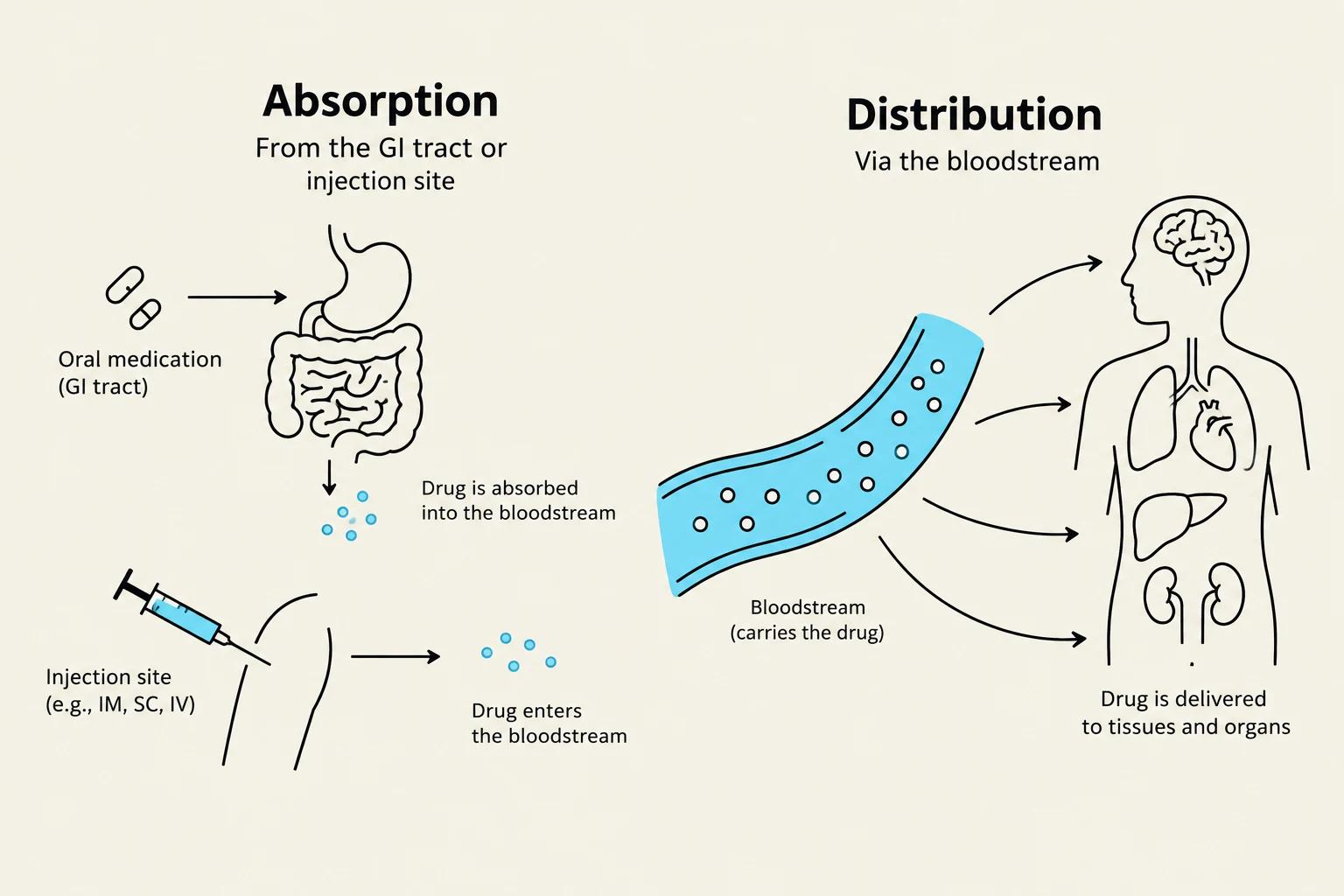
Absorption is the movement of a drug from its administration site into the bloodstream. The route significantly impacts this:
Enteral (Oral, Sublingual, Rectal): Oral drugs often undergo the first-pass effect, where the liver metabolizes a large portion of the drug before it reaches systemic circulation. Sublingual/buccal routes bypass the liver.
Parenteral (IV, IM, SubQ): These bypass the first-pass effect. IV drugs enter systemic circulation immediately.
Topical/Transdermal: Provides a steady release over a long period.
Once absorbed, Distribution occurs as the drug is transported via the bloodstream to its site of action. Many drugs bind to carrier proteins like albumin; only "free" (unbound) drugs are pharmacologically active.
This diagram illustrates the absorption and distribution of medication in the body. It shows how oral medication is absorbed from the gastrointestinal tract and how drugs administered via injection enter the bloodstream. The bloodstream then carries the drug to various tissues and organs for delivery.
Metabolism and Excretion
Metabolism (biotransformation) is the biochemical alteration of a drug, primarily occurring in the liver via cytochrome P450 enzymes. Excretion is the removal of the drug from the body, with the kidneys being the primary organ for this task.
Mathematical Concept: Half-Life
The half-life (t1/2) is the time required for the serum concentration of a drug to reduce by 50%.
Example Problem:
If a drug has a peak level of 160 mg/L and a half-life of 4 hours, how long until it reaches 20 mg/L?
Pharmacodynamics explores how drugs interact with receptors to produce effects. An agonist mimics a natural substance to activate a receptor, while an antagonist blocks the receptor.
Therapeutic Index and Interactions
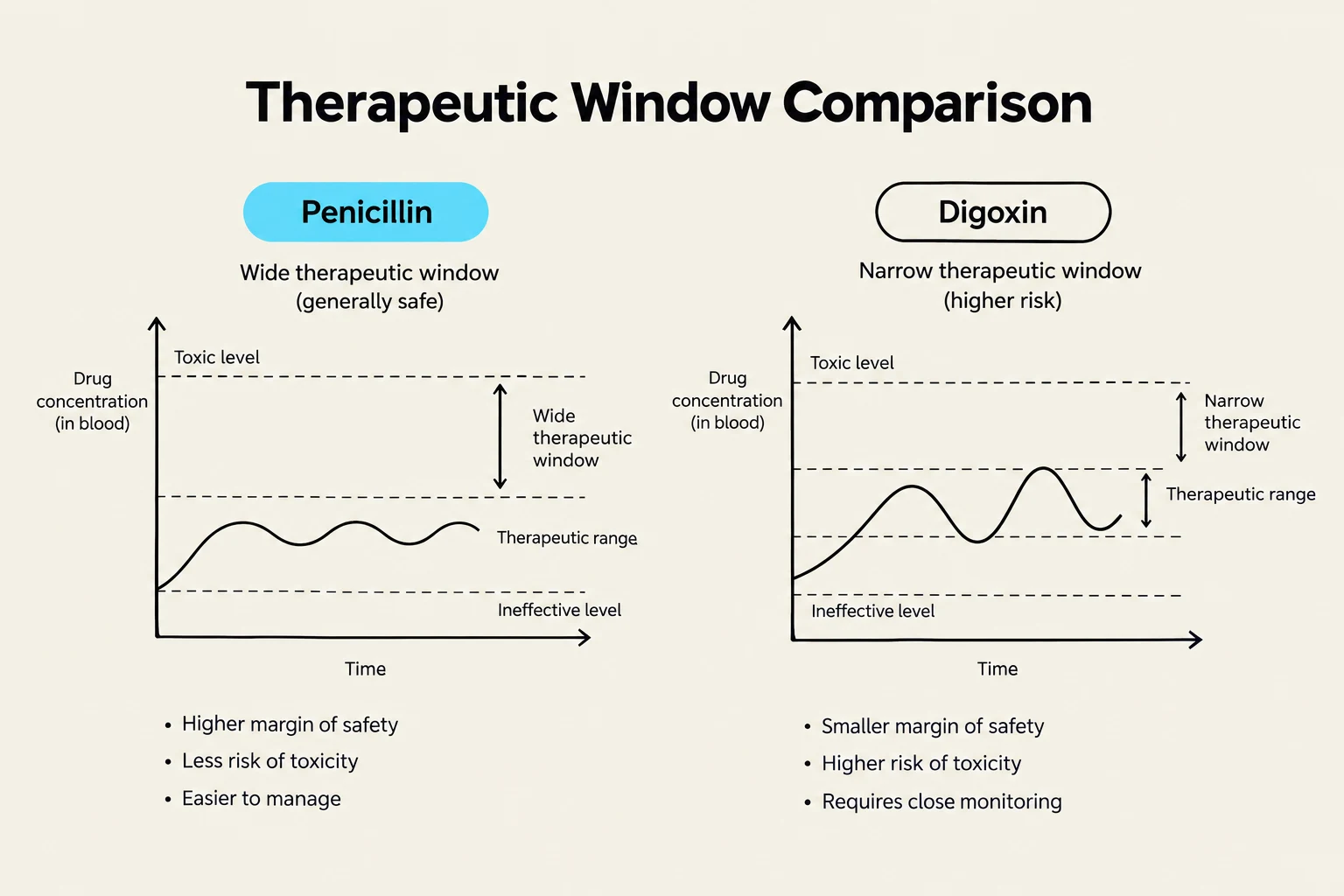
Safety is often measured by the Therapeutic Index (TI), which is the ratio between the toxic dose (TD50) and the effective dose (ED50):
TI=ED50TD50
A higher TI indicates a safer drug with a wider margin of error.
Finally, nurses must monitor for Adverse Drug Events (ADEs). While medication errors are preventable mistakes in the "Ten Rights," an Adverse Drug Reaction (ADR) is an unexpected, undesirable response that occurs even when the medication is administered correctly. Nurses must also be vigilant for drug interactions, which can be additive (1+1=2), synergistic (1+1=3), or antagonistic (1+1<2).
Comparison of therapeutic windows for Penicillin and Digoxin, illustrating drug concentration over time relative to toxic, therapeutic, and ineffective levels.
Ultimately, successful drug therapy relies on adherence—the active, voluntary, and collaborative involvement of the patient in their prescribed treatment plan.
Keep reading for free.
Create an account to finish this reading and make it part of your study routine.