Nursing Prioritization and Time Management Strategies
This content provides essential strategies for nurses to effectively manage their time and prioritize patient care in a fast-paced healthcare environment. It covers shifting from task to outcome orientation, key prioritization frameworks like ABCs and Maslow's Hierarchy, effective planning, delegation, managing interru
In the fast-paced environment of healthcare, nurses are constantly faced with competing demands. Effective time management is not simply about "moving faster"; it is a set of related common-sense skills that allow a nurse to use time in the most productive way possible to deliver safe, high-quality nursing care. When mastered, these skills allow for better prioritization, clearer decision-making regarding patient outcomes, and the ability to perform the most critical interventions first.
Shifting from Tasks to Outcomes
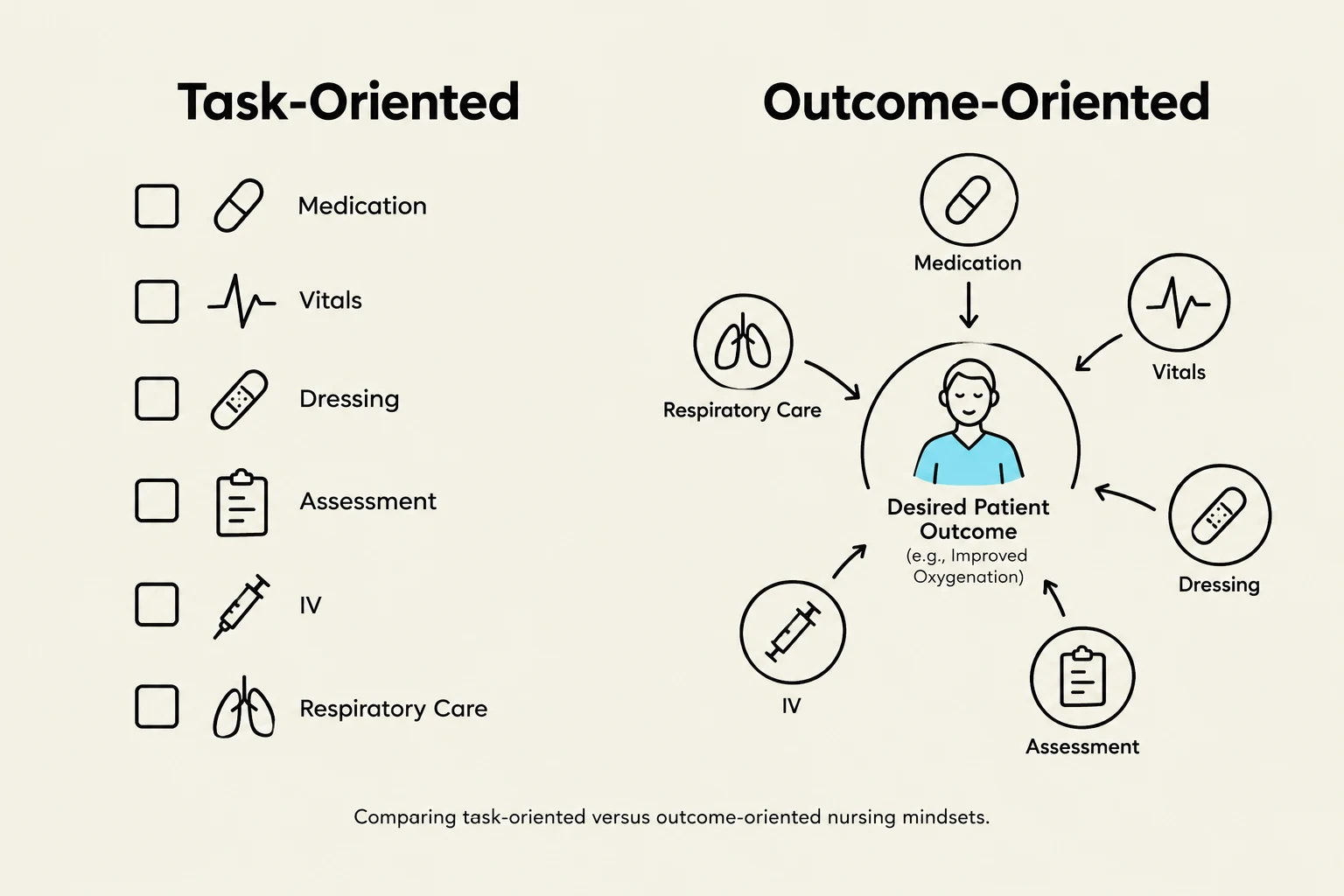
This graphic compares task-oriented versus outcome-oriented nursing mindsets, illustrating different approaches to patient care.
The foundation of effective time management is a fundamental shift in mindset: moving from a task orientation to an outcome/results orientation.
A task-oriented nurse focuses on "checking boxes"—completing a dressing change, giving a medication, or documenting a vital sign—without necessarily connecting these actions to the patient's broader clinical picture. In contrast, an outcome-oriented nurse sets long-term goals and desired results for each patient and uses those goals to organize care. While these goals must remain flexible to account for the unpredictable nature of clinical practice, they serve as the "North Star" that guides every intervention.
Priority Determination: Frameworks for Decision Making
The ABCDE hierarchy for sustaining life, illustrating increasing urgency and priority from bottom to top: Exposure, Disability, Circulation, Breathing, and Airway.
Prioritization is the process of ordering nursing problems based on urgency and importance to establish a preferential order for actions. To do this effectively, nurses should use established clinical frameworks rather than relying on "whatever hits first" or the "squeaky wheel" (the loudest patient).
Key Prioritization Frameworks
The ABC Framework: This is a fundamental tool for sustaining life. The hierarchy is:
Airway
Breathing
Circulation
Disability
Exposure
Note: Severity matters. A severe circulation problem may take priority over a minor breathing problem.
Maslow’s Hierarchy of Needs: Consider physiological needs (oxygen, water, food) as the highest priority before moving to safety, love/belonging, esteem, and self-actualization.
Acute vs. Chronic: Prioritize acute, unstable, or urgent problems over chronic, stable, or non-urgent ones.
Systemic vs. Local: Generally, a systemic issue (affecting the whole body) takes priority over a local issue (affecting one body part).
Life before Limb: Prioritize interventions that prevent death over those that prevent permanent disability.
💡 Exam Tip: Analyzing Priority Questions
When faced with a prioritization question on an exam, ask yourself:
Is the situation life-threatening or life-altering?
Is the data presented abnormal or unexpected for this specific disease process?
Is the patient's condition stable or unstable?
Effective Planning and Task Completion
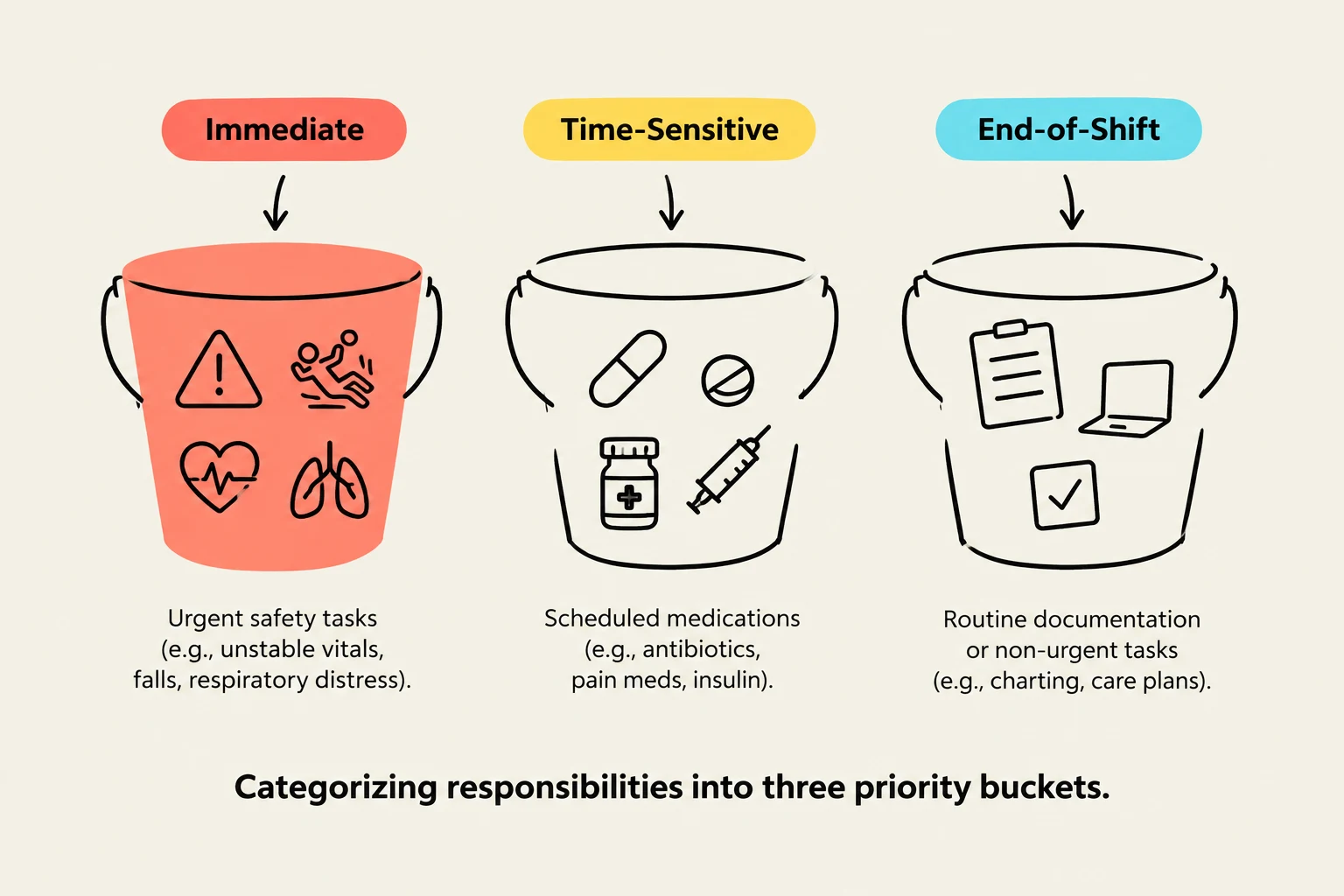
Categorizing responsibilities into three priority buckets: Immediate, Time-Sensitive, and End-of-Shift, with examples of tasks for each.
Effective planning involves looking at the "big picture". A nurse should be able to categorize their responsibilities into three distinct buckets:
Immediate: What must be done right now to ensure safety?
Time-Sensitive: What must be done by a specific time to comply with facility policy or ensure quality care (e.g., scheduled medications)?
End-of-Shift: What can wait until later in the day?
A key strategy for maintaining momentum is to complete one client care task before beginning the next, always starting with the highest priority task. This prevents the "management by crisis" style of nursing where tasks are left half-finished, leading to inefficiency and increased stress.
Delegation and Teamwork
Nurses cannot work in isolation. Part of effective time management is knowing when to delegate tasks to other competent members of the healthcare team. Failure to delegate is a common time waster that leads to feeling overwhelmed.
However, delegation must be done effectively. Nurses should be cognizant of the assistance needed by team members and offer help during unexpected crises or during their own "down time".
Managing Interruptions and Self-Care
Even the best plan can be derailed by interruptions. Common time wasters include telephone calls, unexpected meetings, ineffective communication, and an inability to say "no" to unreasonable demands.
To combat this, nurses should:
Organize the workspace: Reduce clutter to minimize distractions.
Prepare in advance: Know exactly what supplies are needed before entering a patient's room to avoid unnecessary trips to the supply closet.
Practice Self-Care: Time management includes scheduling time for physical and mental breaks and meals. Neglecting self-care leads to burnout and decreased productivity.
The Cyclic Process: Time Analysis
Time management is a continuous cycle. It begins with goal setting and planning, moves through execution and continual reassessment (re-prioritizing as patient conditions change), and ends with evaluation.
At the end of a shift, perform a time analysis. Ask yourself:
Was my time used wisely?
What were my biggest interruptions?
How did I handle them, and how did they interfere with my care?
By reviewing these patterns, you can develop a personal time inventory to eliminate unnecessary steps and improve your efficiency for the next shift.
Feature
Good Time Management
Poor Time Management
Productivity
High/Efficient
Impaired
Stress Levels
Decreased
Increased/Overwhelmed
Patient Care
High Quality/Satisfactory
Omission of important tasks
Keep reading for free.
Create an account to finish this reading and make it part of your study routine.