Nursing Pharmacology and Medication Management: A Systemic Approach
An overview of nursing pharmacology, focusing on understanding drug actions systemically rather than through rote memorization. Covers anticonvulsants, psychiatric medications, and anesthesia, emphasizing mechanisms, side effects, and critical nursing considerations.
Pharmacology is often perceived as a massive, overwhelming list of drugs to memorize. However, rather than viewing medications as isolated facts, successful nursing practice requires understanding them as an interconnected web of chemical interactions. When a drug is introduced, it doesn't just affect one target; it circulates systemically, affecting various organs and biological processes. To master this, you must move beyond rote memorization and focus on the "why" and "how" behind drug actions.
The Bedrock of Clinical Decision-Making: The ABCs
Before administering any medication, a nurse must prioritize the patient's stability using the ABCs: Airway, Breathing, and Circulation. This is the foundational rule of nursing. If a patient is unstable or heavily sedated, assessing and supporting the airway is the absolute first step. It does not matter if you have the perfect medication in hand if oxygen is not reaching the brain. This priority becomes even more critical when dealing with medications that depress the Central Nervous System (CNS) or affect vascular tone.
Anticonvulsants and Seizure Management
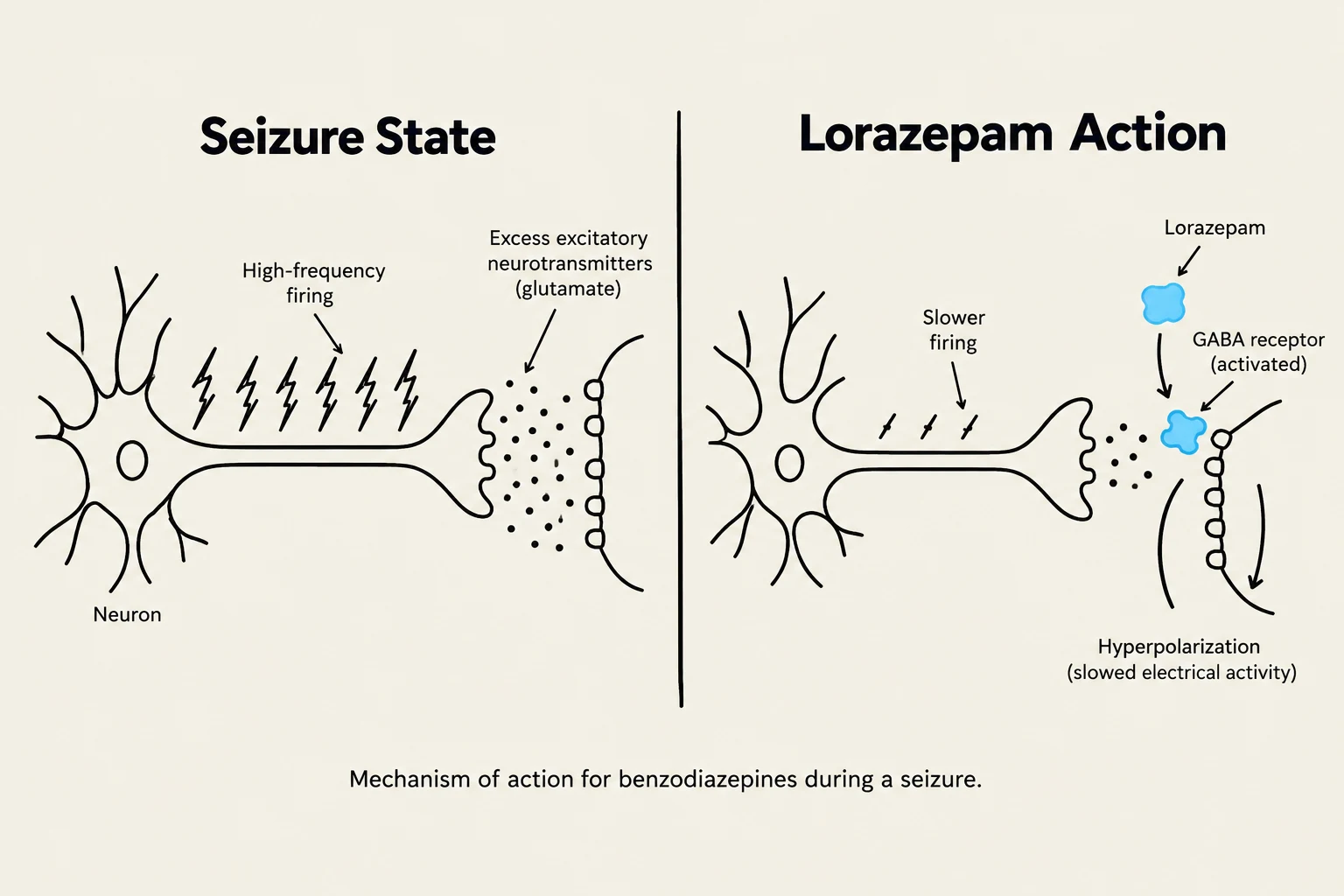
This diagram illustrates the mechanism of action for benzodiazepines during a seizure. The left side shows a neuron in a seizure state with high-frequency firing and excess excitatory neurotransmitters. The right side depicts Lorazepam's action, where it binds to GABA receptors, leading to hyperpolarization and slowed electrical activity.
Seizures represent a massive electrical overdrive in the brain, burning through oxygen and glucose at a terrifying rate.
Status Epilepticus: The Medical Emergency
Status epilepticus is defined by seizures lasting five minutes or longer, or repeated seizures without the patient regaining consciousness in between. This is a critical emergency. The first-line treatment is the administration of IV lorazepam (or diazepam if lorazepam is unavailable).
The mechanism of action involves the neurotransmitter GABA, which acts as the brain's natural "brake pedal". During a seizure, excitatory signals are "flooring the gas"; lorazepam binds to GABA receptors to amplify this inhibitory effect, hyperpolarizing neurons so they cannot fire as easily.
Maintenance Therapy: Phenytoin (Dilantin)
For daily seizure control, medications like phenytoin act as a "governor" on an engine, stabilizing sodium channels to raise the threshold required for a nerve to fire.
Therapeutic Level: The target range is 10–20 mcg/mL.
Administration Safety: Phenytoin is highly alkaline and unstable. It must be pushed slowly (never faster than 50 mg/min) and must be diluted with normal saline. Mixing it with other fluids can cause crystallization in the IV line, and if it escapes the vein, it can cause severe tissue necrosis.
Side Effects:
Gingival Hyperplasia: Patients often experience swollen, overgrowing gums due to altered collagen metabolism.
Enzyme Induction: Phenytoin increases hepatic enzymes, which causes the body to break down oral contraceptives faster, decreasing their effectiveness.
Critical Risks:
Rebound Seizures: Phenytoin is a lifetime medication; abrupt withdrawal can cause the seizure threshold to plummet, leading to status epilepticus.
Stevens-Johnson Syndrome (SJS): A life-threatening hypersensitivity reaction where the immune system attacks the skin cells, causing fever, a spreading rash, and mucosal blisters.
Carbamazepine (Tegretol)
Used for seizures and trigeminal neuralgia, carbamazepine carries a significant risk of bone marrow depression. Because its metabolites are toxic to hematopoietic stem cells, nurses must monitor Complete Blood Counts (CBC) to check for low white blood cells (infection risk) or low platelets (bleeding risk).
Psychiatric Medications
Lithium: The Salt Connection
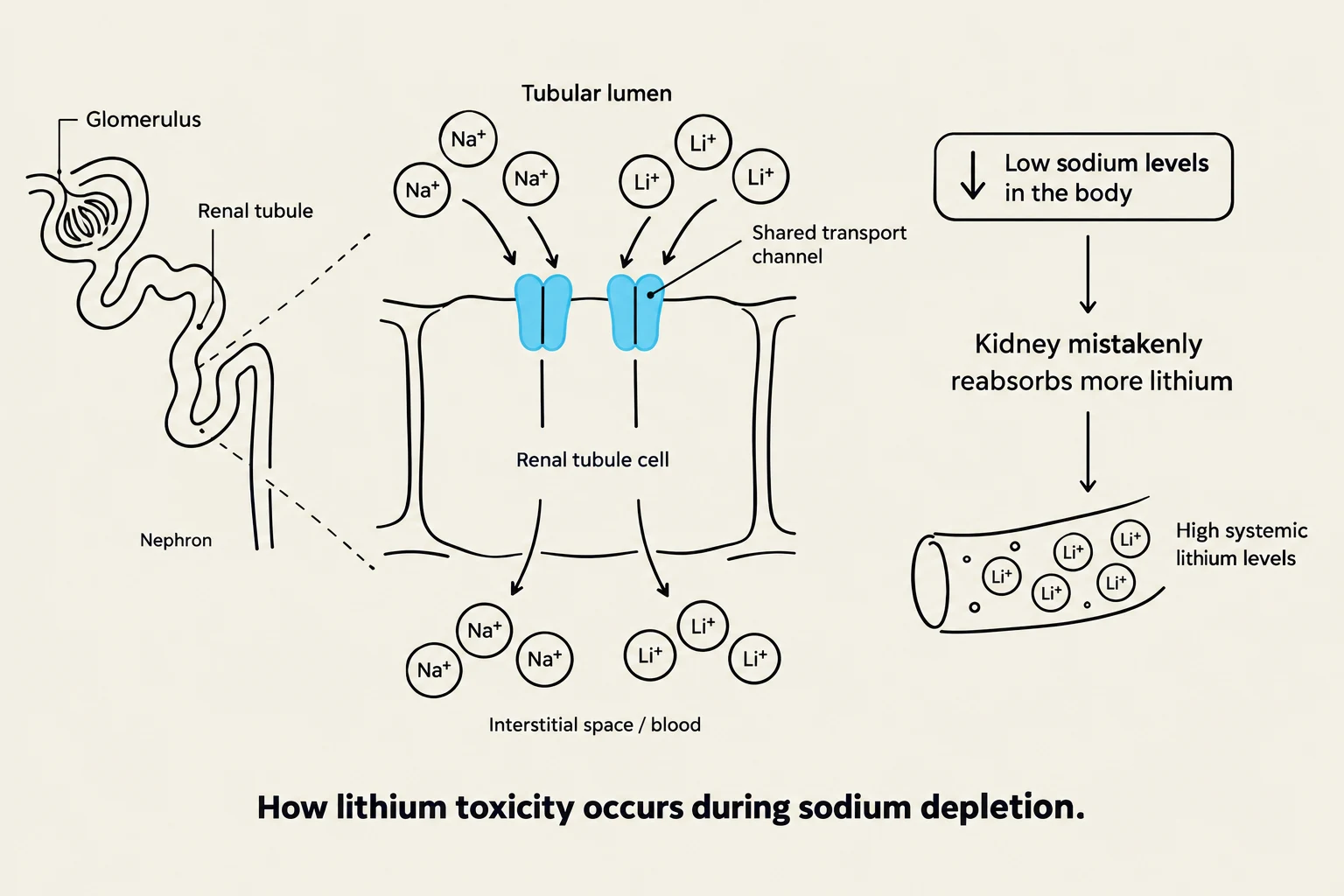
Diagram illustrating how lithium toxicity occurs during sodium depletion, showing the reabsorption of lithium by the kidney when sodium levels are low.
Lithium is the gold standard for treating bipolar disorder, but it is chemically a salt that behaves very similarly to sodium. This similarity creates a dangerous relationship with renal function:
The Mechanism of Toxicity: When a patient is dehydrated or has low sodium levels, the kidneys enter "survival mode" and attempt to reabsorb as much salt as possible. Because lithium looks like sodium, the kidneys mistakenly reabsorb lithium, causing levels to spike into the toxic range.
Symptoms of Toxicity: Persistent vomiting, coarse hand tremors, confusion, and slurred speech.
Nursing Education: Patients must maintain consistent sodium and fluid intake.
Long-term Risk: Chronic use can inhibit thyroid hormone release, leading to hypothyroidism.
Benzodiazepines (e.g., Alprazolam)
Benzodiazepines are CNS depressants used for anxiety.
Safety Warning: Never combine benzodiazepines with alcohol or opioids, as this compounds CNS depression and can stop the patient's breathing.
Reversal Agent:Flumazenil is the antidote, but it carries a massive risk: it can trigger severe withdrawal seizures by suddenly ripping the drug off the receptors, leaving the brain with no "braking system".
Antipsychotics (e.g., Olanzapine)
Antipsychotics work by blocking dopamine receptors to reduce hallucinations. However, blocking dopamine can lead to:
Anticholinergic Effects: Blocking the "rest and digest" system leads to the classic symptoms: "can't see" (blurred vision), "can't spit" (dry mouth), "can't poop" (constipation), and "can't pee" (urinary retention). Urinary retention is a major red flag that must be reported immediately.
Neuroleptic Malignant Syndrome (NMS): A rare, life-threatening reaction characterized by high fever, severe muscle rigidity, and autonomic instability.
Movement Disorders: Parkinson's vs. Multiple Sclerosis
Understanding the difference between these two is essential for pharmacology. Parkinson's is a chemical shortage of dopamine, whereas Multiple Sclerosis (MS) is a structural issue where the immune system destroys the myelin sheath.
Treating Parkinson's: Levodopa and Carbidopa
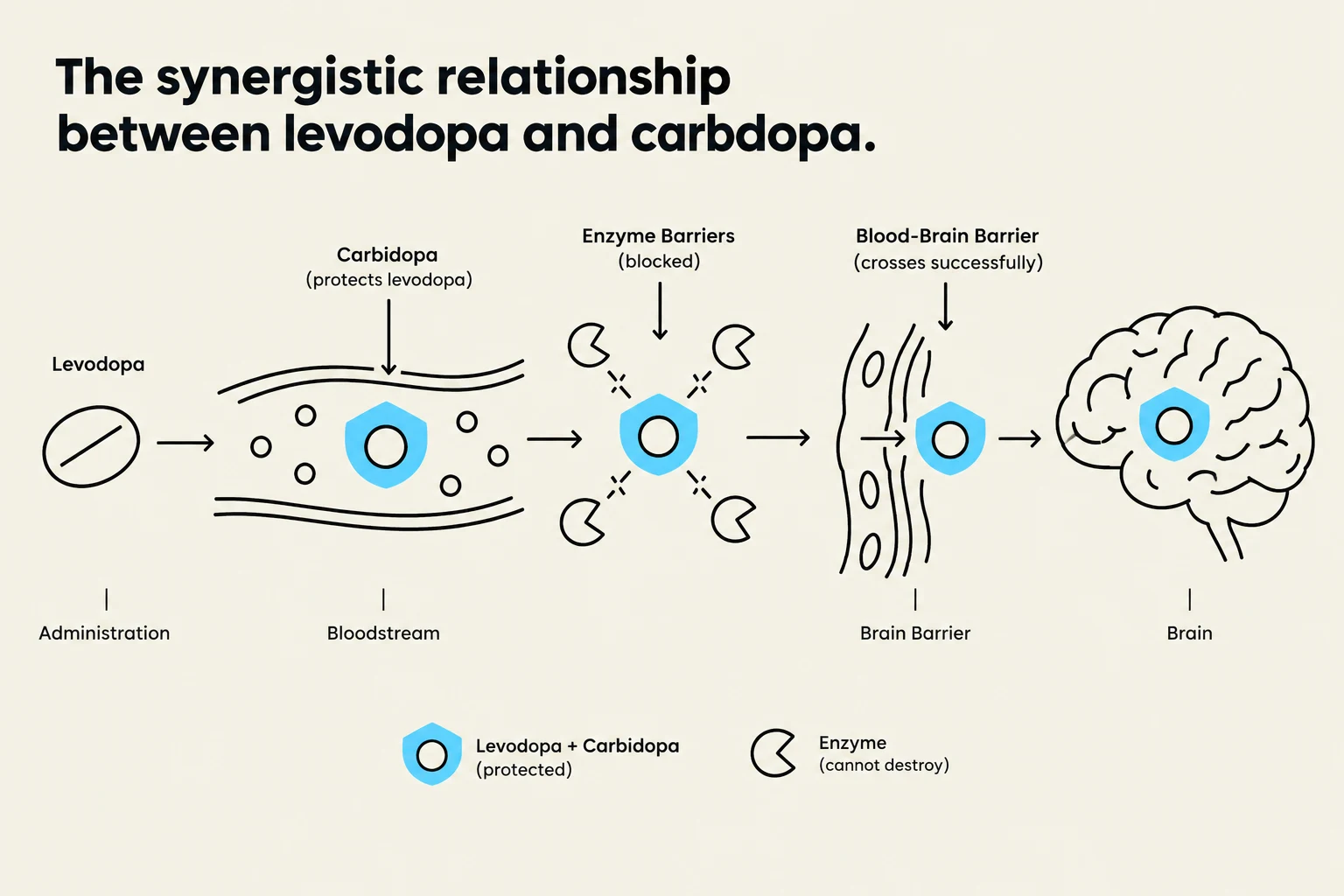
This diagram illustrates the synergistic relationship between levodopa and carbidopa, showing how carbidopa protects levodopa from enzyme barriers and allows it to cross the blood-brain barrier to reach the brain.
The primary treatment is a combination of levodopa (the precursor to dopamine) and carbidopa (the "bodyguard").
The Logic: Levodopa is the "VIP guest" that needs to enter the brain, but enzymes in the bloodstream destroy it before it arrives. Carbidopa prevents this breakdown in the periphery, ensuring the levodopa reaches the brain.
Dietary Restriction: Patients should avoid high-protein meals when taking this medication. Amino acids from protein use the same "doors" (carrier proteins) as levodopa; if the system is flooded with protein, the levodopa cannot be absorbed.
Localized Pressure and Anesthesia
Migraines and Glaucoma
Sumatriptan (Imitrex): An abortive migraine therapy that constricts dilated cranial blood vessels. It is contraindicated in patients with heart disease because it can constrict coronary arteries. It is also teratogenic, as it can constrict uterine arteries and compromise fetal blood flow.
Timolol (Glaucoma): A non-selective beta-blocker used in eye drops.
Nursing Alert: After administering Timolol, you must apply pressure to the inner corner of the eye (the lacrimal punctum) for 30–60 seconds. Failure to do so allows the drug to drain into the nasal mucosa and enter the bloodstream, potentially causing bradycardia or bronchospasm in asthma patients.
Anesthesia Types
Type
Mechanism/Effect
Critical Nursing Consideration
General
Complete loss of consciousness and reflexes
Mandatory mechanical ventilation (loss of gag/breath drive)
Local
Blocks sodium channels in a specific nerve
Watch for systemic toxicity (metallic taste, tinnitus)
Conscious Sedation
Deep relaxation/amnesia
Patient must still be able to maintain their own airway
Spinal
Numbing of the lower body via subarachnoid injection
Monitor for rapid vasodilation and hypotension (shock risk)
Clinical Pearl: In spinal anesthesia, blood pressure can crash because the anesthetic paralyzes the sympathetic nerve fibers responsible for maintaining vascular tone. This causes blood to pool in the legs and abdomen, reducing the amount of blood returning to the heart.
Keep reading for free.
Create an account to finish this reading and make it part of your study routine.