This content provides a comprehensive overview of spinal cord injuries (SCI), including anatomy, mechanisms of injury, types of shock (spinal and neurogenic), emergency and surgical management, clinical manifestations based on injury level, incomplete SCI syndromes, and the critical complication of autonomic hyperrefle
Spinal cord injuries (SCI) represent some of the most complex challenges in neurological nursing. Because the spinal cord serves as the primary conduit for signals traveling between the brain and the body, any disruption to its integrity can result in profound physical, psychological, and autonomic consequences. Effective nursing management requires a deep understanding of anatomy, the distinction between different types of shock, and the ability to recognize life-threatening emergencies like autonomic hyperreflexia.
Spinal Cord Anatomy and Back Pain
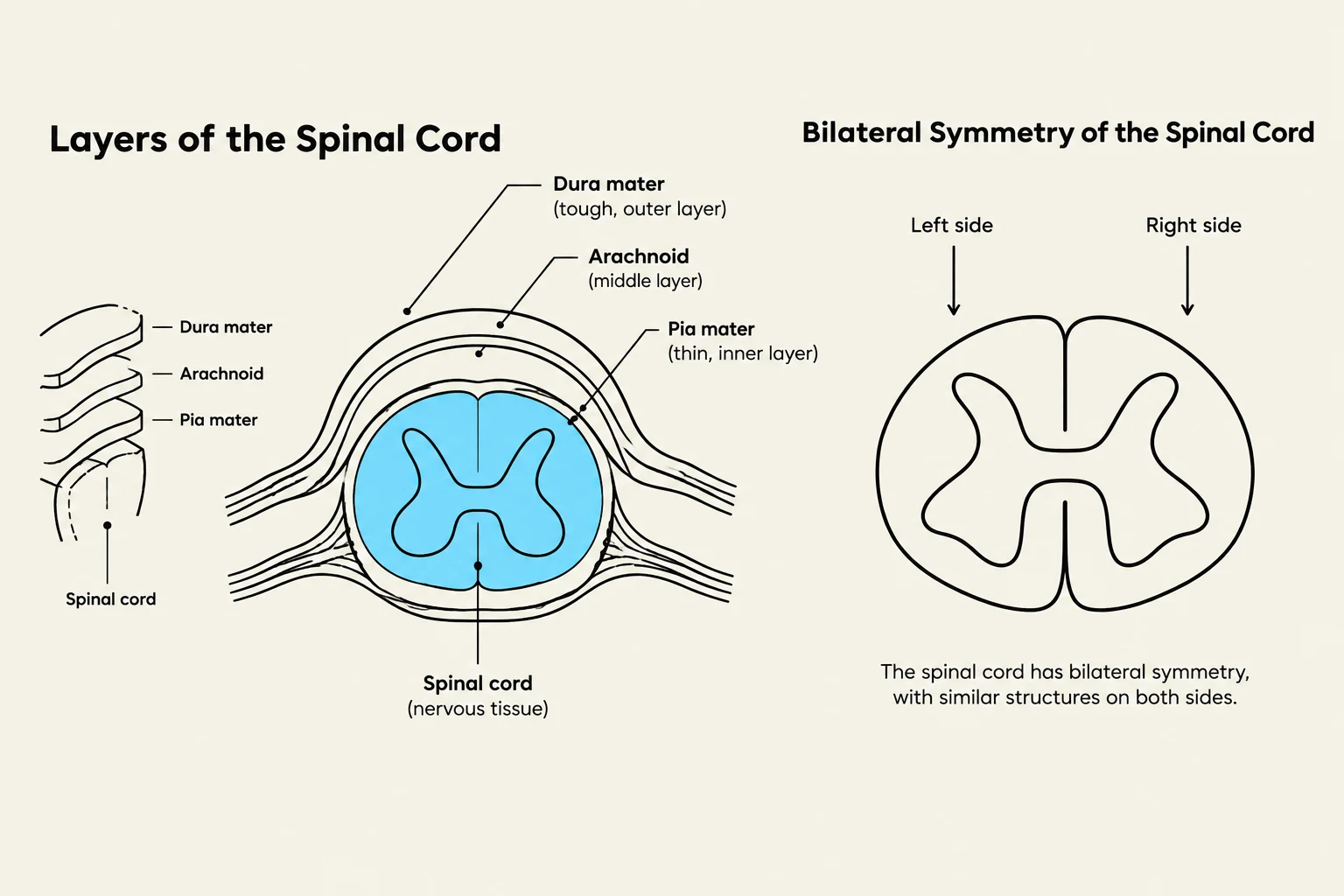
The spinal cord is protected by a series of layers known by the mnemonic "PAD": the Pia mater (closest to the cord), the Arachnoid mater, and the Dura mater. Within the cord, neural tracts mirror each other from left to right, facilitating bilateral communication.
It is important to distinguish between general back pain and spinal cord injury. Back pain is a common neurological ailment and a leading cause of disability worldwide. It is categorized as acute (less than 6 weeks) or chronic (more than 12 weeks). While many cases are caused by degenerative processes like osteoarthritis or disc herniation, others stem from trauma.
Clinical Note: Approximately 10% of patients presenting with back pain will eventually require surgical intervention, such as a microdiscectomy or spinal fusion, to relieve nerve root pressure.
Diagrams illustrating the layers of the spinal cord and its bilateral symmetry.
Mechanisms of Spinal Cord Injury
SCI is most commonly caused by traumatic events. The leading mechanisms include motor vehicle collisions (38%), falls from heights (31%), violence (14%), and sports-related injuries (9%).
When an injury occurs, the damage happens in two distinct phases:
Primary Injury: The immediate physical trauma, such as blunt force or a penetrating object, which can cause bone displacement or the tearing of blood vessels.
Secondary Injury: This occurs within minutes of the primary trauma and involves ongoing cellular death, hemorrhage leading to infarction, vasospasms, and edema.
Spinal Shock vs. Neurogenic Shock
One of the most critical tasks for a nurse is distinguishing between these two types of shock, as their management and implications differ significantly.
Feature
Spinal Shock
Neurogenic Shock
Mechanism
Loss of reflex activity below injury
Loss of Sympathetic Nervous System (SNS) innervation
Key Signs
Flaccid paralysis, loss of deep reflexes, loss of sphincter tone
Bradycardia, Hypotension, temperature dysregulation
Timeline
Can last weeks to months
Life-threatening; risk is highest in the first hour
Clinical Note
Resolved when reflexes return
Often associated with injuries at T6 or higher
Emergency and Surgical Management
In the acute phase of SCI, emergency care focuses on stabilization and preventing further secondary injury.
Emergency Nursing Priorities:
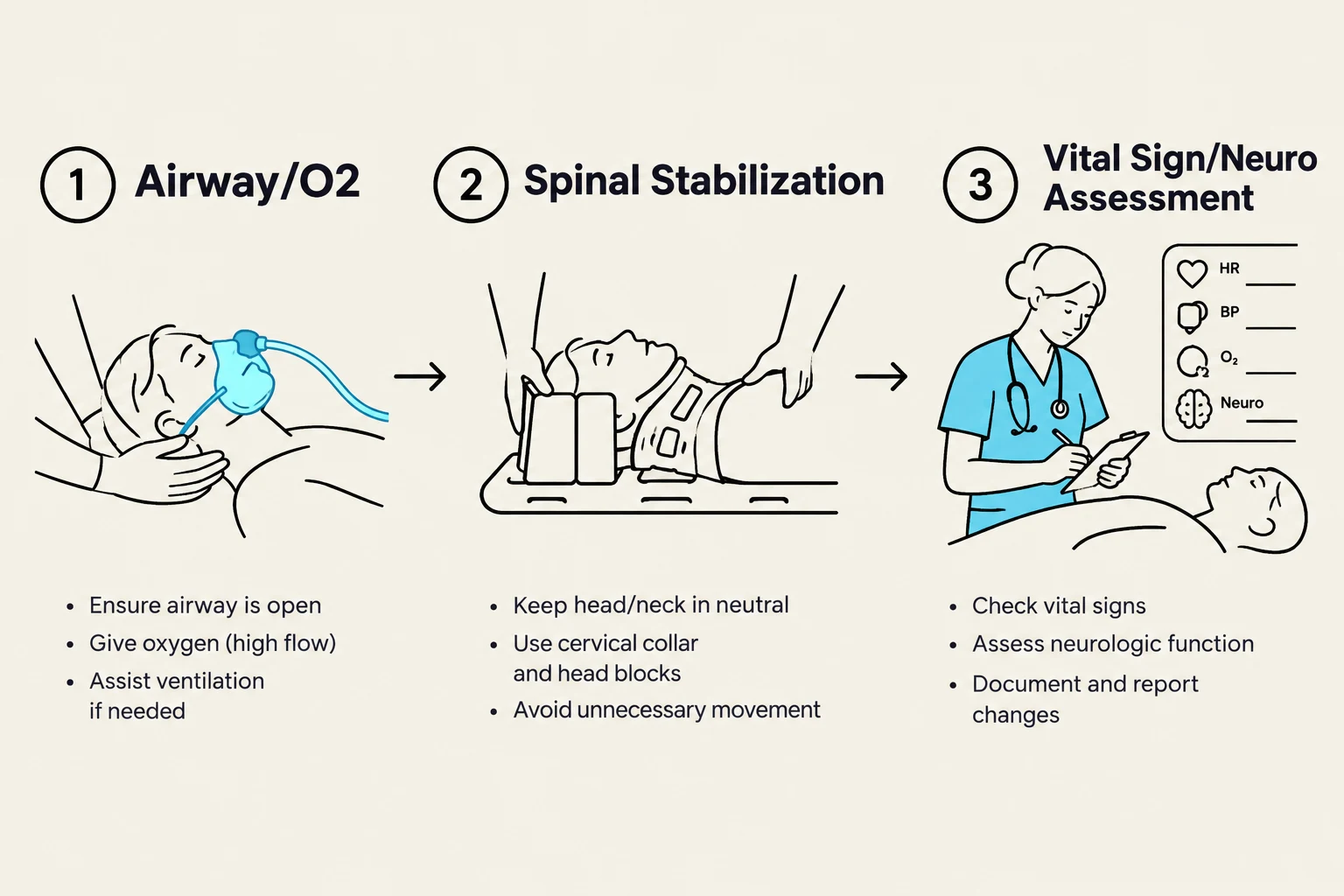
Airway/Breathing: Maintain a patent airway and provide oxygen. For injuries above C4, respiratory failure is a major risk.
Circulation: Monitor vital signs closely. Administer isotonic fluids and potentially vasopressors (to keep systolic BP >90) or atropine for bradycardia.
Stabilization: Maintain spinal alignment and use CT scans to diagnose the level of injury.
Elimination: Insert a Foley catheter (monitor for 30 mL/hr output) and potentially an NG tube to manage paralytic ileus.
If surgical intervention is required, the primary goals are to relieve pressure on the cord and stabilize the spine. Common procedures include laminectomies, spinal fusions, or the use of Harrington rods.
This illustration outlines the initial steps in emergency medical care, focusing on airway management, spinal stabilization, and vital sign assessment.
Clinical Manifestations and Injury Levels
The level of injury dictates the functional outcome. For example, C1–C3 injuries are often fatal without intervention, while C4 injuries result in tetraplegia (quadriplegia). Thoracic injuries typically result in paraplegia, whereas lumbar injuries may still allow for some ambulation.
Systemic Manifestations
Respiratory: Diaphragmatic impairment can lead to a poor cough and atelectasis.
Gastrointestinal: Patients are at risk for paralytic ileus and neurogenic bowel.
Integumentary: High risk for pressure ulcers; patients must be repositioned every 2 hours (or every 15 minutes if in a wheelchair).
Genitourinary: Urinary retention and the need for a bladder program or intermittent catheterization.
Incomplete Spinal Cord Injury Syndromes
Unlike a complete injury, where all motor and sensory function is lost below the level of injury, incomplete injuries present specific patterns of deficit:
Anterior Cord Syndrome: Damage to the anterior spinal artery; results in motor paralysis and loss of pain/temperature sensation, but touch and vibration remain intact.
Brown-Séquard Syndrome: Damage to half of the cord; results in ipsilateral (same side) motor loss and contralateral (opposite side) loss of pain/temperature.
Central Cord Syndrome: Most common in the cervical region; causes motor weakness primarily in the upper extremities.
Conus Medullaris/Cauda Equina Syndrome: Damage to the lower sacral/lumbar roots; results in asymmetric weakness, saddle anesthesia, and areflexic bowel/bladder.
Autonomic Hyperreflexia: A Medical Emergency
For patients with injuries at or above T6, Autonomic Hyperreflexia is a critical complication that requires immediate recognition. It is caused by an exaggerated sympathetic response to a noxious stimulus below the level of injury, such as a distended bladder (e.g., a blocked catheter) or constipation.
Signs to watch for:
Severe hypertension (the most common sign)
Bradycardia
Severe headache
Diaphoresis (sweating)
Nursing Alert: If a patient with SCI complains of a sudden, severe headache, check their blood pressure immediately! This could be the first sign of autonomic hyperreflexia.
Immediate Interventions:
Sit the patient up (raise the Head of Bed) to help lower blood pressure.
Assess for and remove the trigger (e.g., empty the bladder or relieve constipation).
Notify the healthcare provider for administration of anti-hypertensives.
Failure to treat this condition can lead to life-threatening complications, including myocardial infarction (MI), seizures, or cerebral hemorrhage.
Nursing Management and Rehabilitation
The ultimate goal of nursing care is to return the client to the highest possible degree of self-sufficiency. This requires a multidisciplinary rehabilitation approach involving physical therapy (PT), occupational therapy (OT), and psychological support.
Key Nursing Focus Areas:
Skin Integrity: Monitor pre-albumin levels and use specialized cushions to prevent neurogenic skin breakdown.
Elimination: Implement strict neurogenic bowel and bladder programs, including intermittent catheterization and pre/post-void residual checks.
Psychosocial Support: Address grief and depression, which are common following the life-altering nature of SCI.
Sexual Health: Provide education; notably, 95% of males can still produce sperm for fertility despite SCI.
Keep reading for free.
Create an account to finish this reading and make it part of your study routine.