This content provides a comprehensive overview of spinal cord injuries (SCI), including their epidemiology, etiology, pathophysiology (primary vs. secondary injury), clinical presentation and classification, and essential nursing management strategies. It details immediate priorities like immobilization and airway mana
Spinal Cord Injury (SCI) is a critical medical condition characterized by the disruption of nerve axons within the spinal cord, resulting in the loss of motor and sensory functions below the level of the injury. While primary injuries caused by major trauma are often irreversible, the condition leads to significant long-term morbidity and permanent disability. Understanding the etiology, pathophysiology, and the complex nursing priorities required for management is essential for improving patient outcomes and preventing secondary complications.
Epidemiology and Etiology
In the United States, SCI is a major public health concern, with approximately 17,000 new cases occurring annually and roughly 282,000 individuals living with the condition. The demographic at highest risk includes males aged 16 to 30 years.
The etiology of SCI can be categorized into several common causes:
Motor Vehicle Collisions (38%): The leading cause, involving cars, motorcycles, pedestrians, and passengers.
Falls (31%): A significant cause, particularly among older populations due to age-related bone fragility.
Violence (14%): Primarily gunshot wounds, but also includes stabbings and blunt force trauma.
Sports Injuries (9%): Activities such as skiing, football, gymnastics, and diving.
Diving Accidents (4%): Impacting the surface of a pool or body of water from high altitudes can lead to a broken neck and spinal cord compression.
Other (5%): Includes medical and surgical etiologies.
Pathophysiology: Primary vs. Secondary Injury
The damage to the spinal cord occurs in two distinct phases: the primary injury and the secondary injury.
Primary Injury
The primary injury is the initial mechanical disruption of axons caused by stretch, laceration, or direct impact. Common mechanisms include compression from fractured vertebrae, contusion, or distraction (a stretch and tear of the spinal cord in its axial plane).
Secondary Injury
Secondary injury refers to a series of biological phenomena that begin within minutes and can continue for weeks or months following the initial insult.
Acute Phase: Involves vascular damage, ionic imbalances, free-radical formation, the initial inflammatory response, and neurotransmitter accumulation.
Subacute Phase: Includes demyelination of surviving axons, Wallerian degeneration, matrix remodeling, and the formation of a glial scar.
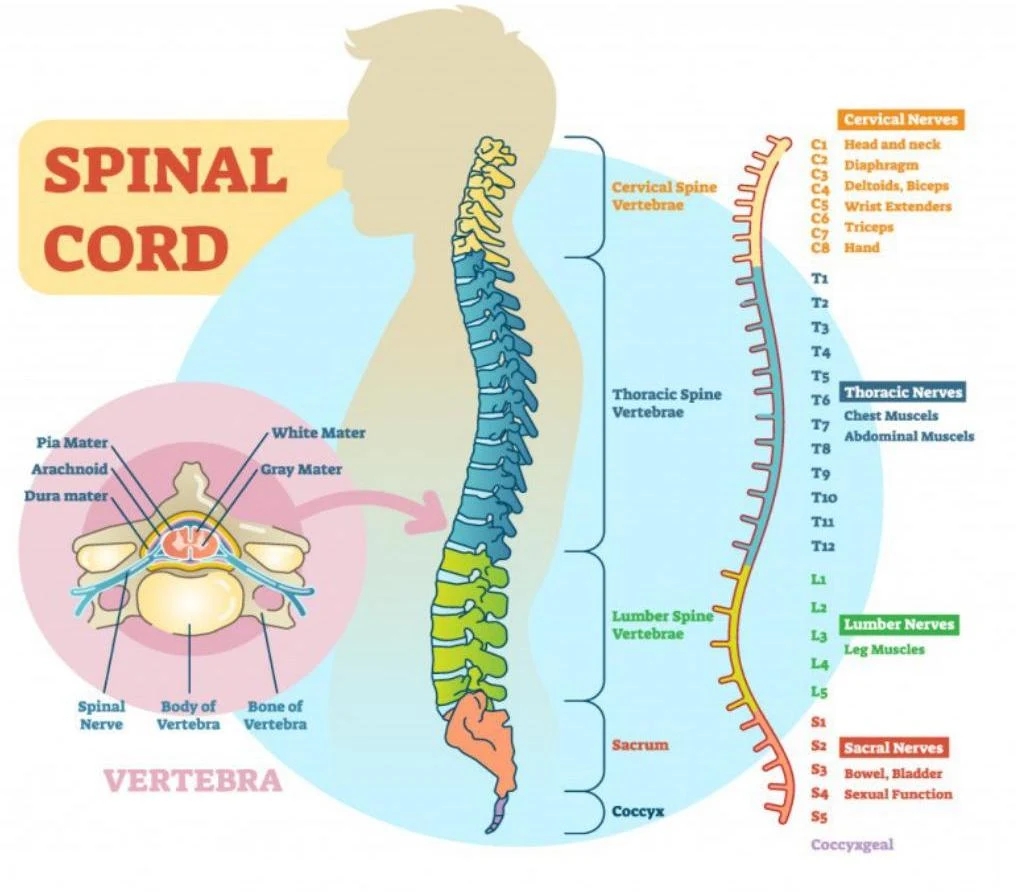
This illustration details the anatomy of the human spinal cord, including its vertebral segments, associated nerves, and cross-sectional structures like the pia mater, arachnoid, dura mater, white matter, and gray matter.
Clinical Presentation and Classification
The clinical manifestation of SCI depends heavily on the level and severity of the injury.
Degree of Injury
Complete SCI: A total loss of motor and sensory function below the level of injury.
Incomplete SCI: Preserved motor and/or sensory function below the level of injury, often referred to as "sacral sparing".
Level of Injury and Functional Deficits
The higher the injury in the spinal column, the greater the loss of function.
Level
Classification
Clinical Manifestations
C1–C4
Tetraplegia
Paralysis of all four limbs and the trunk. Patients may require mechanical ventilation due to impaired diaphragm function.
C5–C8
Tetraplegia
Loss of hand and trunk function, but may retain some arm movement (e.g., elbow extension at C5).
T1–T12
Paraplegia
Paralysis of the legs and trunk; arms are preserved.
L1–S5
Paraplegia
Paralysis of the lower extremities and loss of bowel/bladder control.
Exam Tip: When assessing a patient with a cervical injury (e.g., C5), always prioritize respiratory assessment. Impairment of the diaphragm or intercostal muscles can lead to rapid respiratory failure.
Specific Syndromes
Incomplete injuries may present as specific clinical syndromes:
Anterior Cord Syndrome: Often from vascular events; results in loss of motor function and pain/temperature sensation, but preserves vibration and proprioception.
Posterior Cord Syndrome: Results in loss of vibration, proprioception, and light touch, while motor function is preserved.
Brown-Sequard Syndrome: A hemicord lesion (often from penetrating injury) causing ipsilateral loss of motor function and contralateral loss of pain/temperature.
Nursing Management
Nursing management in the acute phase focuses on stabilization and preventing further neurological damage.
Immediate Nursing Priorities
Immobilization: Maintain strict neck and spinal alignment using devices such as tongs and traction, or a halo vest, to prevent further mechanical damage.
Airway Management: Monitor respiratory effort closely. Patients with high cervical injuries may require intubation and mechanical ventilation.
Hemodynamic Monitoring: Monitor for neurogenic shock, characterized by hypotension (e.g., $BP\ 85/50\ mmHg$) and bradycardia. It is critical to maintain a mean arterial pressure (MAP) >85mmHg during the first 7 days post-injury.
Neurological Assessment: Perform frequent assessments using the ASIA (American Spinal Injury Association) Impairment Scale to track the progression or resolution of the injury.
Comprehensive Care Strategies
Nursing care must be multidisciplinary, addressing multiple body systems to prevent complications like pressure sores, UTIs, and DVT.
Body System
Potential Problem
Nursing Interventions
Respiratory
Insufficiency/Failure
Monitor for fatigue; provide pulmonary toileting (suctioning, coughing).
Cardiovascular
Autonomic Dysreflexia (AD)
Monitor for sudden BP spikes, headache, and flushing; manage symptoms.
Dermatologic
Skin Breakdown
Reposition every 2 hours; use pressure-relieving devices (e.g., egg-crate mattresses).
Genitourinary
Urinary Retention
Implement catheterization protocols as ordered.
Musculoskeletal
Contractures
Provide frequent range-of-motion (ROM) exercises; administer antispasmodics.
Clinical Alert: Autonomic Dysreflexia (AD)
AD is a life-threatening emergency occurring in patients with SCI at or above the thoracic level. It is characterized by a sudden, severe increase in blood pressure, often triggered by noxious stimuli like a full bladder or constipation.
Psychological Support
Because SCI is often sudden and life-altering, patients frequently experience anxiety, depression, and frustration. Nurses should encourage the use of relaxation techniques, facilitate connections to support groups, and collaborate with psychiatrists to manage emotional adjustment.
Keep reading for free.
Create an account to finish this reading and make it part of your study routine.