Managing Client Care and Delegation
Nurses must balance accountability with the need to manage workloads through delegation. While you may delegate tasks, you remain accountable for the overall nursing judgment and the supervision of those tasks.
When delegating to assistive personnel (AP), you must adhere to the Five Rights of Delegation:
- Right Task: Is the task permitted for this staff member?
- Right Circumstance: Is the client stable enough for this task?
- Right Person: Does the delegatee have the training and competence?
- Right Direction/Communication: Did you provide clear instructions and expected findings?
- Right Supervision/Evaluation: Are you monitoring the task and reviewing the results?
Exam Tip: You cannot delegate initial assessments, nursing diagnoses, clinical judgment, care planning, or initial patient teaching to unlicensed assistive personnel.
Effective time management involves identifying immediate threats and clustering compatible tasks to increase efficiency. However, safety always takes priority over completing a routine checklist.
Priority-Setting Frameworks
In a clinical setting, you will often face multiple competing needs. Use these frameworks to decide which client or intervention requires your attention first:
The ABCDE Approach
This is a rapid method for identifying life-threatening issues:
- A (Airway): Is the airway patent? (e.g., checking for obstruction or stridor).
- B (Breathing): Assess respiratory rate, effort, and oxygen saturation.
- C (Circulation): Check pulse, blood pressure, and signs of bleeding or shock.
- D (Disability): Assess neurological status and level of consciousness.
- E (Exposure): Inspect for injury, rash, or bleeding while maintaining dignity.
Maslow’s Hierarchy of Needs
When multiple non-emergency needs exist, prioritize based on Maslow's levels:
- Physiologic: Oxygen, fluids, nutrition, and elimination.
- Safety/Security: Fall prevention and infection control.
- Love/Belonging: Social connections and family support.
- Esteem/Self-Actualization: Dignity and personal growth.
Clinical Judgment and the Nursing Process
Clinical judgment is the reasoned conclusion a nurse reaches by combining knowledge and assessment data. This process is organized through ADPIE:
- Assessment: Collecting subjective data (what the client says) and objective data (what you observe/measure).
- Diagnosis/Analysis: Identifying the client's problem (e.g., Acute Pain or Risk for Infection).
- Planning: Setting SMART goals (Specific, Measurable, Achievable, Relevant, and Time-bound).
- Implementation: Carrying out interventions, which can be Independent (nursing-led), Dependent (requires a provider's order), or Collaborative (working with PT or Dietitians).
- Evaluation: Comparing the client's response to the goal and deciding if the plan needs modification.
Exam Tip: If a question asks for the "first action" and there is no immediate life-threatening emergency, the answer is often Assessment.
Common Nursing Problems and Cues
Understanding specific nursing diagnoses and their associated cues is vital for exam success:
| Nursing Problem | Key Assessment Cues | Common Interventions |
|---|
| Ineffective Breathing Pattern | Rapid/shallow respirations, accessory muscle use | Position upright, monitor O2 saturation, escalate distress |
| Impaired Skin Integrity | Redness, warmth, purulent drainage, pressure points | Use Braden Scale to assess risk, reposition, aseptic wound care |
| Acute Pain | Client self-report (primary measure), guarding, facial expressions | Administer analgesics, reassess after intervention |
| Risk for Infection | Fever, elevated WBC, purulent drainage, tachycardia | Monitor vitals, maintain asepsis, report abnormal findings |
Case Study Application: Postoperative Hip Fracture
Consider a 75-year-old client four days post-hip surgery with a temperature of 103°F, a WBC of 14,500, and purulent wound drainage.
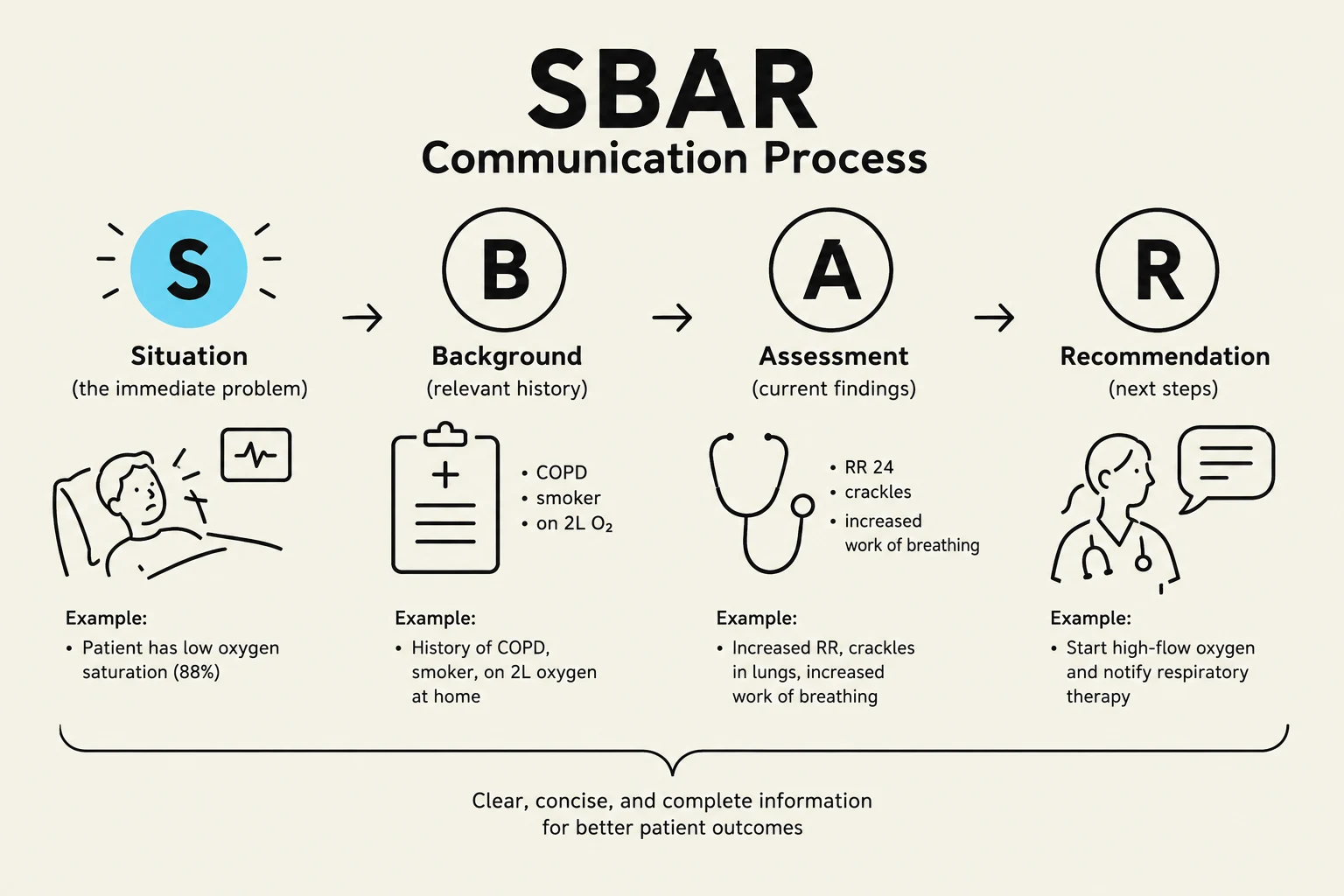
While the client also has pain (5/10) and impaired mobility, the highest priority is the potential for systemic infection or deterioration. Using the ABCDE and priority-setting frameworks, the nurse must prioritize the fever and purulent drainage as an urgent threat, necessitating immediate assessment and provider notification via SBAR.