Nursing Documentation and Confidentiality Standards
This article explores the essential principles of accurate nursing documentation and the rigorous professional standards required to maintain patient confidentiality, covering the nursing process, purposes of medical records, criteria for high-quality documentation, professional standards, and legal obligations.
In the fast-paced environment of healthcare, information is the most critical tool for ensuring patient safety. Nursing documentation is not merely a clerical task; it is a fundamental method of communicating patient information among intra- and inter-professional healthcare providers. When documentation is poor, care can become disjointed, disorganized, and potentially unsafe. This article explores the essential principles of accurate documentation and the rigorous professional standards required to maintain patient confidentiality.
The Foundation: The Nursing Process
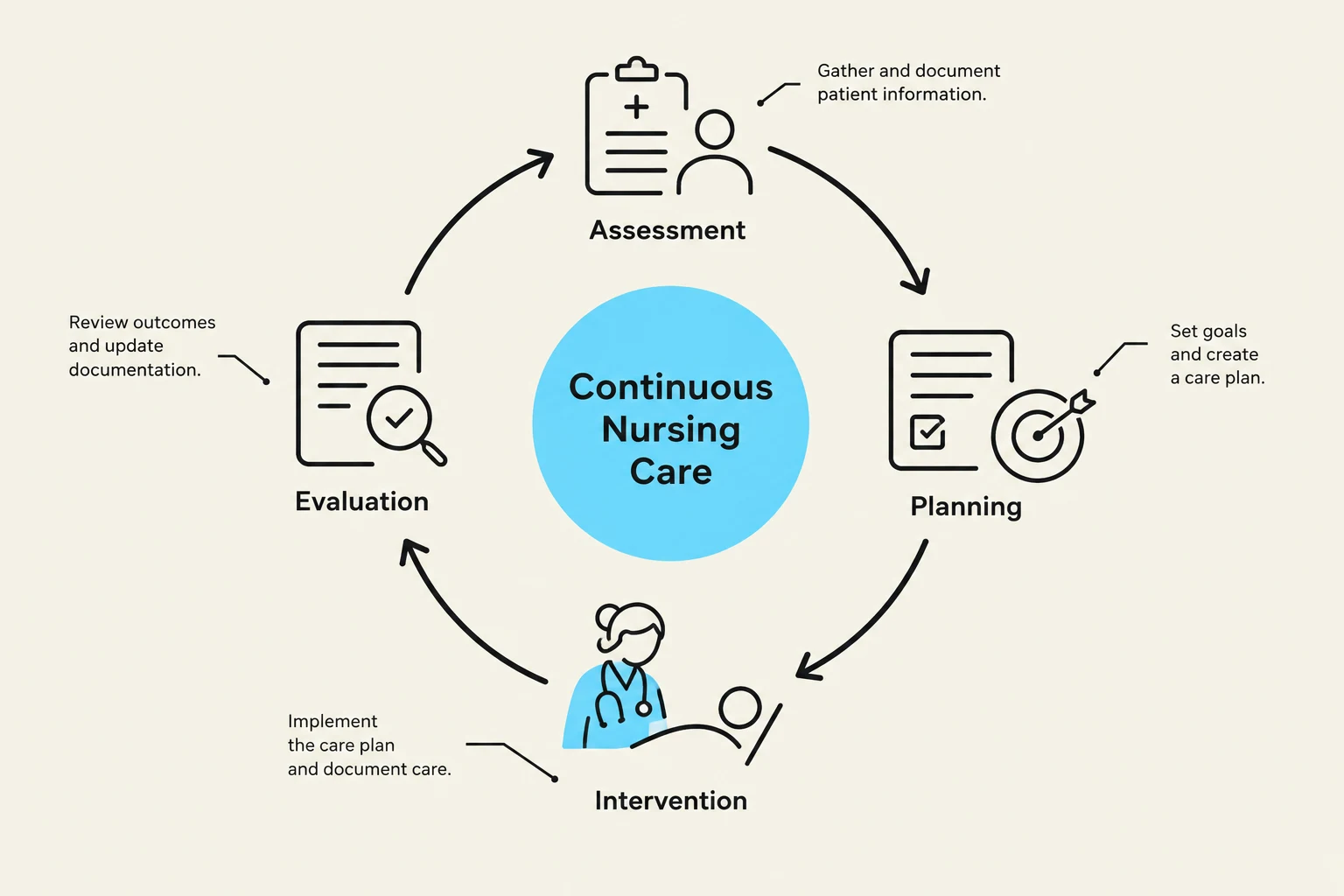
This diagram illustrates the continuous nursing care process, which includes assessment, planning, intervention, and evaluation.
Documentation is deeply integrated with the nursing process. Rather than just recording events, nurses use a critical thinking approach to ensure that care is organized, continuous, and safe. A complete nursing record should reflect the full cycle of care: assessment, planning, intervention, and evaluation.
By documenting within the context of the nursing process, nurses provide evidence of patient and family teaching, which is a requirement for high-quality care. This systematic approach ensures that the care plan remains clear, current, relevant, and individualized to meet the specific needs and wishes of the client.
The Six Purposes of Medical Records
Medical records serve much more than a single function. They are multifaceted tools used for:
Communication and care planning: Ensuring all providers are on the same page.
Legal documentation: Serving as a permanent, confidential legal record of care.
Funding and resource management: Supporting the administrative needs of healthcare institutions.
Auditing and monitoring: Allowing for the review of care quality.
Research: Providing data for evidence-based practice.
Education: Serving as a learning tool for students and professionals.
Criteria for High-Quality Documentation
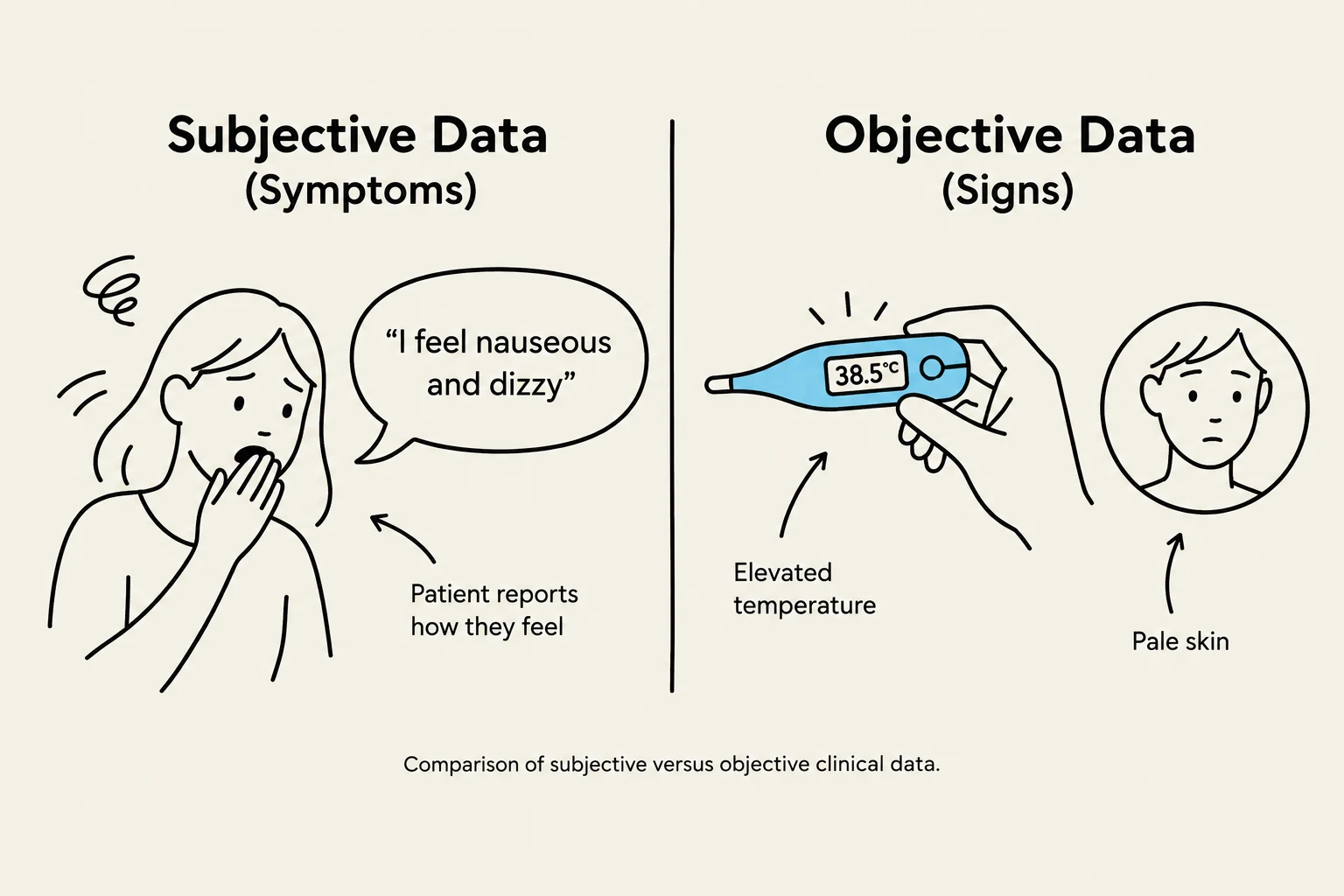
Comparison of subjective versus objective clinical data.
To minimize the risk of errors or patient harm, all entries must adhere to seven essential criteria:
Legible: Readable by all healthcare members (crucial for handwritten notes).
Reliable: Accurate and trustworthy.
Precise: Using correct spelling and proper units of measurement.
Complete: Comprehensive enough to track client outcomes.
Consistent: Uniform throughout the entire record.
Clear: Effective and unambiguous.
Timely: Recorded promptly to reflect the current status of the patient.
Exam Tip: Subjective vs. Objective Data
When documenting, distinguish between what the patient tells you and what you observe.
Subjective Data (Symptoms): What the patient feels or perceives (e.g., "I have pain").
Objective Data (Signs): What you can see, feel, or measure (e.g., a visible bruise or a blood pressure reading).
Professional Standards and Principles
According to the College of Nurses of Ontario (CNO), nursing documentation is governed by three core principles:
1. Communication
Nurses must provide an accurate, clear, and comprehensive picture of the client’s needs, the specific interventions performed, and the resulting client outcomes. This includes interdisciplinary communication through patient records, oral reports, and consultations.
2. Accountability
Nurses hold professional responsibility for ensuring that all documentation is accurate, complete, and recorded in a timely manner. Failing to record pertinent information—such as medication administration, drug reactions, or changes in patient condition—can lead to malpractice.
3. Security
Nurses are mandated to safeguard client health information. This involves maintaining strict confidentiality and adhering to institutional policies regarding information retention and destruction.
Confidentiality and Legal Obligations
Confidentiality is a cornerstone of the nursing profession. It is guided by professional standards and legislation, such as the Personal Health Information Protection Act (PHIPA), which outlines rules for the collection, use, and disclosure of personal health information.
Nurses are legally and ethically obligated to protect records from unauthorized readers. However, there are specific instances where a nurse is legally obligated to break confidentiality:
To provide necessary health care when consent cannot be obtained quickly.
To contact a relative or friend of an incapacitated or ill client for consent.
To confirm a client's location or general health status (unless the client has expressly requested otherwise).
To eliminate or reduce a significant risk of harm to a person.
Social Media Responsibility
In the modern era, professional responsibility extends to the digital world. Nurses must exercise extreme caution regarding the use of social media to ensure they do not violate patient privacy or professional standards.
Clinical Practice Tip: Avoiding Malpractice
To protect your professional license, avoid these common documentation mistakes:
Recording on the wrong chart.
Failing to document a discontinued medication.
Pre-charting (documenting care before it has actually happened).
Using unapproved abbreviations or jargon.
Documentation Methods and Tools
Nurses use various methods to organize information, including:
Narrative Notes: A chronological story of the patient's status.
SOAP: Subjective, Objective, Assessment, Plan.
SBAR: Situation, Background, Assessment, Recommendation (often used for communication between providers).
PIE: Problem, Intervention, Evaluation.
The transition to Electronic Health Records (EHR) has improved patient-centered care by providing timely access to data and improving interdisciplinary communication. However, EHRs require heightened security measures, such as automatic sign-offs, firewalls, and strict password management, to protect patient privacy.
Keep reading for free.
Create an account to finish this reading and make it part of your study routine.