Nucleotides, Nucleic Acids, and Genetic Information
Explores the fundamental building blocks of life: nucleotides and nucleic acids. Covers DNA and RNA structure, stability, denaturation, and the central dogma of molecular biology, including replication, transcription, and translation.
The blueprint of life is written in the language of nucleic acids. These complex macromolecules are responsible for storing, transmitting, and expressing the genetic information that directs every biological process. To understand how a single cell can replicate itself or how a protein is synthesized, we must first look at the chemical building blocks that make up these molecules: the nucleotides.
The Building Blocks: Nucleosides and Nucleotides
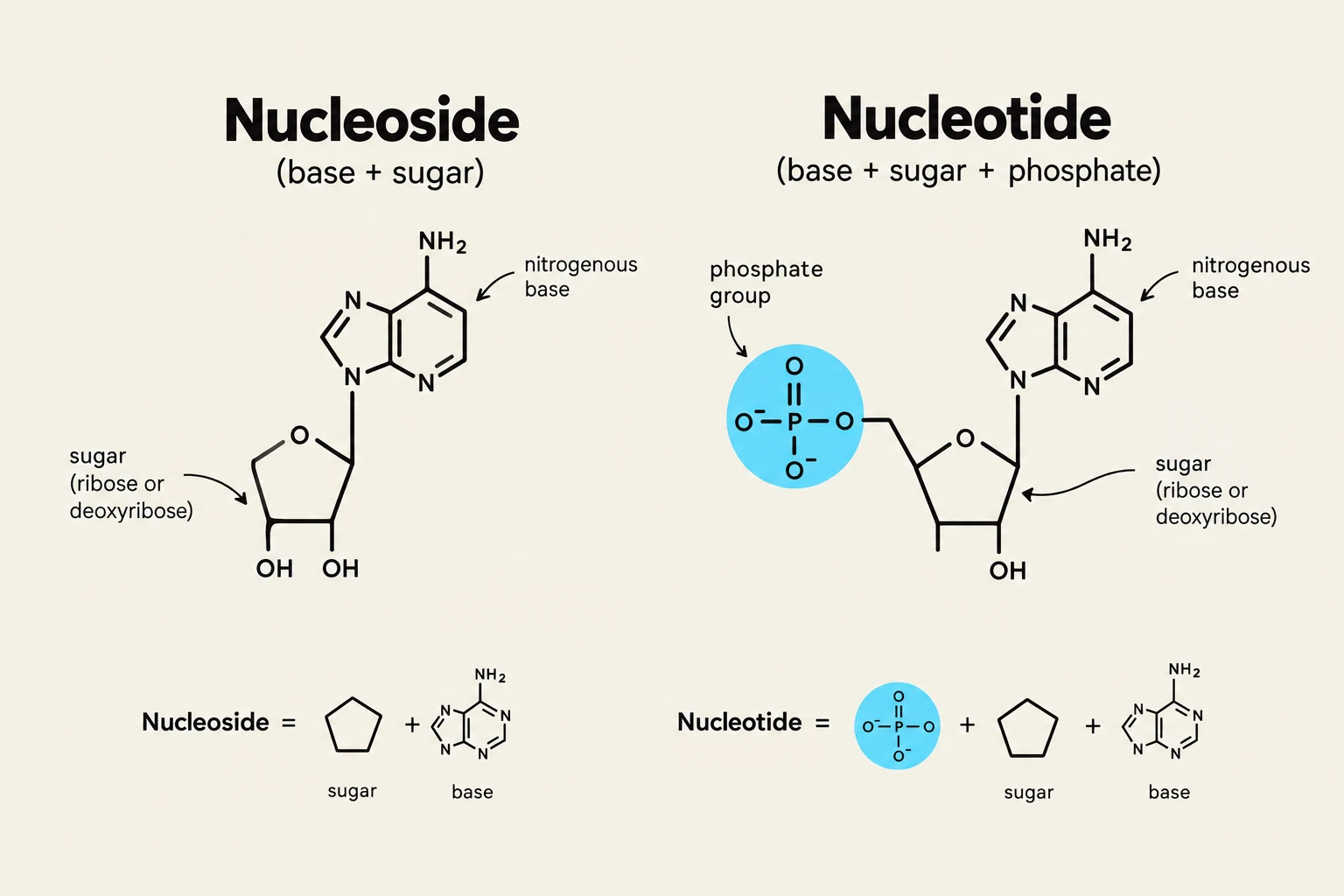
At the most basic level, nucleic acids are polymers composed of monomeric units called nucleotides. A nucleotide is a tripartite molecule consisting of three distinct components: a nitrogenous nucleobase, a five-carbon sugar (pentose), and one or more phosphate groups.
To distinguish between these components, biochemists use specific terminology. When a nucleobase is covalently bonded to a five-carbon sugar but lacks a phosphate group, the resulting molecule is called a nucleoside. The addition of a phosphate group to the nucleoside transforms it into a nucleotide. When these nucleotides link together through phosphodiester bonds, they form long chains known as polynucleotides, which constitute the primary structure of DNA and RNA.
Diagrams illustrating the chemical structures of a nucleoside and a nucleotide, highlighting their constituent components: a nitrogenous base, a sugar (ribose or deoxyribose), and a phosphate group.
DNA Structure and Stability
Deoxyribonucleic acid (DNA) is the primary repository of genetic information. In most organisms, DNA exists as a double-stranded helix. The stability of this double helix is not derived from a single force but from a combination of several molecular interactions:
Hydrogen bonding: Occurs between complementary nucleobases (A with T, and G with C).
Base stacking: Van der Waals and hydrophobic interactions between the flat surfaces of adjacent bases within the same strand.
Ionic interactions: Interactions between the negatively charged phosphate backbone and surrounding cations.
Beyond the double helix, DNA can adopt more complex tertiary structures, such as supercoiling, where the helix is further twisted upon itself to fit within the confines of a cell.
DNA Denaturation and the Melting Curve
The two strands of a DNA duplex are held together by non-covalent interactions, meaning they can be separated by physical or chemical means. This process is known as denaturation. When DNA is heated, the rigid, organized duplex strands separate into flexible, disordered single strands.
This transition has two measurable physical consequences:
Decrease in viscosity: The transition from rigid, long duplexes to flexible single strands makes the solution less viscous.
Hyperchromic effect: There is a significant increase in ultraviolet (UV) absorbance upon denaturation. This occurs because the disruption of electronic interactions among the stacked neighboring bases allows them to absorb more UV light.
Exam Tip: If you see a graph where UV absorbance suddenly spikes during a temperature increase, you are looking at the hyperchromic effect during DNA denaturation.
The denaturation process is "cooperative," meaning once the strands begin to unzip, the rest of the molecule follows quickly. This results in a sigmoidal (S-shaped) melting curve. The midpoint of this curve is defined as the melting temperature (Tm).
The Tm is not a fixed constant for a specific sequence; it is influenced by the solvent, pH, and the concentration of ions. Crucially, the Tm increases linearly with the mole fraction of G•C base pairs, because Guanine and Cytosine form three hydrogen bonds, whereas Adenine and Thymine form only two.
This graph illustrates the relationship between temperature and UV absorbance of DNA, showing how double-stranded DNA denatures into single-stranded DNA at higher temperatures, leading to increased UV absorbance.
The Diversity of RNA
Ribonucleic acid (RNA) is structurally more diverse than DNA and is typically synthesized as a single strand. Because it is single-stranded, RNA often folds back on itself to form complex shapes through intramolecular base pairing.
Secondary and Tertiary Structures
RNA can form several distinct structural motifs:
Stem–loop structures: Formed when a single strand base-pairs with itself, creating a "stem" of double-stranded regions and a "loop" of unpaired bases.
A-form double helix: When RNA does pair with another strand (such as DNA or another RNA), it typically adopts an A-form geometry rather than the B-form seen in DNA.
Complex tertiary shapes: In molecules like tRNA, the RNA folds into a compact, L-shaped structure. This shape is stabilized by unusual hydrogen-bonding associations and covalently modified bases.
RNA molecules also exhibit highly complex secondary and tertiary structures in larger forms, such as rRNA (ribosomal RNA), which provides the structural and catalytic framework for the ribosome. Notably, some RNA molecules function as biological catalysts, meaning they can facilitate chemical reactions.
The Central Dogma of Molecular Biology
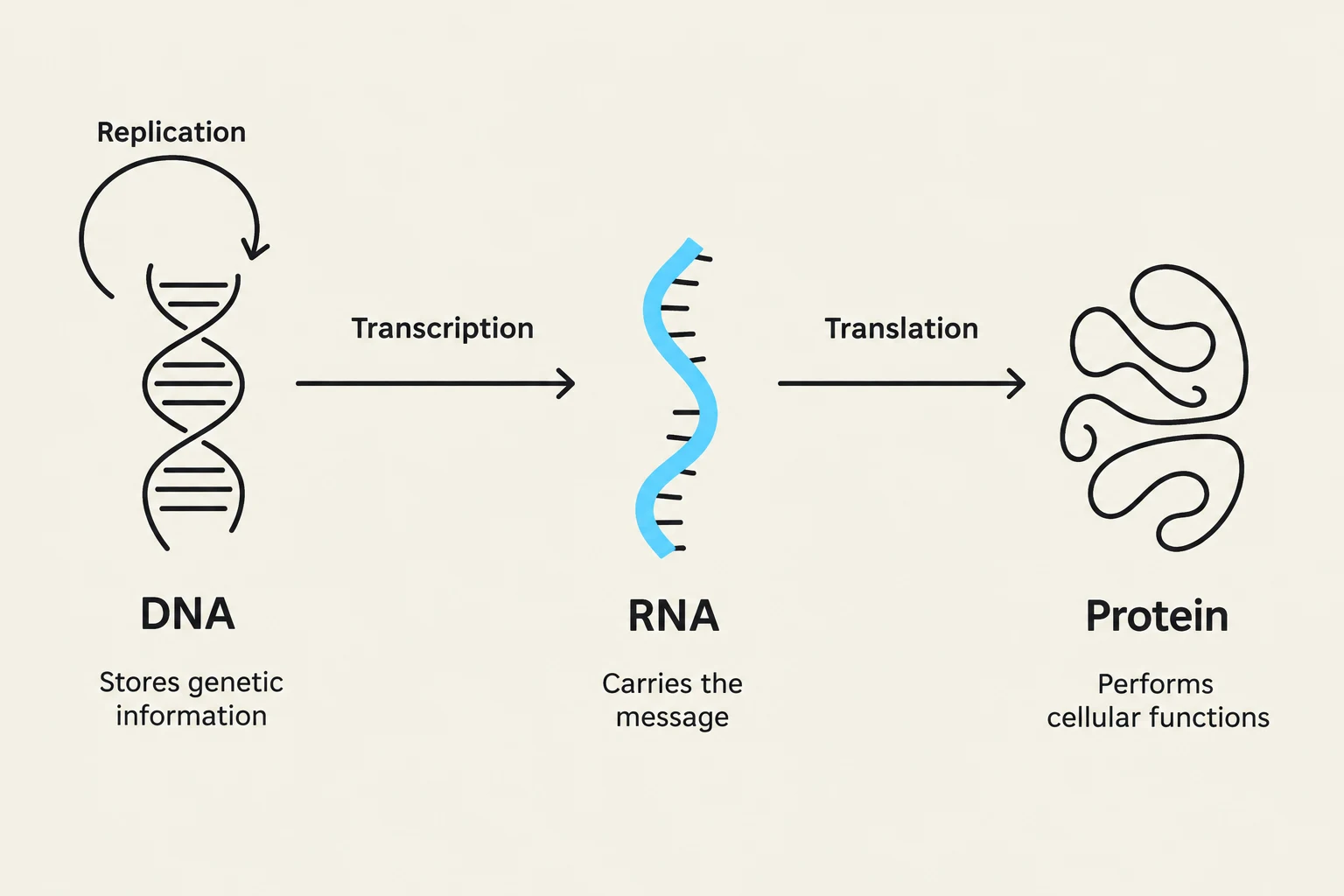
The relationship between DNA, RNA, and proteins is governed by the central dogma of molecular biology, which describes the directional flow of genetic information:
DNA Replication: To ensure genetic continuity, DNA must copy itself. This is often described as semiconservative replication, where each new DNA molecule consists of one original strand and one newly synthesized strand.
Transcription: The information stored in a DNA gene is "rewritten" into a mobile messenger molecule called RNA.
Translation: The sequence of the RNA is then "read" by the cellular machinery to synthesize proteins.
Proteins are the functional products of the cell; they carry out the work directed by the original genetic code stored in the DNA.
This diagram illustrates the central dogma of molecular biology, showing the processes of DNA replication, transcription from DNA to RNA, and translation from RNA to protein.
Keep reading for free.
Create an account to finish this reading and make it part of your study routine.