


To understand how life stores its most precious instructions, we must look past the complex machinery of the cell and zoom in on the molecular level. At the heart of biological information is the nucleic acid—a long chain of repeating units called nucleotides. While we often think of DNA as a single, massive entity, it is actually a sophisticated polymer built from these small, highly organized building blocks.
The Building Block: The Nucleotide
A single nucleotide is composed of three distinct parts: a sugar, a nitrogenous base, and a phosphate group. Think of a nucleotide as a single bead on a string. While the "string" (the backbone) provides the structure, the "bead" (the base) provides the actual information.
The identity of a nucleotide is determined by its components:
- The Sugar: Determines the type of nucleic acid (DNA vs. RNA).
- The Base: Determines the "letter" or code (A, T, G, C, or U).
- The Phosphate: Determines the energy state and the number of phosphates attached (mono, di, or tri).
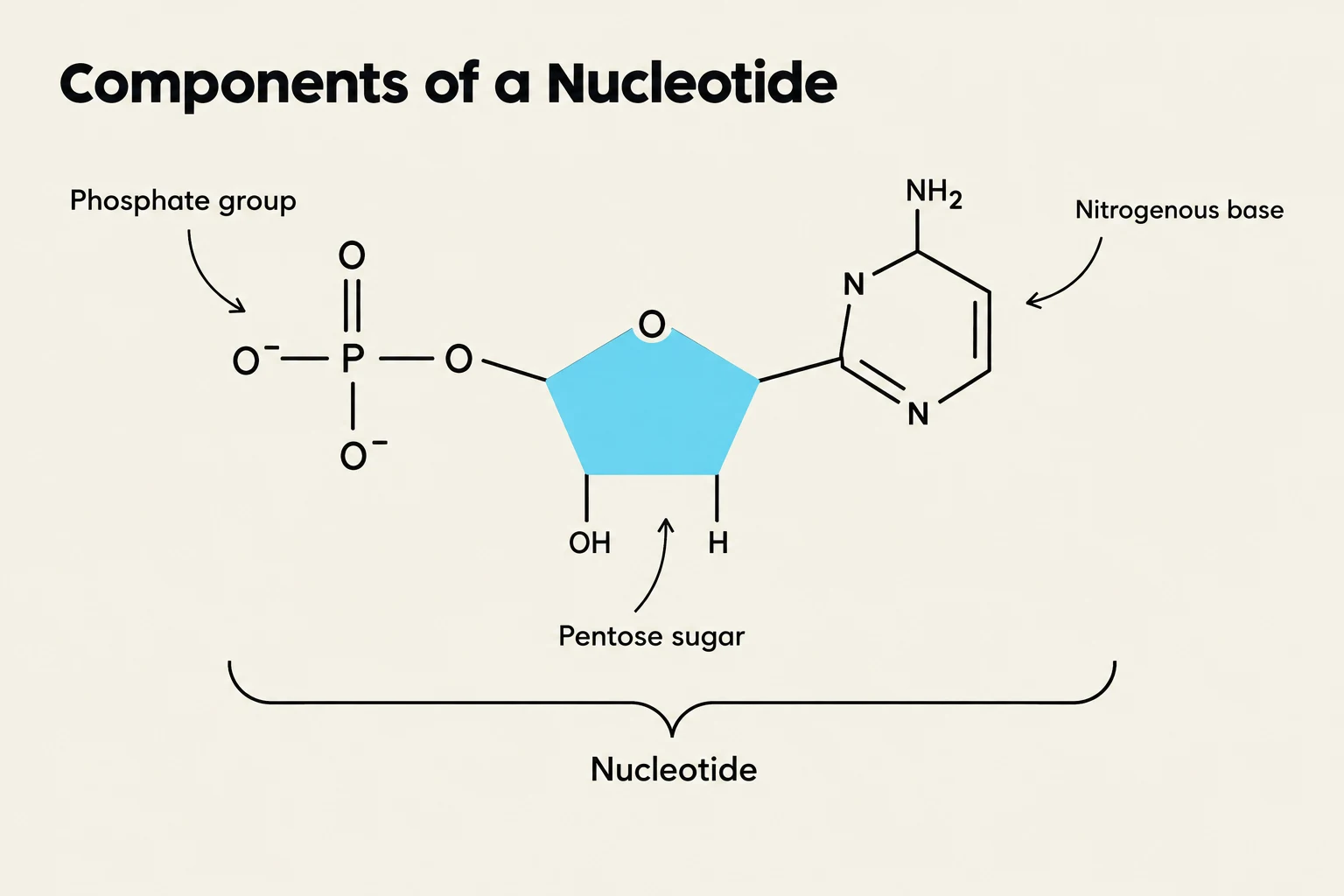
The Pentose Sugar: The Structural Anchor
The sugar is the central hub of the nucleotide. It is a five-carbon ring, and its specific structure is vital for both the identity of the molecule and the directionality of the DNA strand. To understand how DNA works, we must label the carbons in this ring using a numbering system from $1'5'$.
- $1'$ Carbon: This is the attachment point for the nitrogenous base (A, T, G, or C).
- $2'$ Carbon: This is the "identity" carbon. If this carbon has a hydrogen atom (H) attached, the molecule is DNA. If it has a hydroxyl group (OH) attached, it is RNA.
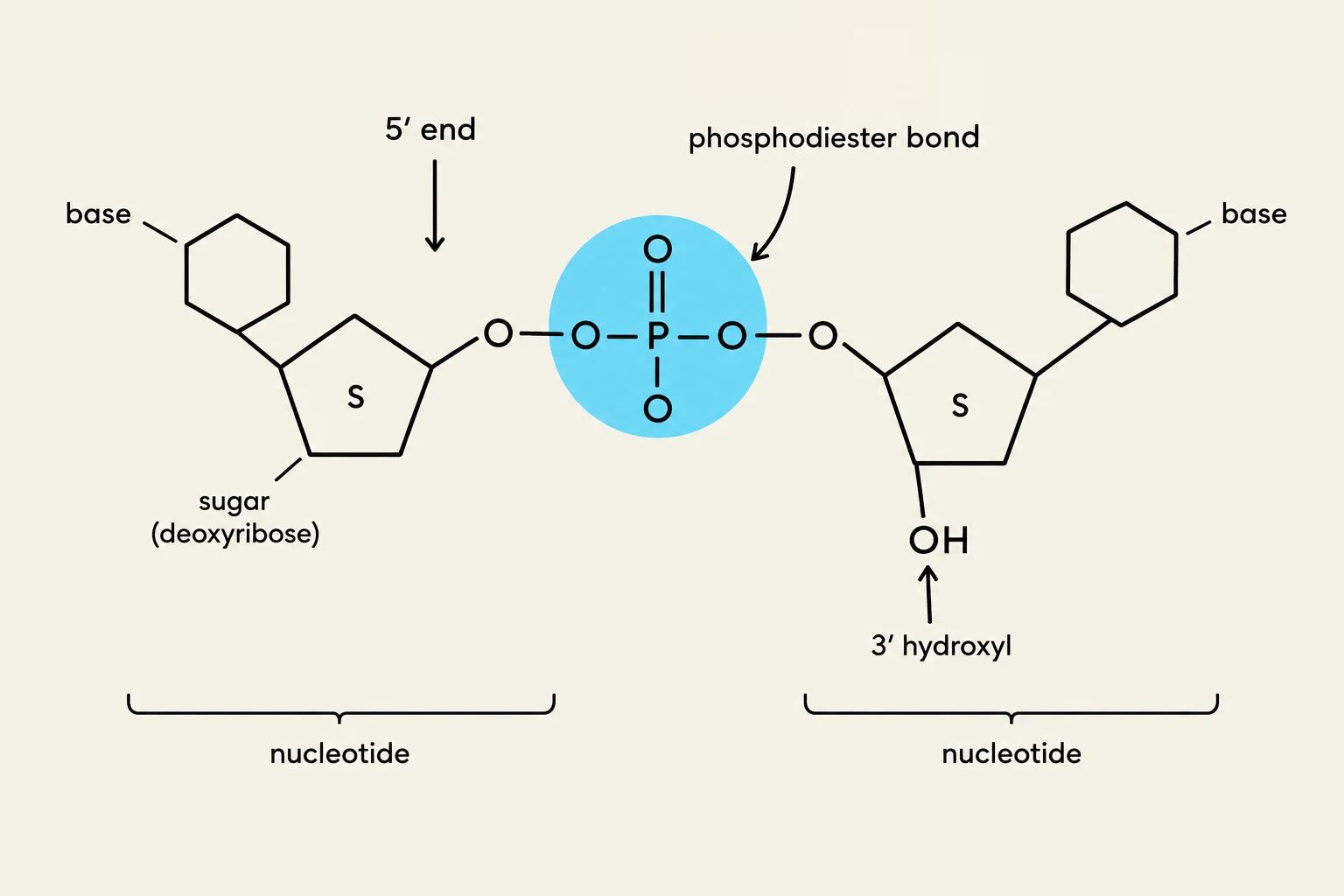
- $3'$ Carbon: This carbon features an OH group, which acts as the "clip" where the next nucleotide in the chain will attach.
- $5'$ Carbon: This carbon sticks out of the ring and serves as the attachment point for the phosphate group.
Keep reading for free.
Create an account to finish this reading and make it part of your study routine.
Continue reading freeAlready have an account? Log in
Updated