


Nucleotides are far more than just the building blocks of our genetic blueprint. While they form the structural basis of DNA and RNA, they also serve as the primary currency of cellular energy (ATP), essential components of coenzymes like NAD+ and FAD, and critical regulators in signal transduction via second messengers like cAMP. Because of these diverse and vital roles, the cell has evolved sophisticated mechanisms to synthesize, recycle, and convert these molecules to meet metabolic demands.
The Conversion of Nucleoside Monophosphates to Triphosphates
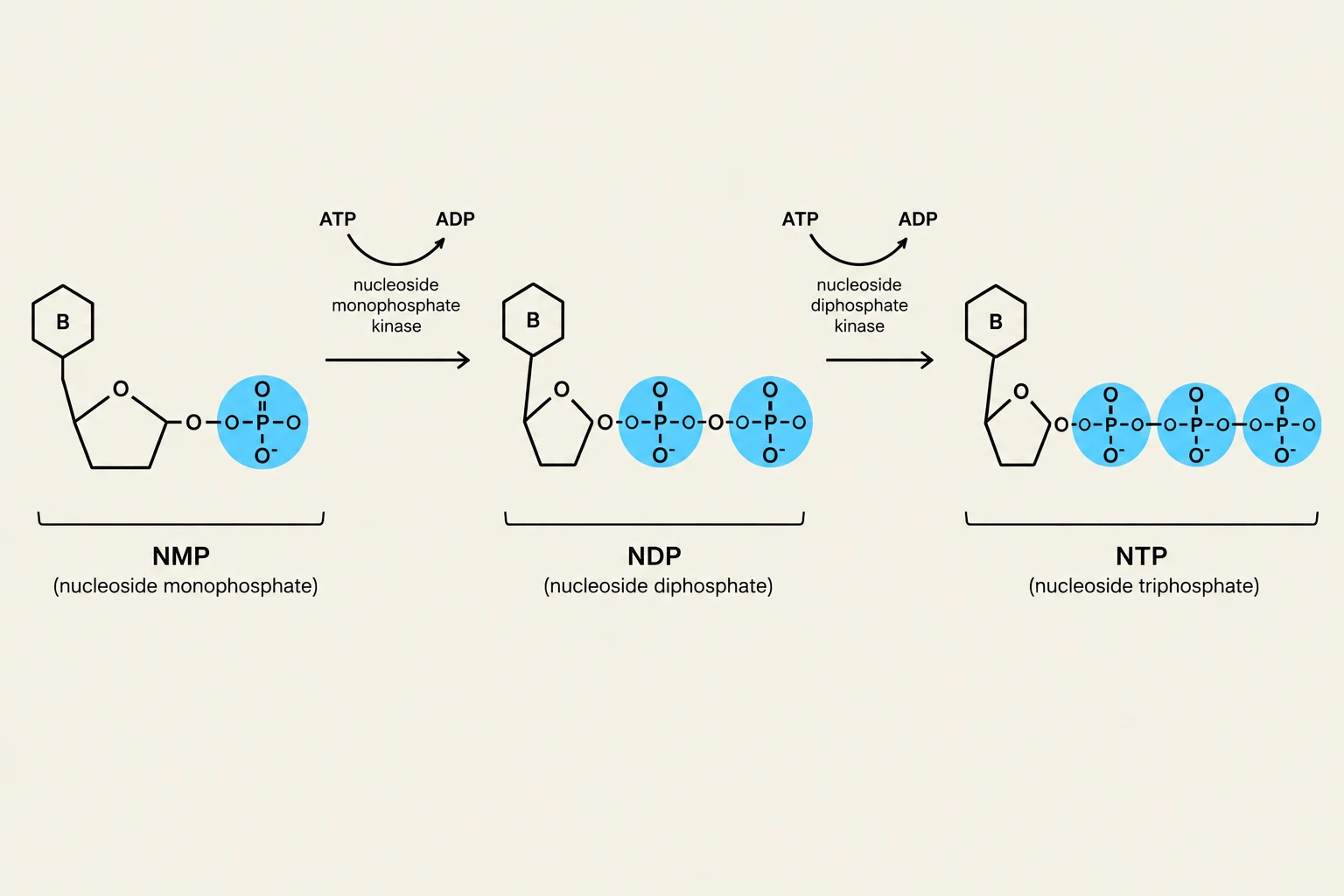
Once a nucleotide is formed—either through the de novo pathway (building from scratch) or the salvage pathway (recycling)—it typically exists as a nucleoside monophosphate (NMP). However, for most biological functions, especially energy transfer and DNA synthesis, these must be converted into nucleoside diphosphates (NDP) and nucleoside triphosphates (NTP).
This process is driven by specific kinases. For example, in the synthesis of pyrimidines, UMP is converted to UDP by an ATP-dependent nucleoside monophosphate kinase:
. Subsequently, the diphosphate is converted to the triphosphate (UTP) by a nucleoside diphosphate kinase:
. These reactions are highly efficient, ensuring that the cell maintains a steady supply of high-energy triphosphates.
The Purine Salvage Pathway
Synthesizing purines de novo is metabolically "expensive," requiring significant amounts of amino acids and energy. To conserve resources, cells utilize the Salvage Pathway, which reattaches free purine bases—derived from the diet or the breakdown of nucleic acids—directly onto a sugar phosphate backbone.
Keep reading for free.
Create an account to finish this reading and make it part of your study routine.
Continue reading freeAlready have an account? Log in
Updated