Nucleotide Metabolism: De Novo and Salvage Pathways
Explore the essential roles of nucleotides beyond genetic material, including energy carriers and metabolic regulators. This guide details the de novo and salvage pathways for purine and pyrimidine synthesis, their regulation, and clinical implications of metabolic disruptions.
Nucleotides are much more than just the building blocks of our genetic code. While they are essential for constructing DNA and RNA, they also serve as critical energy carriers (like ATP), components of essential coenzymes (such as NAD+ and FAD), and vital metabolic regulators like the second messenger cAMP. Because of their diverse and indispensable roles, the body has evolved sophisticated mechanisms to ensure a steady supply of purine and pyrimidine nucleotides through two distinct routes: de novo synthesis and salvage pathways.
Digestion and Absorption of Nucleotides
When we consume foods containing nucleic acids, our bodies do not simply absorb the large DNA or RNA molecules directly. Instead, a systematic breakdown occurs. Nucleoproteins are first broken down into proteins and nucleic acids. Nucleases then cleave the nucleic acids into individual nucleotides. These nucleotides are further processed by nucleotidases (which remove the phosphate group to form nucleosides) and nucleosidases (which separate the nitrogenous base from the pentose sugar). The resulting free bases and ribose sugars are then absorbed into the bloodstream.
The Two Routes of Nucleotide Biosynthesis
The cell maintains nucleotide levels through two primary strategies:
De Novo Pathway: This involves building purine and pyrimidine nucleotides "from scratch" using small, simple precursors such as amino acids (NH4+, aspartate, glycine), CO2, and folate derivatives. Because these pathways are essential for rapidly dividing cells, they are frequent targets for anti-cancer, antibacterial, and antiparasitic drugs.
Salvage Pathway: This is a more energy-efficient "recycling" program. It involves taking free nucleosides or bases—either from the diet or from the degradation of the body's own nucleic acids—and reattaching them to a sugar-phosphate backbone.
Exam Tip: If a question asks which pathway is more energy-efficient, the answer is the Salvage Pathway. De novo synthesis requires significant ATP consumption to build the rings from scratch.
De Novo Purine Synthesis
Unlike pyrimidines, which are synthesized as free bases and then attached to a sugar, purines are built directly onto a ribose sugar scaffold.
1. Synthesis of PRPP
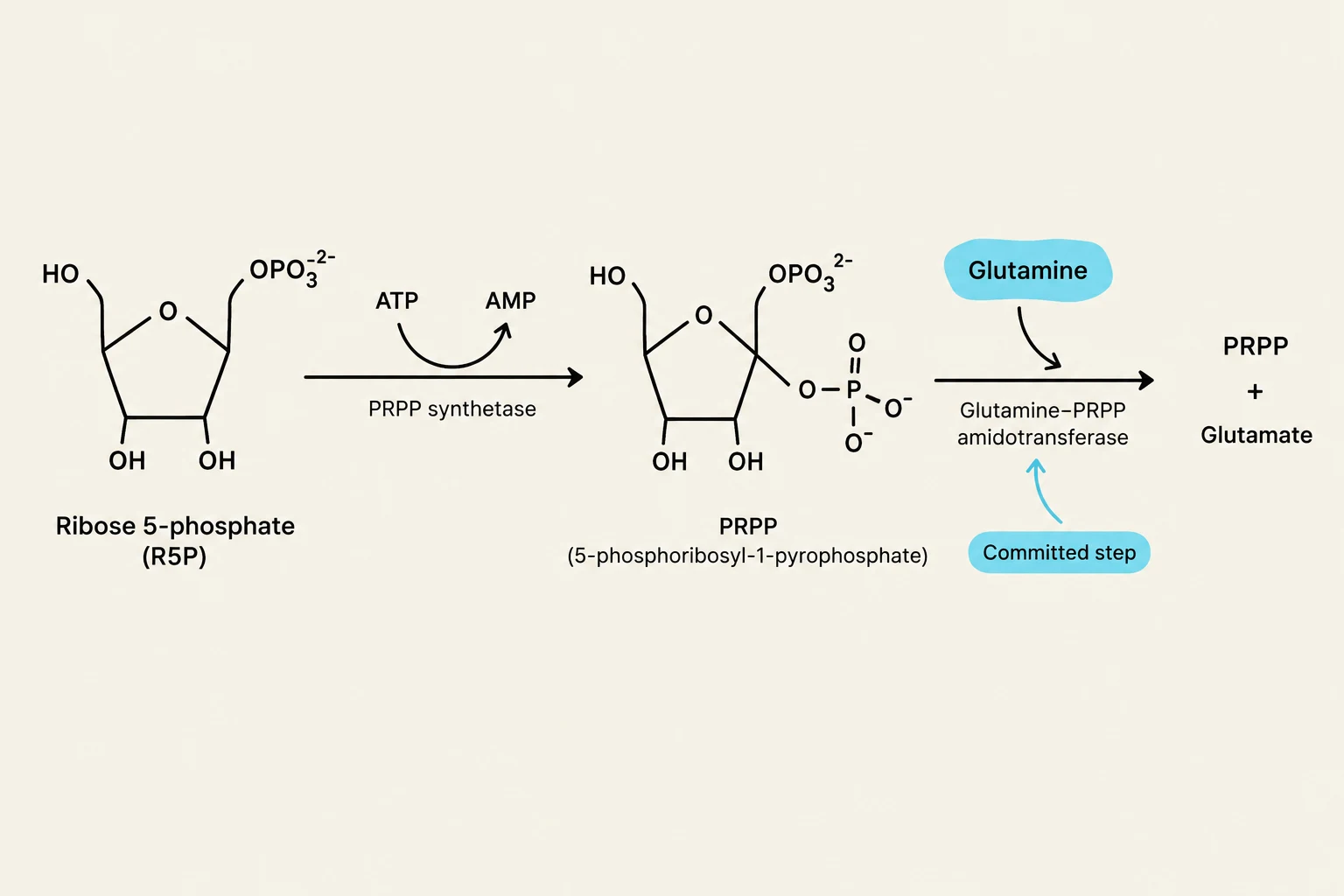
The foundation of both de novo and salvage pathways is 5-phosphoribosyl-1-pyrophosphate (PRPP). PRPP acts as an "activated pentose". It is synthesized from Ribose 5-phosphate and ATP, a reaction catalyzed by the enzyme PRPP synthetase.
2. The Committed Step: 5-Phosphoribosylamine
The first committed step of the de novo purine pathway is the conversion of PRPP into 5-phosphoribosylamine. In this reaction, the amide group from glutamine replaces the pyrophosphate group on the C1 carbon of PRPP. This step is catalyzed by the enzyme glutamine:phosphoribosyl pyrophosphate amidotransferase and is tightly regulated by feedback inhibition from the end products: AMP, GMP, and IMP.
This diagram illustrates the synthesis of PRPP (5-phosphoribosyl-1-pyrophosphate) from Ribose 5-phosphate and ATP, catalyzed by PRPP synthetase. It also shows the subsequent committed step where Glutamine reacts with PRPP, catalyzed by Glutamine-PRPP amidotransferase, to form PRPP and Glutamate.
3. The Parent Nucleotide: IMP
The culmination of the de novo purine ring construction is the formation of Inosine Monophosphate (IMP). IMP is considered the "parent" purine nucleotide because all other purine nucleotides are derived from it. The atoms of the purine ring in IMP are donated by various sources:
Aspartic acid: Provides N-1
Glutamine: Provides N-3 and N-9
Glycine: Provides C-4, C-5, and N-7
CO2: Provides C-6
Tetrahydrofolate (THF): Provides C-2 and C-8
4. Conversion of IMP to AMP and GMP
From IMP, the pathway branches to produce the two primary purine nucleotides. This process requires energy and is cross-regulated to maintain a balance between adenine and guanine levels:
To make AMP: The pathway requires GTP as an energy source.
To make GMP: The pathway requires ATP as an energy source.
This reciprocal requirement ensures that if GTP levels are high, AMP production is stimulated, and vice versa.
Regulation of De Novo Purine Synthesis
The regulation of this pathway is critical to prevent the wasteful overproduction of nucleotides. The most important regulator is the intracellular concentration of PRPP. Additionally, the pathway is subject to feedback inhibition: high concentrations of the end products (AMP, GMP, and IMP) inhibit the committed step enzyme.
The Purine Salvage Pathway
The salvage pathway is vital for recycling free purine bases like adenine, guanine, and hypoxanthine. These bases are reattached to PRPP to form nucleotides through the action of two key transferase enzymes:
Disruptions in nucleotide metabolism lead to severe clinical conditions.
Lesch-Nyhan Syndrome
This is an X-linked recessive disorder caused by a severe deficiency in HGPRT activity. Without HGPRT, the body cannot salvage purines, leading to:
A buildup of PRPP, which over-activates the de novo pathway.
Excessive production and subsequent degradation of purines into uric acid.
Symptoms: Gouty arthritis, mental retardation, aggressiveness, and self-mutilation.
Gout and Hyperuricemia
Purine degradation in humans ultimately produces uric acid. If uric acid levels in the plasma exceed normal limits (Hyperuricemia), it can precipitate as sodium urate crystals in the joints, causing intense inflammation and pain known as Gout.
Treatment:Allopurinol is a common treatment; it is an analog of hypoxanthine that inhibits xanthine oxidase, the enzyme responsible for converting xanthine to uric acid.
Adenosine Deaminase (ADA) Deficiency
A deficiency in the enzyme ADA leads to an accumulation of adenosine. This excess is converted into dATP, which inhibits ribonucleotide reductase. This inhibition prevents the production of all deoxyribonucleotides, meaning cells cannot synthesize DNA or divide. This is the underlying cause of Severe Combined Immunodeficiency (SCID), characterized by a lack of both T and B cells.
Pyrimidine Metabolism Summary
Unlike purines, pyrimidines are synthesized as a complete ring first and then attached to PRPP. The committed step in mammalian pyrimidine synthesis is catalyzed by Carbamoyl Phosphate Synthetase II (CPS-II).
The degradation of pyrimidines (cytosine and uracil →β-alanine; thymine →β-aminoisobutyric acid) produces highly water-soluble products. Consequently, unlike purine degradation, pyrimidine overproduction rarely results in significant clinical symptoms.
This illustration shows the chemical structures of purines and pyrimidines, which are nitrogenous bases found in DNA and RNA. Purines, like adenine and guanine, consist of a double ring structure (a six-membered ring fused with a five-membered ring). Pyrimidines, such as cytosine, thymine, and uracil, have a single six-membered ring structure.
Keep reading for free.
Create an account to finish this reading and make it part of your study routine.