Explores the diverse landscape of nucleic acid therapeutics, from oligonucleotides that silence genes to mRNA platforms that have revolutionized vaccination efforts, detailing their mechanisms, delivery, and immune responses.
The field of biopharmaceuticals has undergone a paradigm shift, moving from the administration of large, complex proteins to the delivery of the genetic instructions themselves. By leveraging the fundamental principles of the Central Dogma—the process by which genetic information flows from DNA to RNA and finally to protein—scientists can now modulate gene expression or trigger specific immune responses with unprecedented precision. This article explores the diverse landscape of nucleic acid therapeutics, ranging from short oligonucleotides that silence "undruggable" genes to mRNA platforms that have revolutionized global vaccination efforts.
The Foundation: The Central Dogma and Nucleic Acid Structure
To understand how nucleic acid drugs work, one must first understand the biological blueprint they manipulate. Nucleic acids, including Deoxyribonucleic acid (DNA) and Ribonucleic acid (RNA), are polymers of nucleotides. Each nucleotide consists of a nitrogenous base (a purine or a pyrimidine), a sugar, and a phosphate group.
The Central Dogma describes the directional flow of information:
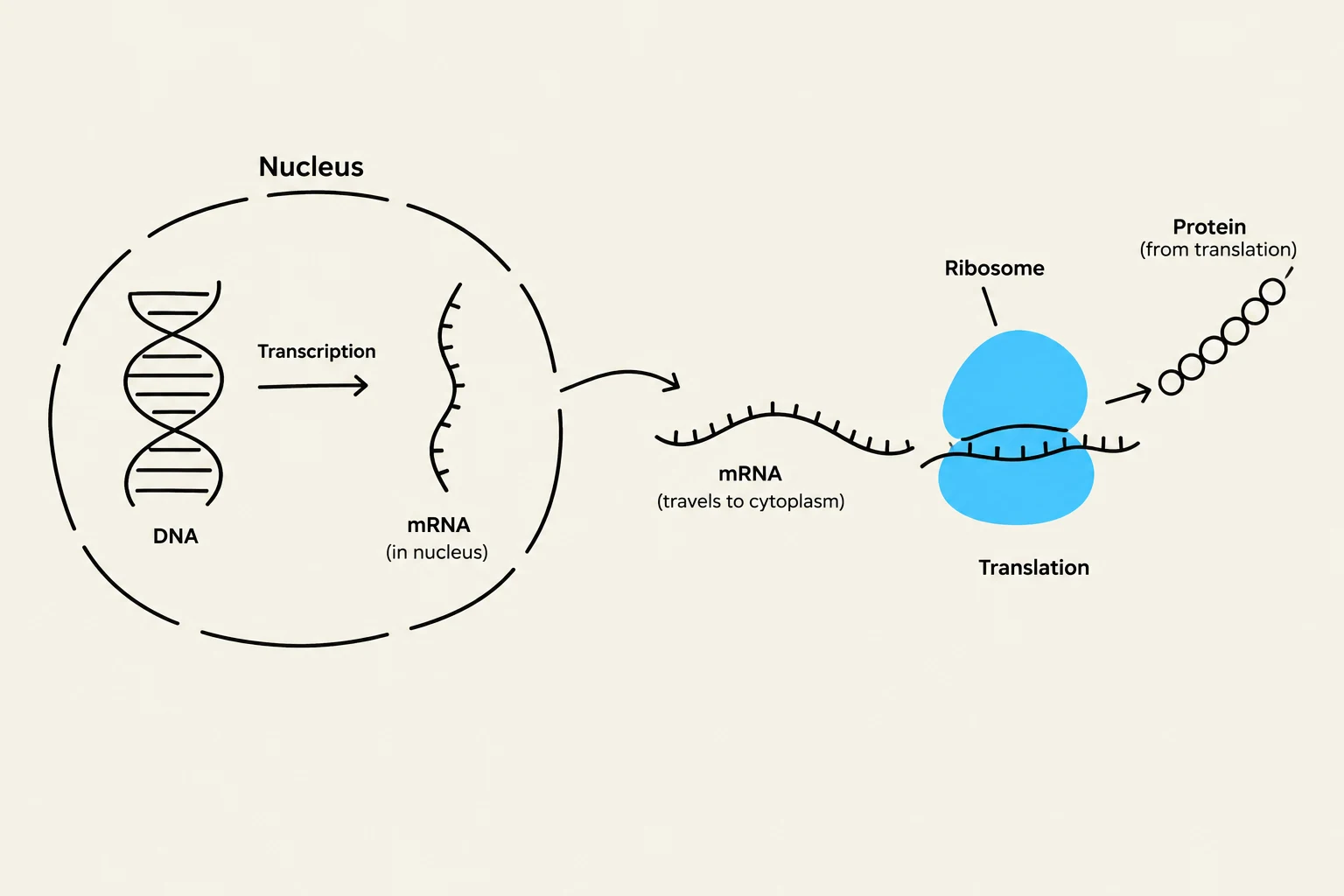
Transcription: DNA is transcribed into messenger RNA (mRNA).
Translation: mRNA is translated by ribosomes into a functional protein.
While DNA typically serves as the long-term storage of genetic information in a double-stranded format, RNA is usually single-stranded and acts as the intermediate messenger. Therapeutic interventions can target any stage of this flow to either prevent the production of a harmful protein or induce the production of a beneficial one.
This diagram illustrates the process of protein synthesis, showing transcription of DNA into mRNA within the nucleus and translation of mRNA into protein by ribosomes in the cytoplasm.
Oligonucleotide Therapeutics: Targeting the RNA Level
Oligonucleotides are short (typically 10–50 nucleotides) single- or double-stranded DNA or RNA sequences. They are particularly valuable because they can target "undruggable" proteins—those that lack suitable binding sites for traditional small-molecule drugs—by intervening at the mRNA level instead.
Antisense Oligonucleotides (ASOs)
ASOs are single-stranded molecules designed to bind to a complementary target mRNA sequence via Watson-Crick base pairing. Once bound, they can function through three primary mechanisms:
RNase H-mediated cleavage: Using "gapmers" (ASOs with a DNA core and modified RNA ends), the drug forms a DNA:RNA hybrid that recruits the enzyme RNase H to degrade the target mRNA.
Steric hindrance: The ASO binds to the RNA and physically blocks the ribosomal subunits from assembling or moving, thereby arresting translation.
Splice modulation: Occurring in the nucleus, ASOs bind to pre-mRNA to alter how introns and exons are joined. A key clinical example is Nusinersen, used for Spinal Muscular Atrophy (SMA), which promotes the inclusion of exon 7 to produce a functional protein.
RNA Interference (RNAi): siRNA and miRNA
While ASOs are single-stranded, RNA interference utilizes double-stranded RNA to silence genes.
Small Interfering RNA (siRNA): These are short (19–25 nucleotides) double-stranded molecules that utilize the RISC (RNA-induced silencing complex) pathway to achieve highly sequence-specific mRNA degradation.
MicroRNA (miRNA): These are endogenous-like small RNAs that regulate multiple mRNA targets simultaneously, typically by promoting degradation or repressing translation.
Aptamers: The "Chemical Antibodies"
Aptamers are short, single-stranded nucleic acids that fold into complex three-dimensional tertiary structures. Unlike monoclonal antibodies that rely on protein-protein interactions, aptamers bind to targets (such as proteins or carbohydrates) through shape recognition. They offer advantages over monoclonal antibodies, including easier and more cost-effective synthesis and high target specificity. An example is pegaptanib, a VEGF antagonist used for treating wet age-related macular degeneration.
Exam Tip: When comparing ASOs and siRNAs, remember that ASOs are single-stranded and can work via RNase H or steric hindrance, whereas siRNAs are double-stranded and specifically utilize the RISC pathway for degradation.
mRNA Therapeutics and Vaccine Mechanisms
Unlike oligonucleotides that aim to silence a gene, mRNA therapeutics aim to express a protein. By delivering coding instructions directly to the cell's cytosol, the cell's own ribosomes can translate the mRNA into a specific therapeutic protein or an antigen.
Delivery via Lipid Nanoparticles (LNPs)
A major hurdle for mRNA is its inherent instability and its tendency to be degraded by nucleases before reaching its target. To overcome this, mRNA is encapsulated in lipid nanoparticles (LNPs). These nanoparticles protect the mRNA payload and facilitate its uptake into the cell via endocytosis and subsequent endosomal escape into the cytosol.
The Immune Response: Innate and Adaptive Immunity
mRNA vaccines are designed to mimic a natural viral infection to trigger a robust immune response.
Innate Immunity: As the LNP-mRNA complex enters the cell, the exogenous mRNA is sensed by Pattern Recognition Receptors (PRRs) such as TLRs (Toll-like receptors) in the endosomes and RIG-I in the cytosol. This triggers a proinflammatory cytokine response and Type I Interferon (IFN-I) production.
Adaptive Immunity: Once the mRNA is translated into a target antigen (e.g., the SARS-CoV-2 spike protein), the protein is processed and presented to the immune system. Antigens can be released from the cell to activate B-cells or processed via the proteasome and presented on MHC-I and MHC-II molecules to activate CD8+ T-cells and CD4+ T-cells, respectively. This dual activation establishes long-term immune memory.
Diagram illustrating the process of mRNA entering a cell, being translated into antigen protein by ribosomes, and subsequently presented on the cell surface.
Advantages and Safety
mRNA platforms offer several distinct advantages over traditional vaccine types (such as live-attenuated or inactivated vaccines):
Safety: They are non-infectious and non-integrating, meaning there is no risk of insertional mutagenesis (altering the host's DNA).
Scalability: They allow for rapid, inexpensive, and scalable manufacturing through in vitro transcription.
Versatility: The same platform can be used for prophylactic vaccines (preventing disease, like COVID-19) or therapeutic vaccines (treating existing conditions, like anti-tumour vaccines).
Summary Table of Nucleic Acid Mechanisms
Class
Structure
Primary Mechanism
Therapeutic Goal
ASO
Single-stranded
RNase H cleavage, Steric hindrance, or Splice modulation
Silence/modulate gene expression
siRNA
Double-stranded
RISC-mediated mRNA degradation
Sequence-specific gene silencing
miRNA
Small RNA
Translational repression or degradation
Regulation of multiple mRNA targets
Aptamer
Folded DNA/RNA
Tertiary structure binding to targets
Target specific proteins/ligands
mRNA
Single-stranded
Ribosomal translation into protein
Produce therapeutic proteins/antigens
Keep reading for free.
Create an account to finish this reading and make it part of your study routine.