


In the study of organic chemistry, hydrocarbons are classified based on the types of bonds between their carbon atoms. While alkanes contain only single bonds, unsaturated hydrocarbons—such as alkenes, alkynes, and aromatic compounds—possess double or triple bonds, or unique cyclic electron arrangements. Mastering the IUPAC (International Union of Pure and Applied Chemistry) nomenclature for these groups is essential for communicating molecular structures accurately.
Alkenes and Stereoisomerism
Alkenes are hydrocarbons that contain at least one carbon-carbon double bond. To name an alkene, you identify the longest continuous carbon chain containing the double bond, determine the parent alkane name, and change the suffix from -ane to -ene.
When numbering the chain, you must start from the end that gives the double bond the lowest possible number (locant). If the molecule is a cyclic alkene, the numbering must ensure that substituents receive the lowest possible locants.
Cis-Trans Isomerism
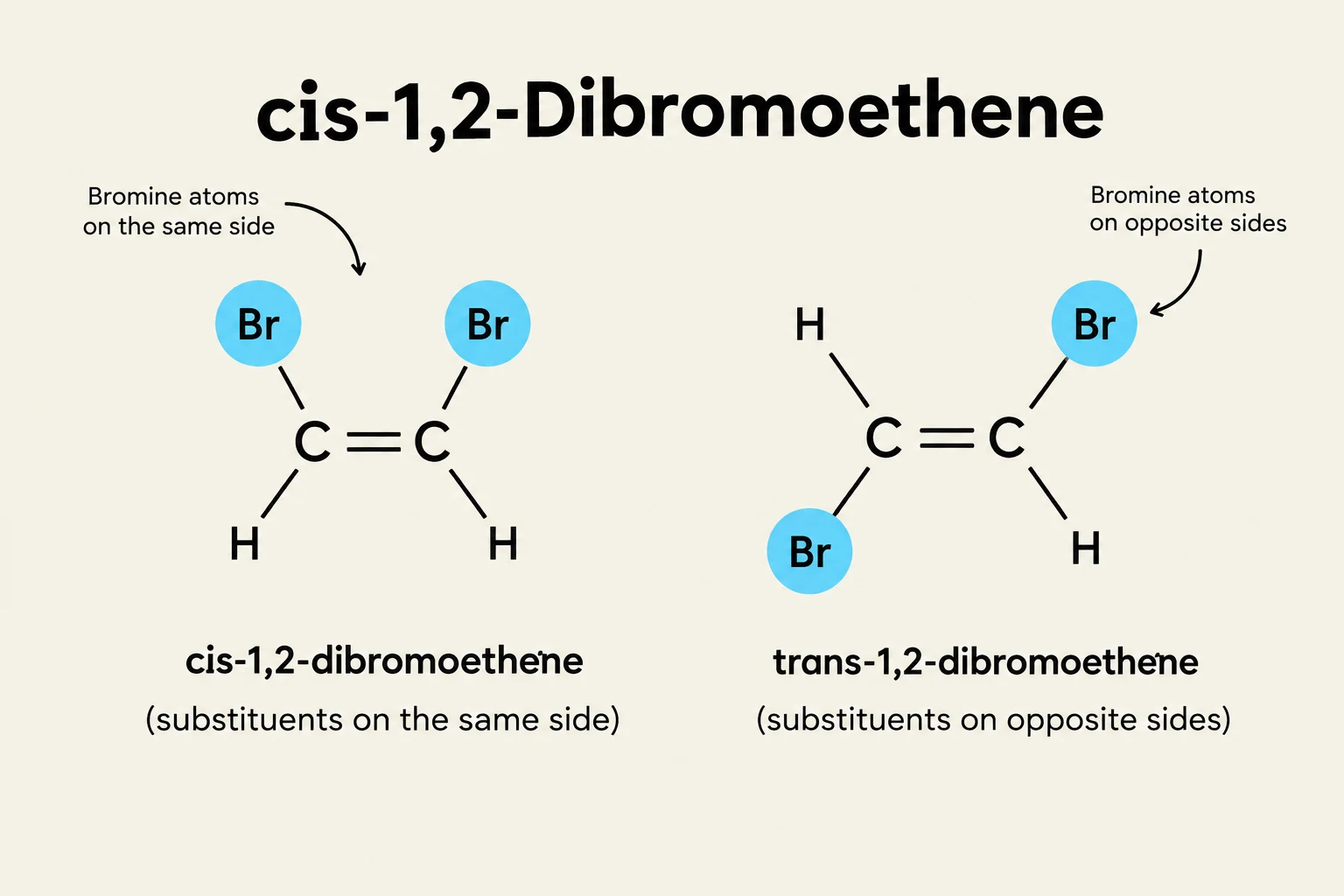
Because double bonds are rigid and cannot rotate freely, alkenes can exist as different geometric isomers. We use the prefixes cis and trans to describe the spatial arrangement of substituents around the double bond:
- cis-: The substituents are located on the same side of the double bond.
- trans-: The substituents are located on opposite sides of the double bond.
For example, in cis-1,2-dibromoethene, both bromine atoms are on the same side of the carbon chain, whereas in trans-1,2-dibromoethene, they are on opposite sides.
Keep reading for free.
Create an account to finish this reading and make it part of your study routine.
Continue reading freeAlready have an account? Log in
Updated