A comprehensive guide to understanding forces and motion in classical mechanics, covering Newton's Second Law, equilibrium, friction, circular motion, projectile motion, and fluid dynamics.
Understanding how objects move requires more than just observing their speed; we must analyze the underlying causes of that motion. In classical mechanics, these causes are known as forces. By applying Newton's Second Law, we can bridge the gap between the forces acting on a particle and its resulting acceleration, allowing us to predict everything from the path of a projectile to the stability of a car on a curved road.
The Foundation: Newton's Second Law and Net Force
At the heart of dynamics is Newton's Second Law, which states that the acceleration of an object is directly proportional to the net force acting upon it and inversely proportional to its mass. Mathematically, this is expressed as:
∑F=ma
Where ∑F represents the vector sum of all external forces, m is the mass (a measure of inertia), and a is the acceleration.
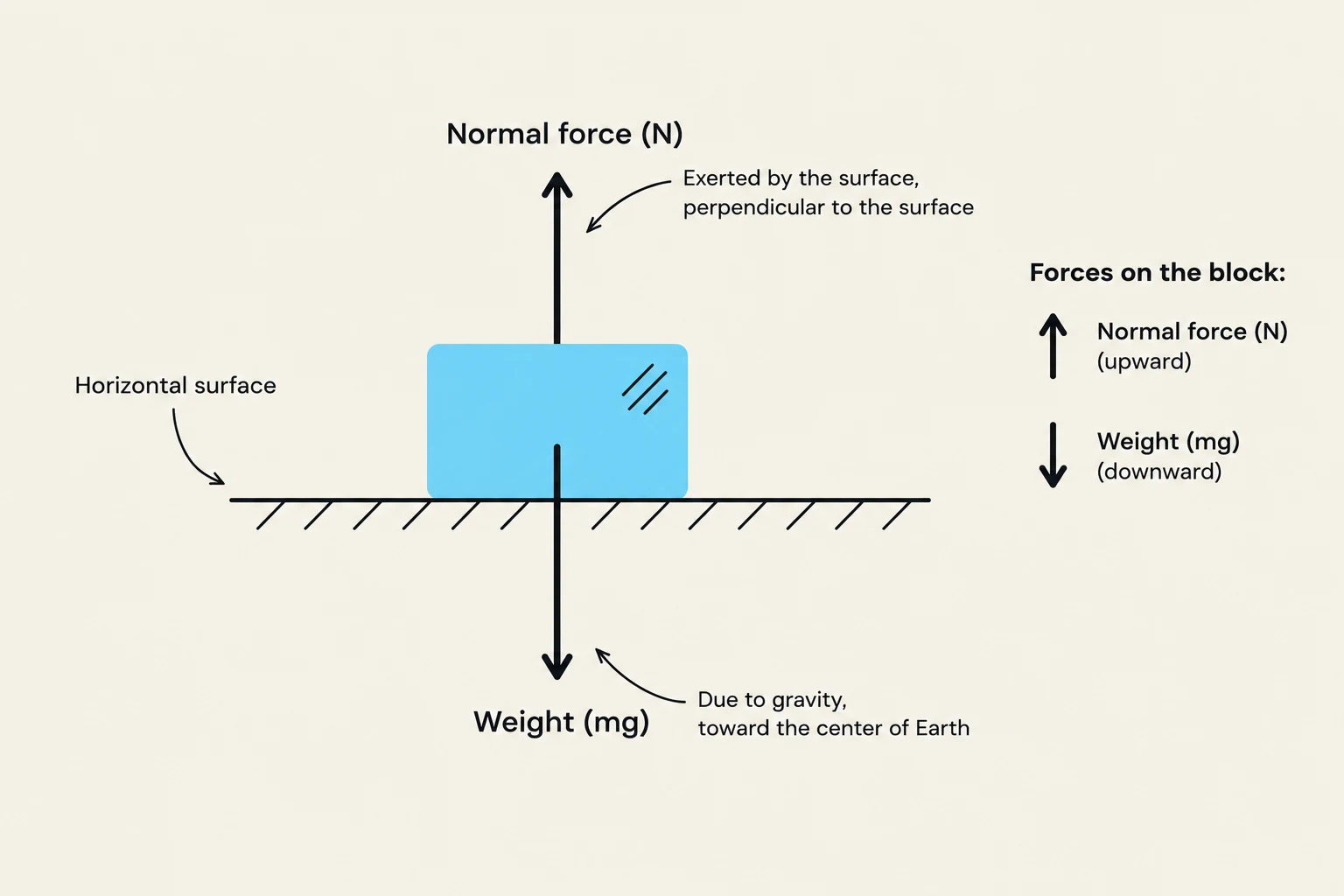
To solve complex problems, physicists use a Net Force Model. This involves identifying every individual force acting on a particle—such as the gravitational force ($W = mg$), tension (T) in a string, or the normal force (N) from a surface—and summing them vectorially. A crucial tool in this process is the Free-Body Diagram (FBD). An FBD is a simplified sketch representing the object as a point, with arrows pointing away from the center to represent each force acting upon it.
Exam Tip: When drawing a Free-Body Diagram, never include "centrifugal force" or "inertial force." These are fictitious forces arising from non-inertial reference frames. Only include real, physical interactions like tension, gravity, or friction.
Diagram illustrating the normal force and weight acting on a block resting on a horizontal surface.
Equilibrium and Apparent Weight
When the net force acting on an object is zero (∑F=0), the object is in a state of equilibrium. This does not necessarily mean the object is at rest; it can also mean the object is moving with a constant velocity (zero acceleration).
A common application of equilibrium is the concept of apparent weight. Your "weight" on a scale is actually the measurement of the normal force exerted by the scale on your body.
If you are in an elevator moving at a constant speed, your acceleration is zero, and the scale reads your actual weight ($N = mg$).
If the elevator accelerates upward with acceleration a, the scale must push harder to overcome gravity and provide that acceleration, resulting in N=m(g+a).
Friction: Static and Kinetic
Friction is a resistive force that opposes the relative motion (or intended motion) between two surfaces. It is categorized into two main types:
Static Friction (fs): This force acts between surfaces that are not moving relative to each other. It can vary in magnitude to exactly balance an applied force up to a maximum limit: fs,max=μsN, where μs is the coefficient of static friction.
Kinetic Friction (fk): Once motion begins, the resisting force is governed by the coefficient of kinetic friction: fk=μkN.
Complex Friction Scenarios
Inclined Planes: On a slope, gravity is split into components. The component parallel to the slope (mgsinθ) pulls the object down, while the component perpendicular to the slope (mgcosθ) determines the normal force and thus the friction.
Vertical Walls: To hold a block against a wall, you must apply a horizontal force to create a normal force. This normal force generates the static friction required to counteract gravity ($f_s = mg$).
Stacked Objects: In systems with multiple masses, the friction between the top and bottom blocks depends on the normal force exerted by the mass above.
Uniform Circular Motion and Centripetal Force
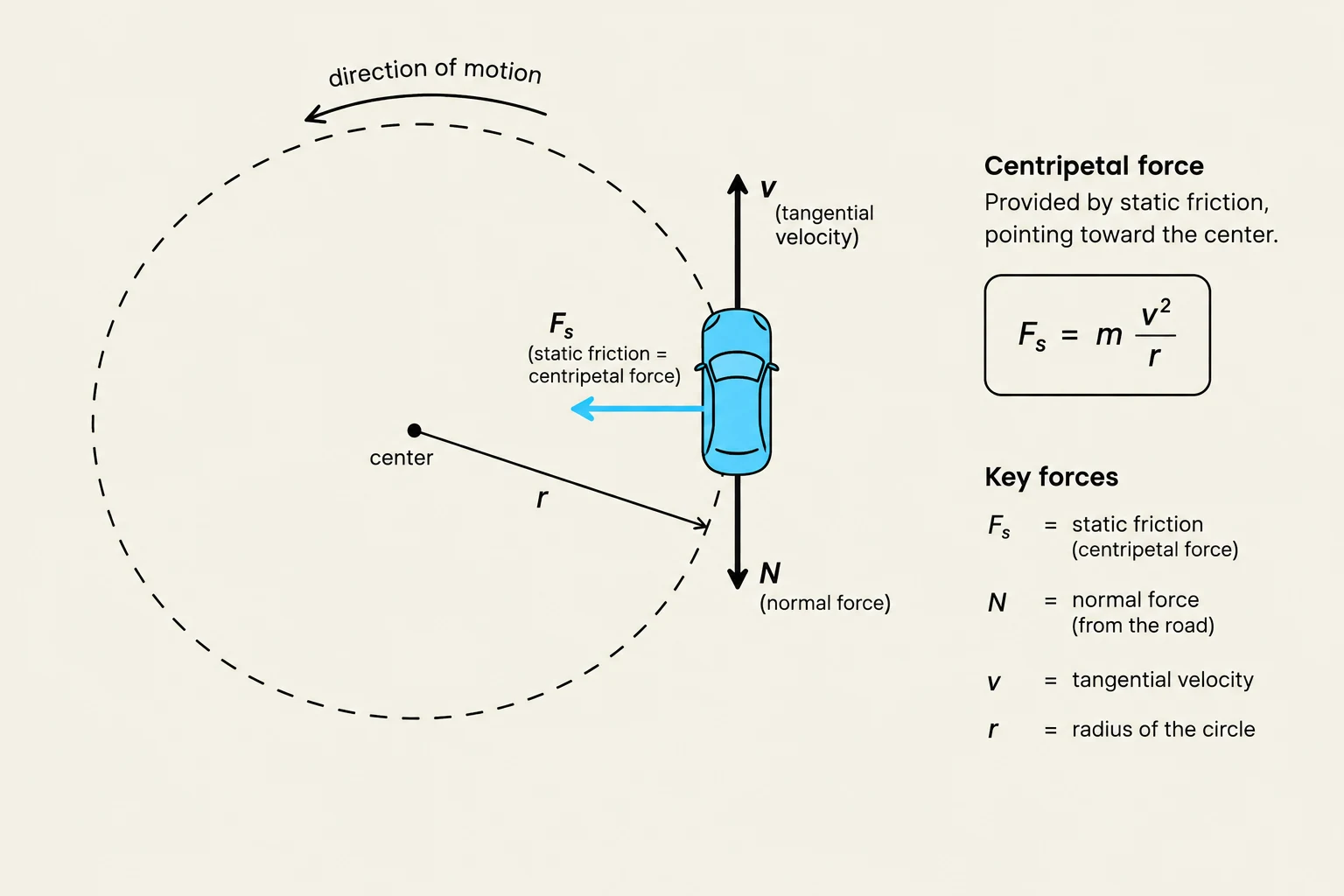
When an object moves in a circle at a constant speed, it is in uniform circular motion. Although the speed is constant, the direction of the velocity is constantly changing, which means the object is accelerating toward the center of the circle. This is known as centripetal acceleration (ac=v2/r).
The "centripetal force" is not a new type of force, but rather a label we give to the net radial force that causes this acceleration. Depending on the situation, this force could be provided by:
Tension in a string (e.g., a conical pendulum or a rotating puck).
Friction between tires and the road.
Normal force (e.g., a roller coaster in a vertical loop).
Diagram illustrating centripetal force acting on a car turning a corner, showing tangential velocity, normal force, and the formula for centripetal force.
For a vehicle on an unbanked curve, the maximum speed (vmax) it can maintain without skidding is limited by the static friction:
μsmg=rmv2⟹vmax=μsgr.
Projectile Motion and Fluid Dynamics
Projectile Motion
In two-dimensional motion, we treat horizontal and vertical components independently.
Horizontal (x): Assuming no air resistance, there is no horizontal force, so the velocity remains constant (vx=v0cosθ).
Vertical (y): The object experiences a constant downward acceleration due to gravity (g).
By solving for the time (t) it takes to reach a certain height or distance, we can determine the landing coordinates and the final velocity vector v=(vx,vy).
Motion in Fluids
When objects move through fluids (like air or water), they encounter a fluid drag force that opposes motion. As an object falls, this drag force increases with speed. Eventually, the drag force plus buoyancy may balance the gravitational force, resulting in zero acceleration. At this point, the object reaches terminal velocity, moving at a constant speed.
Summary Table of Force Analysis Models
Scenario
Analysis Model
Key Equation
Stationary Object
Particle in Equilibrium
∑Fx=0,∑Fy=0
Constant Acceleration
Particle under Constant Acceleration
∑F=ma
Circular Path
Particle in Uniform Circular Motion
∑Fradial=rmv2
Falling with Air Resistance
Particle under Net Force (Drag)
mg−Fdrag=ma
Keep reading for free.
Create an account to finish this reading and make it part of your study routine.