An explanation of Newton's laws of motion, including concepts of mass, inertia, force as a vector, net force, and acceleration. It also covers Newton's law of universal gravitation, the gravitational constant, and the distinction between mass and weight.
Physics is often defined by our ability to predict how objects move and interact. At the heart of classical mechanics lie the principles established by Sir Isaac Newton. These principles bridge the gap between the motion of a small ball rolling on a floor and the massive orbits of planets in space. By understanding the relationship between force, mass, and distance, we can describe the fundamental mechanics of our universe.
Mass and Inertia
Before we can calculate motion, we must understand the property of matter that resists change: mass. Mass is a scalar quantity measured in kilograms (kg). Unlike vectors, mass does not have a direction; it simply represents the amount of matter in an object.
Crucially, mass is the measure of an object's inertia. Inertia is the tendency of an object to resist changes to its state of motion. An object with a large mass has high inertia, meaning it requires a much larger force to change its speed or direction than an object with a small mass.
Force as a Vector
In physics, a force is a push or a pull exerted upon an object resulting from its interaction with another object. Unlike mass, force is a vector quantity. This means that to fully describe a force, you must specify both its magnitude (how strong it is) and its direction (where it is pointing).
The standard SI unit for force is the Newton (N), where:
1 N=1 kg⋅m/s2
Because forces are vectors, they can be broken down into horizontal (x) and vertical (y) components using trigonometry. This is essential when multiple forces act on an object at different angles:
Fx=∣F∣cosθ
Fy=∣F∣sinθ
Exam Tip: When solving problems with multiple forces, always resolve them into their x and y components first. This allows you to sum them up separately to find the total effect in each dimension.
Newton's Second Law of Motion
The relationship between force, mass, and motion is most famously captured in Newton's Second Law. This law states that the acceleration of an object depends on two variables: the net force acting upon the object and the mass of the object.
The mathematical expression is:
Fnet=ma
Where:
Fnet is the sum of all forces acting on the object.
m is the mass.
a is the acceleration.
Net Force and Acceleration
The term net force (Fnet) refers to the vector sum of all forces acting on an object.
Equilibrium: If the net force is zero (Fnet=0), the object is in equilibrium. This means the object will either remain at rest or continue to move with a constant velocity.
Acceleration: If the net force is not zero (Fnet=0), the object will accelerate. Importantly, the acceleration vector always occurs in the same direction as the net force.
Worked Example: Calculating Acceleration
Suppose a forward force of 2.00×10³ N is applied to an object, but there is a resisting force of 1.83×10³ N. If the mass of the object is 1.00×10³ kg, what is the acceleration?
First, find the net force:
Fnet=(2.00×10³ N)−(1.83×10³ N)=0.17×10³ N
Then, use Newton's Second Law:
a=mFneta=1000 kg170 N=0.17 m/s2
The object accelerates at 0.17 m/s2 in the direction of the forward force.
Newton's Law of Universal Gravitation
While Newton's laws of motion describe how forces affect individual objects, his Law of Universal Gravitation describes the force that exists between all objects in the universe.
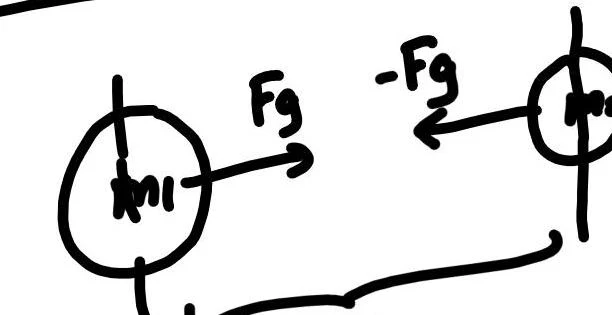
Every mass exerts an attractive force on every other mass. This gravitational force (Fg) is directly proportional to the product of the two masses and inversely proportional to the square of the distance between their centers:
Fg=Gr2m1m2
Diagram illustrating Newton's third law of motion, showing equal and opposite forces between two masses.
In this equation:
m1 and m2 are the masses of the two objects.
r is the distance between the centers of the masses.
G is the universal gravitational constant, which is approximately 6.67×10⁻¹¹ N⋅m2/kg2.
Because G is such a small number, we do not notice gravitational attraction between everyday objects (like two people standing near each other). However, when dealing with celestial bodies like planets, this force becomes massive.
Weight and Gravity
A common point of confusion is the difference between mass and weight. While mass is an intrinsic property of an object that remains constant everywhere, weight (W) is a force. Weight is the specific application of the gravitational force exerted by a celestial body on an object:
$W = F_g = mg$
Here, g represents the acceleration due to gravity. On Earth, g is approximately 9.8 m/s2. However, g is not a universal constant; it depends on the mass and radius of the planet you are standing on.
For example, the acceleration due to gravity on Earth can be calculated using the mass of the Earth (MEarth) and its radius (REarth):
g=REarth2GMEarth
Critical Distinction: If you travel to the Moon, your mass remains exactly the same because the amount of matter in your body hasn't changed. However, your weight will decrease because the Moon's mass is much smaller than Earth's, resulting in a smaller value for g.
Exam Tip: If a question asks how your "mass" changes on Mars, the answer is "it doesn't." If it asks how your "weight" changes, the answer is "it does."
Keep reading for free.
Create an account to finish this reading and make it part of your study routine.