Neurotransmitters, Neuromodulators, and Synaptic Transmission
An overview of the nervous system's chemical communication, including the synthesis, release, and removal of neurotransmitters and neuromodulators, and their pharmacological interventions. Covers acetylcholine, catecholamines, serotonin, amino acids, and neuropeptides.
The nervous system communicates through a sophisticated language of chemical signals. This communication occurs at specialized junctions called synapses, where electrical impulses in one neuron are converted into chemical messages that travel across a gap to influence another cell. Understanding how these chemicals are synthesized, released, and removed is fundamental to grasping how we move, learn, feel emotion, and respond to drugs.
The Mechanics of Synaptic Transmission
Synaptic transmission begins at the presynaptic neuron, the cell sending the signal. When an action potential reaches the axon terminal, it triggers the release of chemical messengers into the synaptic cleft—the narrow space between the sending and receiving cells.
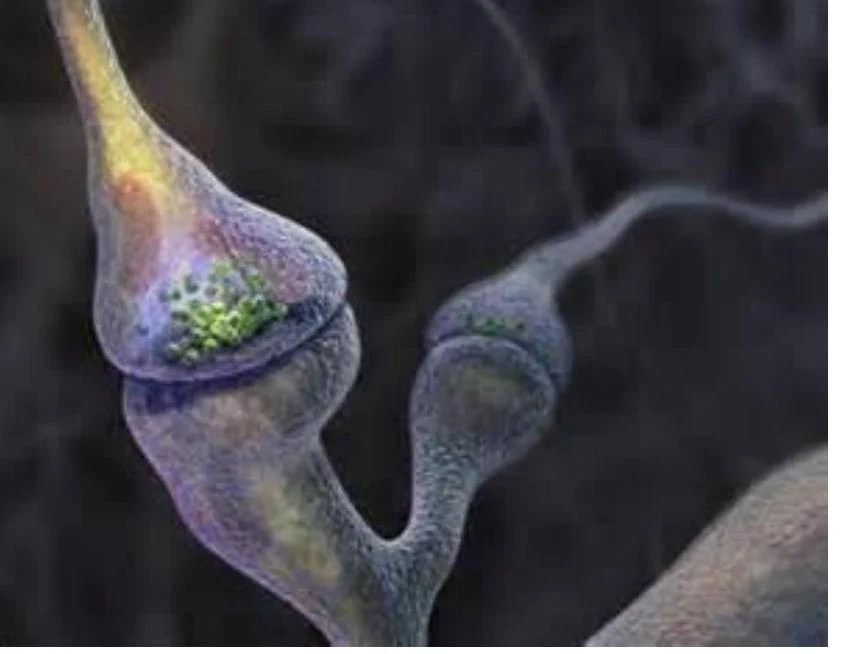
A diagram illustrating a synapse, the junction between two nerve cells.
Once released, these messengers bind to specific receptors on the postsynaptic membrane. The strength and type of the response depend on several factors, including the amount of neurotransmitter released, the rate of its removal, and the specific receptors present on the receiving cell.
Postsynaptic Integration: Summation
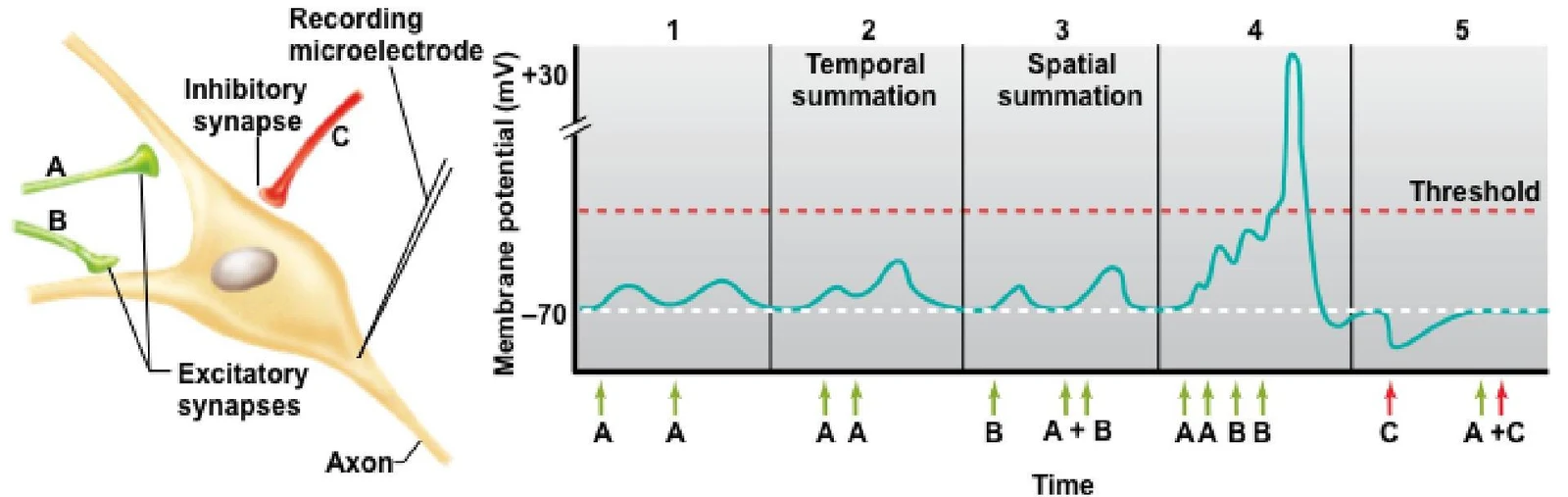
A single synapse rarely dictates whether a neuron fires an action potential. Instead, the postsynaptic neuron must perform postsynaptic integration at the axon hillock, summing up all the incoming excitatory and inhibitory signals.
There are two primary ways this summation occurs:
Temporal Summation: The addition of multiple signals from a single synapse that occur in rapid succession over time.
Spatial Summation: The addition of signals from multiple different synapses occurring at the same time.
This diagram illustrates how excitatory and inhibitory synapses affect the membrane potential of a neuron, demonstrating temporal and spatial summation leading to an action potential when the threshold is reached.
Exam Tip: Remember that synapses can be excitatory (generating an EPSP to bring the membrane closer to threshold) or inhibitory (generating an IPSP to move the membrane further from threshold).
Classification of Chemical Messengers
Chemical messengers are broadly categorized into neurotransmitters, neuromodulators, and neuropeptides.
Neurotransmitters (NTs)
Neurotransmitters are the primary drivers of rapid synaptic transmission. They are classified by their chemical structure:
1. Acetylcholine (ACh)
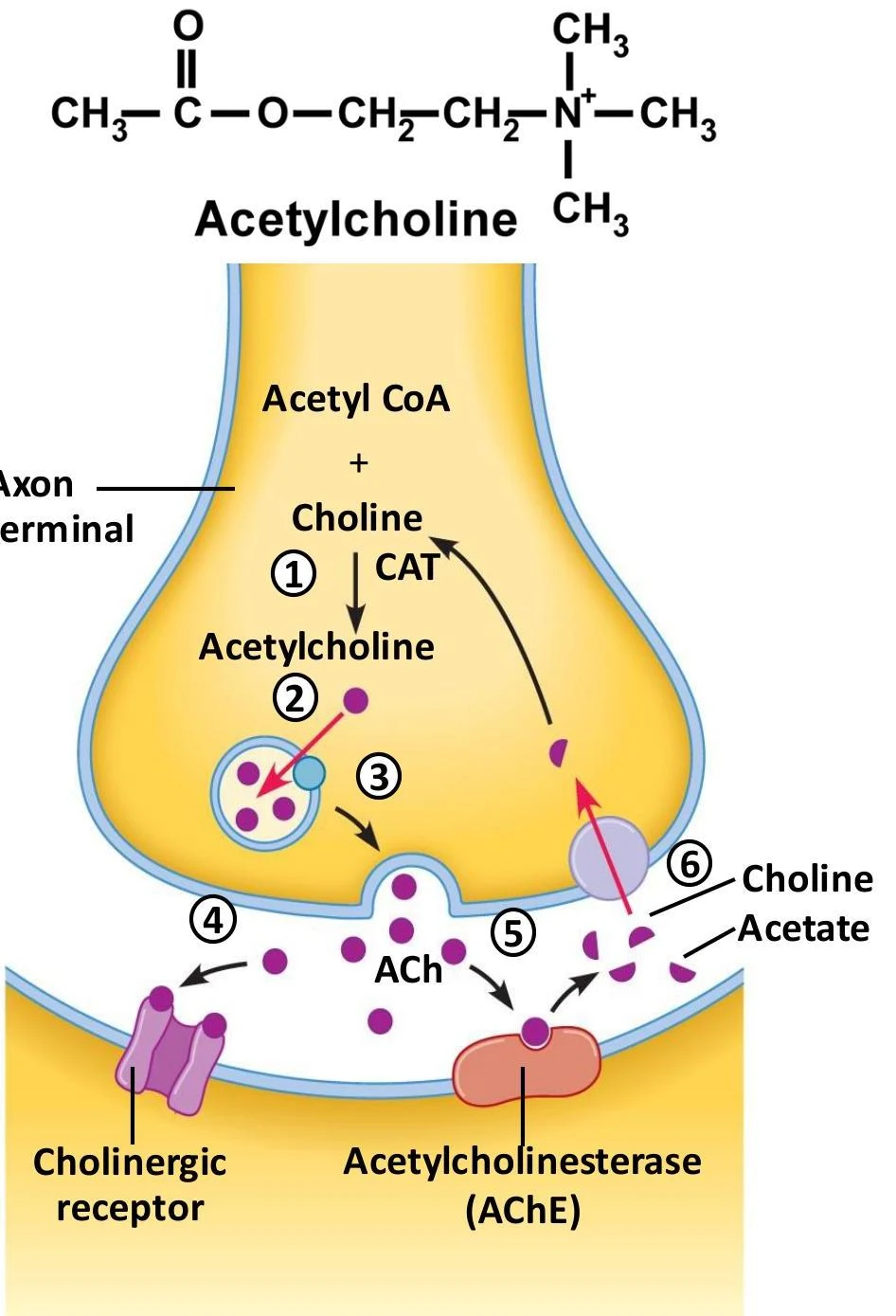
ACh is the most abundant neurotransmitter in the Peripheral Nervous System (PNS). It is synthesized in the axon terminal from Acetyl CoA and choline via the enzyme choline acetyltransferase (CAT). To prevent continuous stimulation, it is rapidly degraded in the cleft by acetylcholinesterase (AChE).
ACh acts on two distinct types of cholinergic receptors:
Nicotinic Receptors: Ionotropic receptors that act as fast-acting ion channels.
Muscarinic Receptors: Metabotropic receptors that utilize G-proteins for slower, more complex signaling.
Diagram illustrating the synthesis, release, and breakdown of acetylcholine at a synapse.
2. Biogenic Amines
These are derived from amino acids and include:
Catecholamines: Derived from tyrosine, these include Dopamine (reward, movement, and motivation), Norepinephrine (fight or flight response), and Epinephrine. They are removed from the cleft via reuptake or enzymatic degradation by MAO (Monoamine Oxidase) and COMT (Catechol-O-methyltransferase).
Serotonin (5-HT): Derived from tryptophan, serotonin regulates mood, sleep, and appetite. It is removed via reuptake (through the SERT transporter) or degradation by MAO.
3. Amino Acid Neurotransmitters
These are the workhorses of the Central Nervous System (CNS):
Excitatory:Glutamate is the primary excitatory NT in the brain. It is essential for Long-Term Potentiation (LTP), the process of strengthening synapses used in learning and memory. However, excessive glutamate can lead to excitotoxicity, causing neuronal death.
Inhibitory:GABA is the major inhibitory neurotransmitter in the brain, while Glycine provides inhibition primarily in the spinal cord and brainstem.
4. Neuropeptides
These are larger molecules (3–36 amino acids) that produce longer-lasting effects than small-molecule neurotransmitters. A key example is the opioid peptides (like endorphins), which provide analgesia (pain relief).
Neuromodulators (NM)
Unlike standard neurotransmitters, neuromodulators have little to no direct effect on the postsynaptic cell on their own. Instead, they modify how the postsynaptic cell responds to other neurotransmitters. They typically utilize G-proteins and second messenger systems, resulting in slower, longer-lasting effects (ranging from minutes to days) that are critical for processes like development and motivational states.
Pharmacological Interventions
Because synaptic transmission relies on a precise balance of synthesis, release, and removal, many drugs and diseases target these specific steps.
Pharmacological agents can act in several ways:
Agonists: Mimic the action of a neurotransmitter.
Antagonists: Block the receptor to prevent the neurotransmitter from acting.
Reuptake Inhibitors: Block the transporters (like SERT or NET) that remove neurotransmitters from the cleft, thereby increasing their concentration and duration of action.
Enzyme Inhibitors: Block the enzymes responsible for degrading neurotransmitters (such as MAO inhibitors used to treat depression).
Clinical Connection: Sarin gas is a potent neurotoxin because it inhibits acetylcholinesterase (AChE), leading to a massive buildup of acetylcholine and overstimulation of the nervous system.
Summary Table: Key Neurotransmitters
Category
Example
Primary Function
Removal Mechanism
Cholinergic
Acetylcholine
Muscle contraction, Parasympathetic activity
Enzymatic (AChE)
Catecholamine
Dopamine
Reward, Movement, Motivation
Reuptake, MAO, COMT
Catecholamine
Norepinephrine
Fight or Flight, Alertness
Reuptake (NET), MAO, COMT
Biogenic Amine
Serotonin
Mood, Sleep, Appetite
Reuptake (SERT), MAO
Amino Acid (Exc)
Glutamate
Learning (LTP), Memory
Reuptake
Amino Acid (Inh)
GABA
CNS Inhibition
Reuptake
Neuropeptide
Endorphins
Analgesia (Pain relief)
Slow degradation
Keep reading for free.
Create an account to finish this reading and make it part of your study routine.