An overview of neurons, glia, and the processes of synaptic transmission and neural coding, including electrical and chemical signaling within and between neurons. It also touches on the developmental imbalance in the adolescent brain.
How is it that a collection of microscopic cells can produce the vast complexity of human thought, memory, and emotion? To understand how we recognize a friend's face or plan a complex task, we must look beneath the surface of the brain to the cellular level. The nervous system relies on a sophisticated interplay between specialized cells and electrical-chemical signals to process the world around us.
The Cellular Architecture: Neurons and Glia
The brain is composed of two primary types of cells: neurons and glia. While neurons are the stars of the show when it comes to information processing, glia are the essential support crew that keeps the system running.
Neurons: The Information Carriers
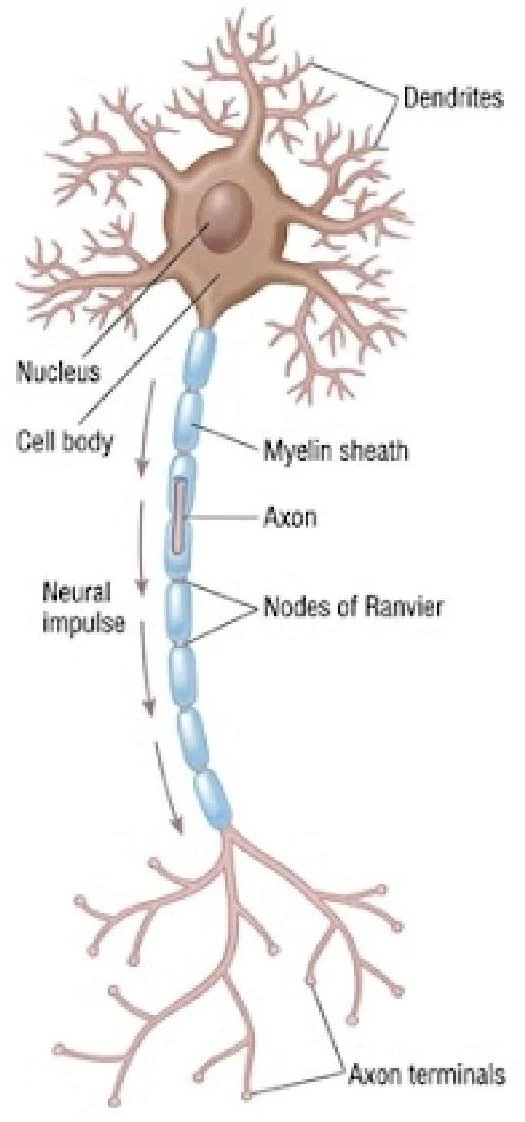
Neurons are individual cells that act as the primary carriers of information. A typical neuron consists of three major structural components:
Dendrites: These branch-like extensions act as the "input" side of the cell, detecting incoming signals from other neurons.
Cell Body: Also known as the soma, this part contains the nucleus and the metabolic machinery required to sustain the cell.
Axon: This is the "output" side of the neuron, a long fiber that transmits information away from the cell body toward other neurons.
Diagram of a neuron, illustrating its key components such as the cell body, nucleus, dendrites, axon, myelin sheath, nodes of Ranvier, and axon terminals, with arrows indicating the direction of neural impulse transmission.
Glia: The Support System
Glial cells provide much more than just structural support. They guide the development of the nervous system, repair damage, and control the flow of nutrients to neurons. One of the most critical types of glia are myelin cells. These cells wrap around axons to create a myelin sheath, which acts as electrical insulation.
This insulation allows the electrical signal to "jump" between the gaps in the sheath, known as the nodes of Ranvier, significantly increasing the speed of transmission—sometimes by up to ten times compared to unmyelinated neurons.
Synaptic Communication: Electrical and Chemical Signaling
Communication in the nervous system is a two-stage process involving both electrical and chemical signals.
1. Electrical Signaling (Within the Neuron)
When a neuron is activated, a signal travels down the axon via an electrical pulse. This is made possible by the movement of ions—atoms or molecules with an electrical charge—in and out of the cell.
If the movement of these ions creates a flow large enough to reach a specific threshold, the neuron produces an action potential. This process follows the all-or-none law: once the threshold is reached, the signal is sent with a constant magnitude; the neuron either fires completely or it does not fire at all.
2. Chemical Signaling (Between Neurons)
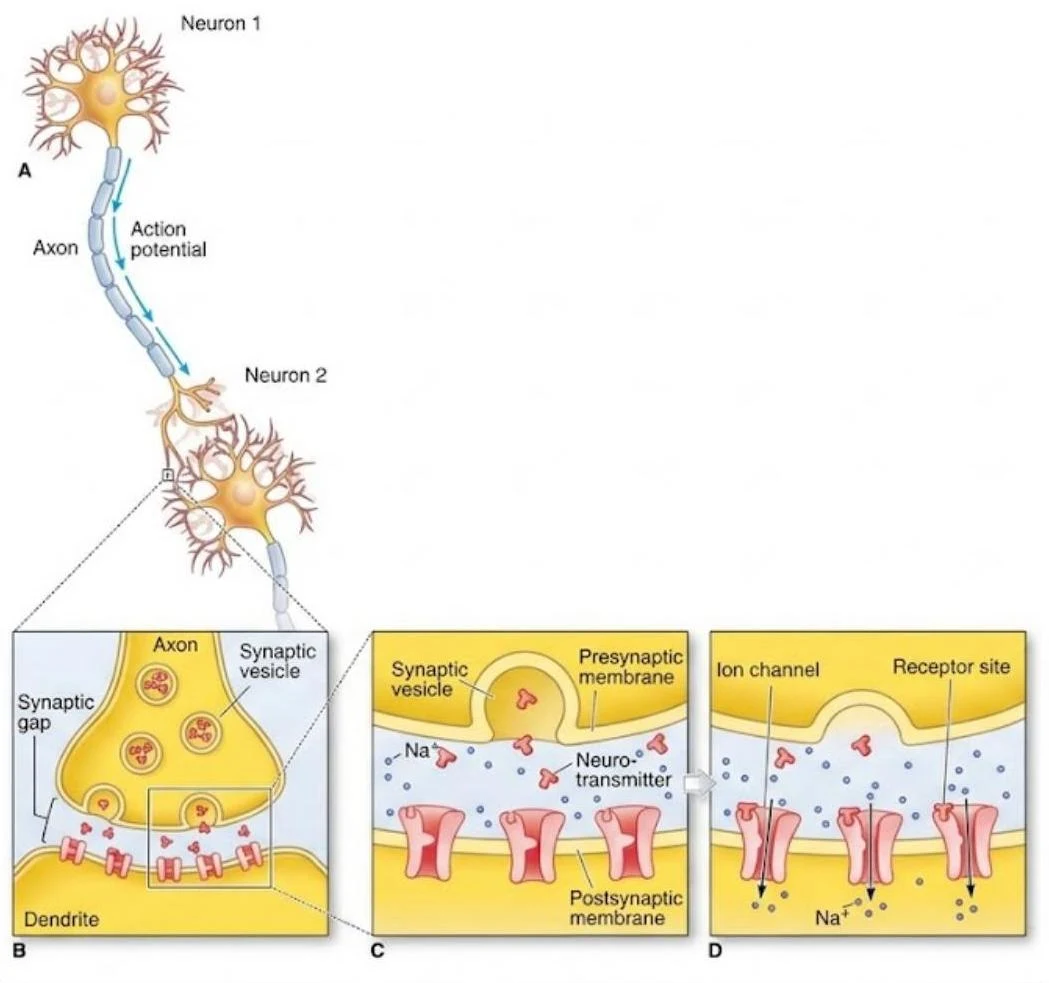
Neurons do not actually touch each other. Instead, they are separated by a tiny gap called the synapse (or synaptic gap). To bridge this gap, the communication shifts from electrical to chemical:
The signal reaches the presynaptic membrane (the end of the axon).
This triggers synaptic vesicles—tiny storage sacs—to burst and release chemicals called neurotransmitters into the gap.
The neurotransmitters drift across the synapse to bind with receptors on the postsynaptic membrane (the dendrite of the receiving neuron).
Diagram illustrating the process of synaptic transmission between two neurons, showing the release of neurotransmitters and their binding to receptors on the postsynaptic membrane.
The arrival of these chemicals causes ions to flow into or out of the postsynaptic cell, which can then trigger a new action potential in that second neuron.
Exam Tip: Synaptic Plasticity
Remember that the synapse is not a static connection. The strength of these chemical connections can be adjusted by experience. This "plasticity" is considered the neurological basis for learning and the storage of new skills.
Neural Coding: How Ideas are Represented
If neurons are just firing electrical pulses, how do those pulses represent a complex idea like "the smell of coffee" or "the concept of justice"? This is known as neural coding. The brain uses two primary methods:
Specific Coding: A specific group of neurons is activated by a specific stimulus. For example, researchers have found specific cells that fire only when a person sees a particular face.
Pattern Coding (Distributed Representation): Information is represented by widespread patterns of activity across many different neurons. This is often used for complex tasks, such as the coordination required for physical movement.
Developmental Imbalance: The Adolescent Brain
The way our brain functions is also heavily influenced by its developmental stage. Not all parts of the brain mature at the same rate, which can lead to significant differences in behavior between children, adolescents, and adults.
The limbic system—the brain structures involved in emotions, learning, and memory (including the amygdala)—develops relatively early. In contrast, the prefrontal cortex, which is responsible for executive functions like impulse control, careful judgment, and long-term planning, does not reach full adult efficiency until a person's mid-20s.
This creates a "developmental gap" in adolescents:
A highly sensitive limbic system that seeks immediate emotional rewards and excitement.
An underdeveloped prefrontal cortex that struggles to inhibit impulses or evaluate long-term consequences.
This imbalance explains why adolescents are often more prone to risk-taking behaviors, such as reckless driving or impulsive decision-making, as they are biologically more tuned to immediate gratification than to future repercussions.
Keep reading for free.
Create an account to finish this reading and make it part of your study routine.