This content explores the neurobiological underpinnings of binge eating, focusing on the mesocorticolimbic reward circuit and its differential activation in binge-eating-prone versus binge-eating-resistant rat models. It examines the roles of the nucleus accumbens and medial prefrontal cortex in reward processing and e
Binge eating is a hallmark symptom of various eating disorders, including bulimia nervosa and binge eating disorder. It is characterized by the consumption of large amounts of food in a short period, often accompanied by a perceived loss of control. While psychosocial factors play a role, researchers are increasingly looking toward the biological underpinnings of this behavior to understand why some individuals are more susceptible to binge eating than others.
One of the most promising areas of study involves the brain's reward system. Specifically, scientists are investigating how the mesocorticolimbic reward circuit reacts to highly rewarding foods. By using animal models, researchers can isolate these biological responses from the complex psychological variables present in humans.
The Mesocorticolimbic Reward Circuit
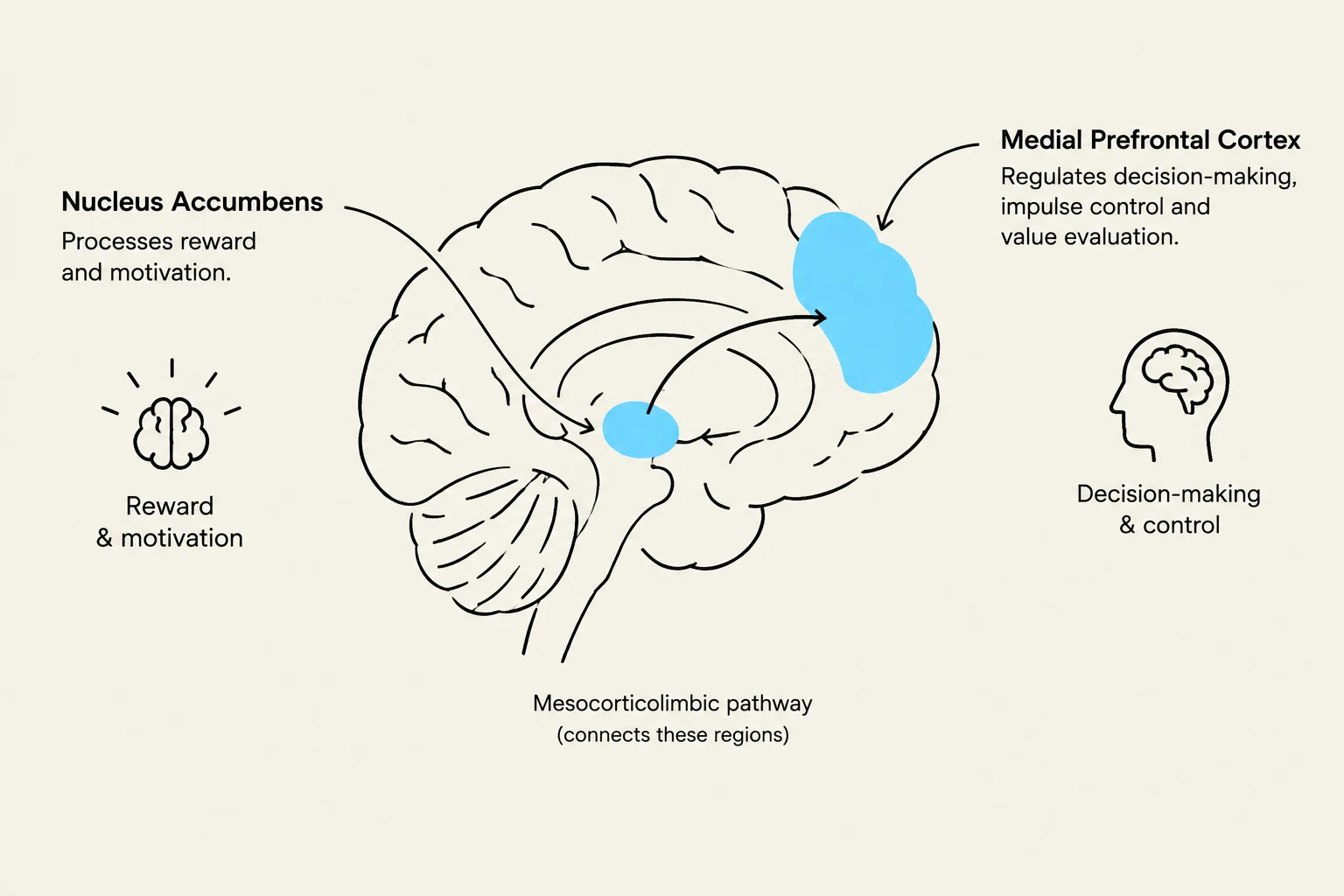
The mesocorticolimbic reward circuit is a fundamental neural pathway responsible for processing rewards. This circuit is central to how an organism perceives the hedonic value (the pleasure derived from a stimulus) and the incentive salience (the "wanting" or motivational pull) of a stimulus, such as palatable food (PF).
Palatable food, such as high-fat pellets, acts as a potent stimulus that activates this circuit more intensely than standard laboratory chow. The circuit primarily involves two key regions:
The Nucleus Accumbens (NA): Often considered the "reward center," it is involved in encoding the pleasure of food and the motivation to obtain it.
The Medial Prefrontal Cortex (mPFC): A region associated with higher-order functions, including executive control and decision-making.
This diagram illustrates the mesocorticolimbic pathway in the brain, highlighting the roles of the Nucleus Accumbens in processing reward and motivation, and the Medial Prefrontal Cortex in regulating decision-making, impulse control, and value evaluation.
Modeling Binge Eating: BEP vs. BER Rats
To study individual differences in binge eating, researchers utilize a model involving Sprague–Dawley rats. By providing intermittent access to palatable food (high-fat pellets) three times a week, researchers can categorize rats into two distinct phenotypes based on their consumption patterns:
Binge Eating Prone (BEP): Rats that consistently consume high amounts of palatable food during feeding tests.
Binge Eating Resistant (BER): Rats that consistently consume low amounts of palatable food.
Crucially, BEP rats are not "general over-eaters"; they binge specifically on palatable food and do not necessarily gain excessive weight compared to their BER counterparts. This makes the model highly effective for studying the specific neurobiology of binge eating rather than general obesity.
Study Tip: When analyzing animal models of addiction or eating disorders, look for "face validity" (does the behavior look like the human version?) and "construct validity" (does the underlying biological mechanism match?). The BEP/BER model is valued for both.
Measuring Neural Activation via Fos Expression
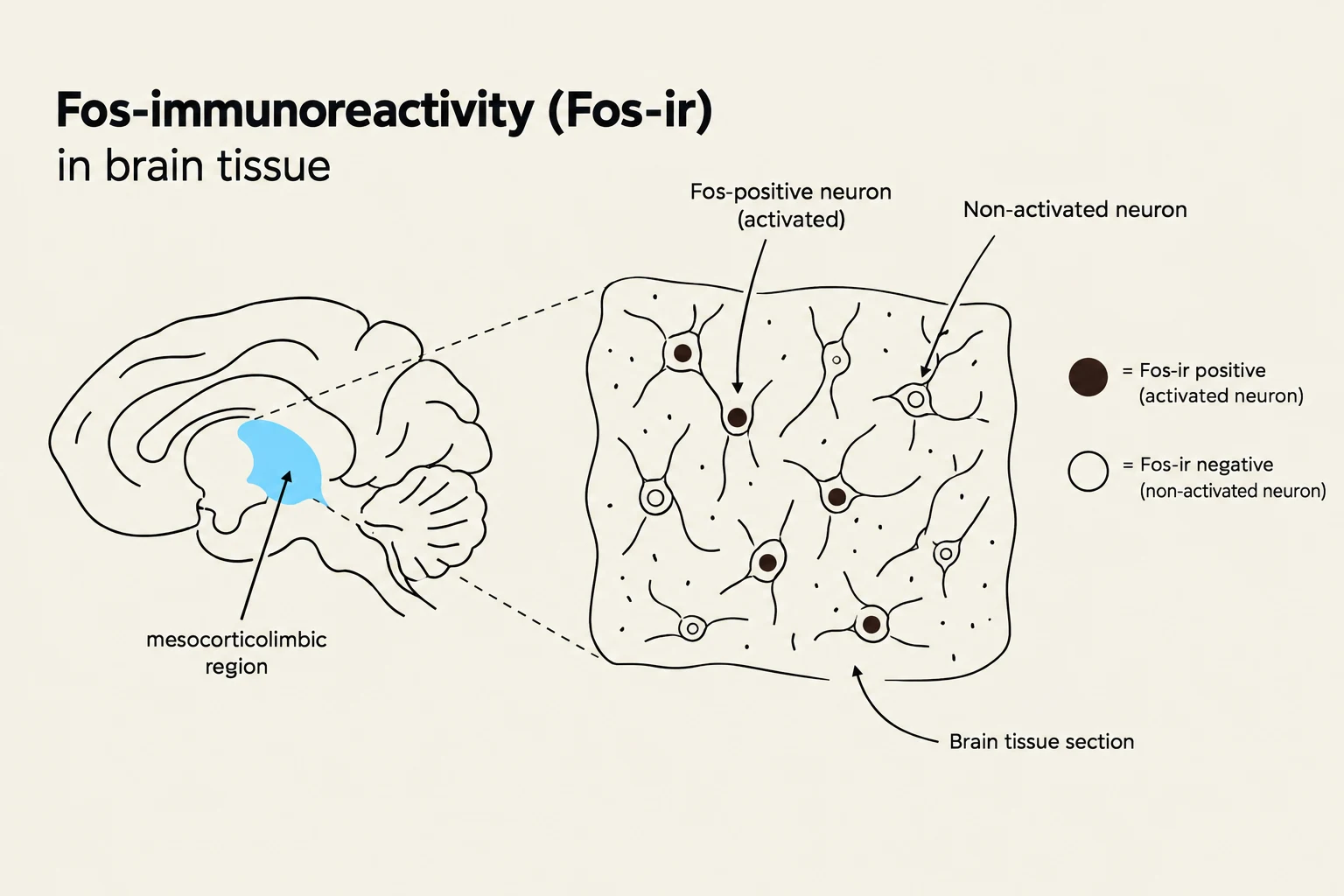
How do scientists actually "see" the brain responding to food? They look for Fos expression. Fos is a protein produced by the c-fos gene, which acts as a marker for neural activity. When a neuron is activated (depolarized), it begins to express Fos within 60–90 minutes. By measuring the number of Fos-immunoreactive (Fos-ir) cells in specific brain regions, researchers can create a map of which parts of the brain were "turned on" by the food.
In the study by Sinclair et al., researchers compared the Fos expression in the NA and mPFC of BEP and BER rats following exposure to palatable food.
This illustration shows Fos-immunoreactivity (Fos-ir) in brain tissue, specifically highlighting the mesolimbic region and a section of brain tissue with activated (Fos-positive) and non-activated (Fos-ir negative) neurons.
Key Findings: Reward vs. Executive Control
The results of the study revealed a significant difference in how these two types of rats process highly rewarding food.
1. Heightened Reward Response
BEP rats showed significantly higher Fos expression in the Nucleus Accumbens (both the core and the shell) compared to BER rats. Because the NA shell is a "hedonic hot spot" for food reward, this suggests that BEP rats may experience a more intense sense of pleasure or a stronger motivational drive to consume palatable food.
2. Altered Executive Control
Perhaps even more importantly, the differences between BEP and BER rats were more robust in the medial prefrontal cortex (mPFC) than in the nucleus accumbens. Specifically, BEP rats showed much higher Fos induction in the prelimbic (PrL) and infralimbic (IL) regions of the mPFC.
Since the mPFC is responsible for executive functions, these findings suggest that binge eating proneness is not just about "liking" food more, but is closely linked to altered executive control over food intake.
Mathematical Note: To ensure that differences in brain activity weren't just a result of the BEP rats eating more food, researchers used an ANCOVA (Analysis of Covariance). This allowed them to statistically control for the amount of food consumed, proving that the higher Fos expression was due to neural responsiveness rather than just the volume of food ingested.
Summary of Results
The following table summarizes the key differences observed in the neural activation (Fos expression) between the two groups after palatable food exposure:
Brain Region
Finding in BEP Rats
Biological Implication
Nucleus Accumbens (NA)
Higher Fos expression
Enhanced perception of reward and motivation
Medial Prefrontal Cortex (mPFC)
Significantly higher Fos expression
Altered executive control over food intake
In conclusion, the study provides evidence that binge eating proneness is associated with an enhanced mesocorticolimbic response to palatable food. While the reward-seeking drive in the nucleus accumbens is increased, the most striking difference lies in the prefrontal cortex, suggesting that a breakdown in the brain's ability to exert executive control may be a primary driver of binge eating behavior.
Keep reading for free.
Create an account to finish this reading and make it part of your study routine.