Network Security: Segmentation, Zero Trust, and Hardening
This article explains fundamental network security principles including segmentation, the Zero Trust model, and system hardening techniques to reduce attack surfaces and build resilient digital infrastructures.
In the modern cybersecurity landscape, the perimeter is no longer a physical wall around an office building. As organizations move to the cloud and embrace remote work, the network has become a fluid, distributed entity. Protecting this environment requires more than just a strong firewall; it requires a fundamental shift in how we design, segment, and secure our digital infrastructure. This article explores the core principles of secure network design, the transition toward Zero Trust, and the practical methods used to harden systems against exploitation.
Principles of Secure Network Design
A secure network is not built by adding security tools to an existing mess; it is built through intentional architecture. The goal is to create a design that minimizes the impact of a single compromise.
Network Segmentation
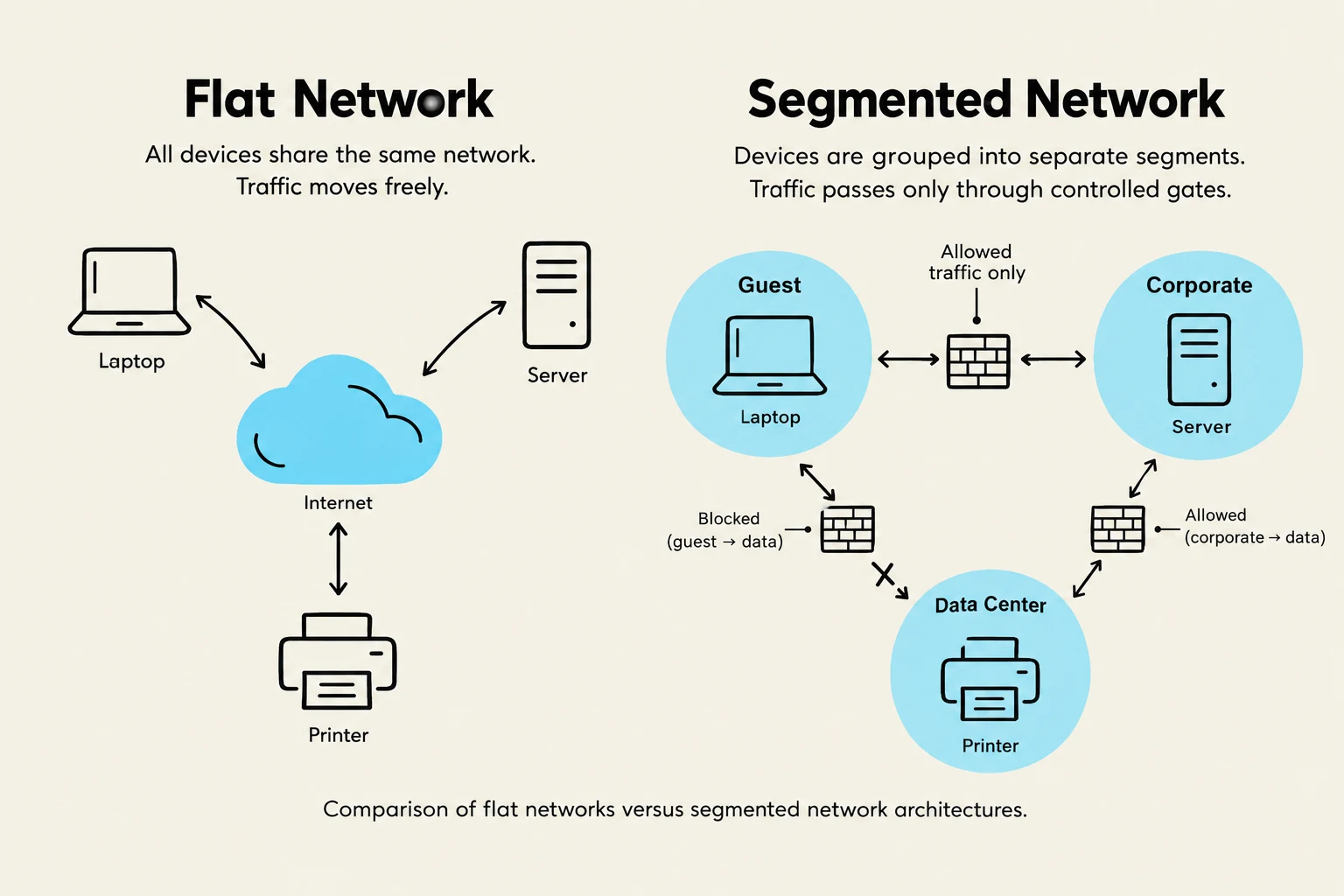
Comparison of flat networks versus segmented network architectures.
One of the most critical concepts in network security is segmentation. In a "flat" network, once an attacker gains access to one device, they can move laterally across the entire environment with ease. Segmentation breaks the network into smaller, isolated subnetworks (segments) based on function, risk level, or data sensitivity.
For example, an organization might separate its guest Wi-Fi, its internal employee workstations, and its high-security database servers into different segments. By using Virtual Local Area Networks (VLANs) and internal firewalls, administrators can control the traffic flowing between these segments.
The Zero Trust Model
The Zero Trust model illustrates a security framework involving user device verification, device health checks, and least privilege authorization before accessing cloud resources, emphasizing continuous verification of every request.
Traditional security relied on the "castle and moat" strategy: once you were inside the network, you were trusted. Modern security has moved toward the Zero Trust model. The core philosophy of Zero Trust is: "Never trust, always verify."
In a Zero Trust architecture, no user or device is trusted by default, regardless of whether they are inside or outside the corporate perimeter. Every request for access to a resource must be authenticated, authorized, and continuously validated.
Exam Tip: When evaluating security models, remember that Zero Trust focuses on identity and context (location, device health, time of day) rather than just network location.
Reducing the Attack Surface through Hardening
Once a secure architecture is designed, the individual components within that network—servers, routers, workstations, and IoT devices—must be "hardened." Hardening is the process of reducing the attack surface, which is the sum total of all points where an unauthorized user can try to enter or extract data from an environment.
System and Service Hardening
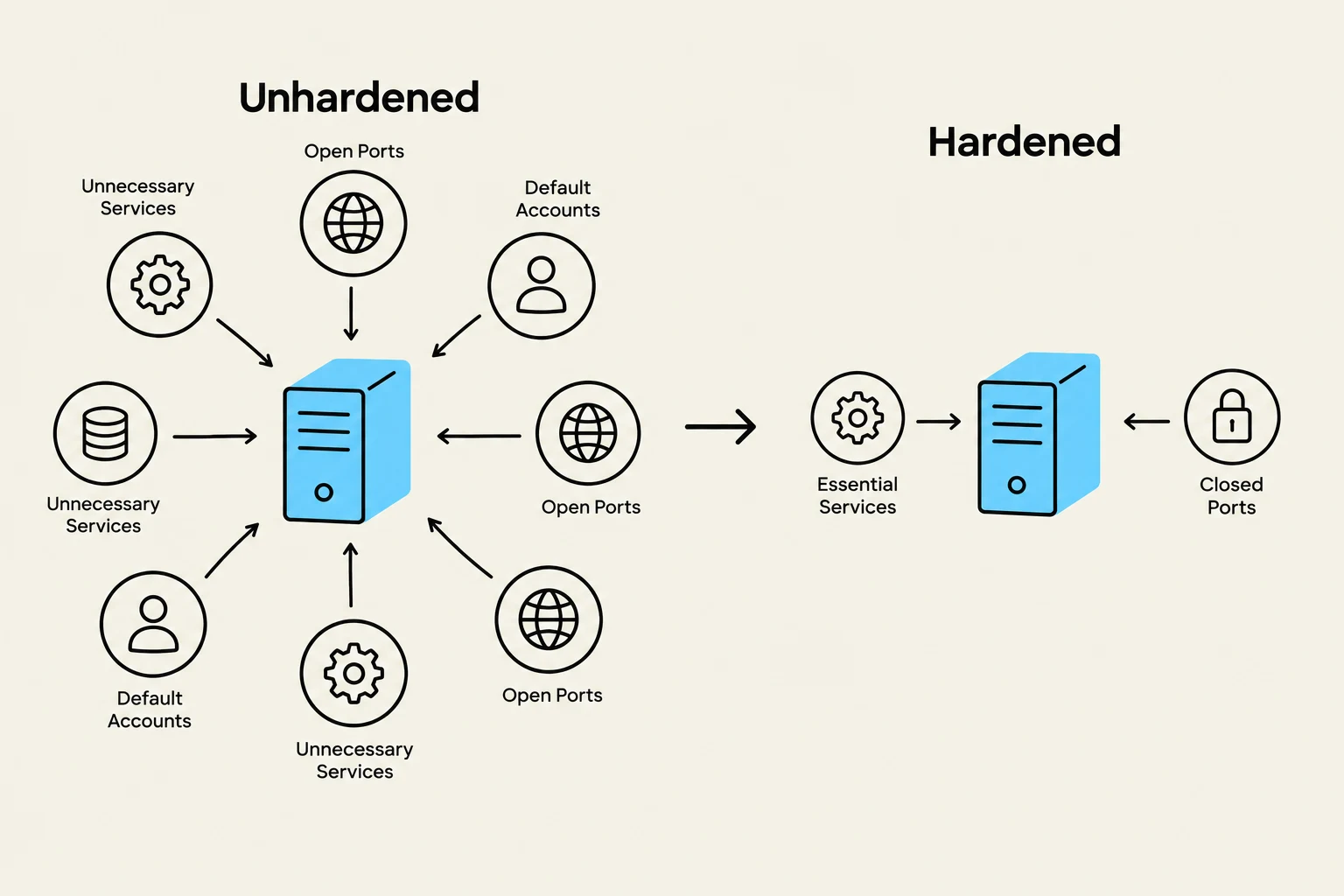
This diagram illustrates the difference between an unhardened and a hardened system. An unhardened system may have unnecessary services, open ports, and default accounts, making it vulnerable. A hardened system, conversely, has only essential services and closed ports, enhancing its security.
Every active service running on a device is a potential doorway for an attacker. Hardening involves a systematic reduction of these entry points:
Disabling Unnecessary Services: If a server is intended to be a web server, it does not need print services, file sharing (SMB), or remote registry services running. Each unnecessary service is a potential vulnerability.
Closing Unused Ports: Network ports that are not required for business operations should be closed at the host and network levels.
Removing Default Accounts and Passwords: Many devices ship with "admin/admin" or "guest/guest" credentials. Hardening requires changing these immediately and disabling default accounts that are not in use.
Patch Management: Keeping software and firmware up to date is the most effective way to close known vulnerabilities (CVEs).
Configuration Management
Hardening is not a one-time event; it is a continuous process. Using configuration management tools allows administrators to enforce a "Gold Image" or a standardized security baseline across thousands of devices. This ensures that if a new device is added to the network, it automatically adheres to the organization's security standards.
A Worked Example: Securing a Corporate Environment
To see these concepts in action, let's look at a hypothetical scenario of a medium-sized company.
The Scenario: A company has a central office with an on-site server, a guest Wi-Fi network, and several remote employees using VPNs.
The Insecure Approach (Flat Network):
All devices (guest laptops, employee PCs, and the server) are on the same subnet.
The server has several unused ports open for testing.
The VPN grants full access to the entire network once the user logs in.
Result: If a guest's laptop is infected with ransomware, it can scan the network, find the server, and encrypt the company's data within minutes.
The Secure Approach (Hardened & Segmented):
Segmentation: The network is split into three VLANs: Guest, Corporate, and Data Center. Traffic between them is strictly controlled by a firewall.
Zero Trust Implementation: The VPN now uses Multi-Factor Authentication (MFA). Even after logging in, the remote employee can only access the specific applications they need for their job, not the entire network.
Hardening: The server has been stripped of all unnecessary services. Only port 443 (HTTPS) is open for web traffic. All default passwords have been changed to complex, unique strings.
Result: If a guest's laptop is infected, the malware is trapped within the Guest VLAN. It cannot "see" the Corporate or Data Center segments, effectively neutralizing the threat.
Summary Table: Flat vs. Hardened Networks
Feature
Flat Network (High Risk)
Hardened/Segmented (Low Risk)
Lateral Movement
Easy; attackers can move freely.
Difficult; blocked by segmentation.
Access Control
Perimeter-based (Trust anyone inside).
Zero Trust (Verify everyone).
Attack Surface
Large; many open ports/services.
Small; only essential services run.
Visibility
Low; hard to spot unusual traffic.
High; segment boundaries act as checkpoints.
By combining the structural integrity of network segmentation and Zero Trust with the granular discipline of system hardening, organizations can build a defense-in-depth strategy capable of withstanding modern cyber threats.
Keep reading for free.
Create an account to finish this reading and make it part of your study routine.