This reading explains the organization of the human nervous system into the Central Nervous System (CNS) and the Peripheral Nervous System (PNS). It details the components and functions of the brain, spinal cord, somatic nervous system, and autonomic nervous system, including the sympathetic and parasympathetic divisio
The human nervous system is an incredibly complex network responsible for everything from the rhythmic beating of your heart to the profound depths of your thoughts and emotions. To study it effectively, scientists do not look at it as one single, undifferentiated mass of tissue. Instead, they organize it into functional divisions based on location and purpose. Understanding this organization is the first step in mastering neuroscience, as it allows us to distinguish between the "command center" of the body and the "communication lines" that connect that center to the rest of the world.
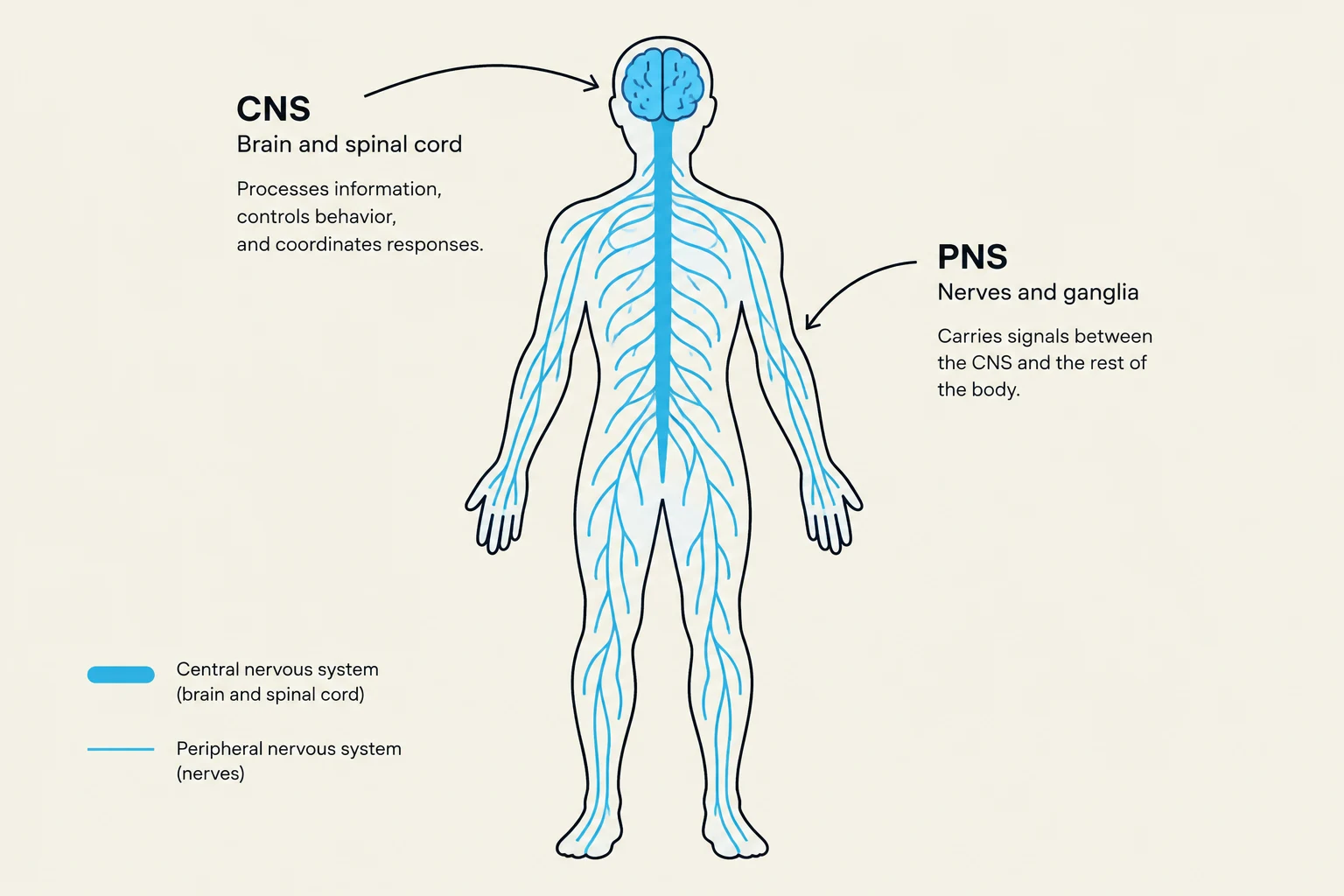
Diagram illustrating the Central Nervous System (CNS) and Peripheral Nervous System (PNS) in the human body.
The Central Nervous System (CNS): The Command Center
At the core of the entire system lies the Central Nervous System (CNS). If you think of the body as a massive corporation, the CNS is the executive boardroom where all the major decisions are made and all information is processed.
The CNS is composed of two primary structures:
The Brain: The most complex organ, responsible for high-level functions such as cognition, memory, emotion, and sensory integration.
The Spinal Cord: A long, slender column of nerve tissue that acts as a high-speed data highway, transmitting signals between the brain and the rest of the body.
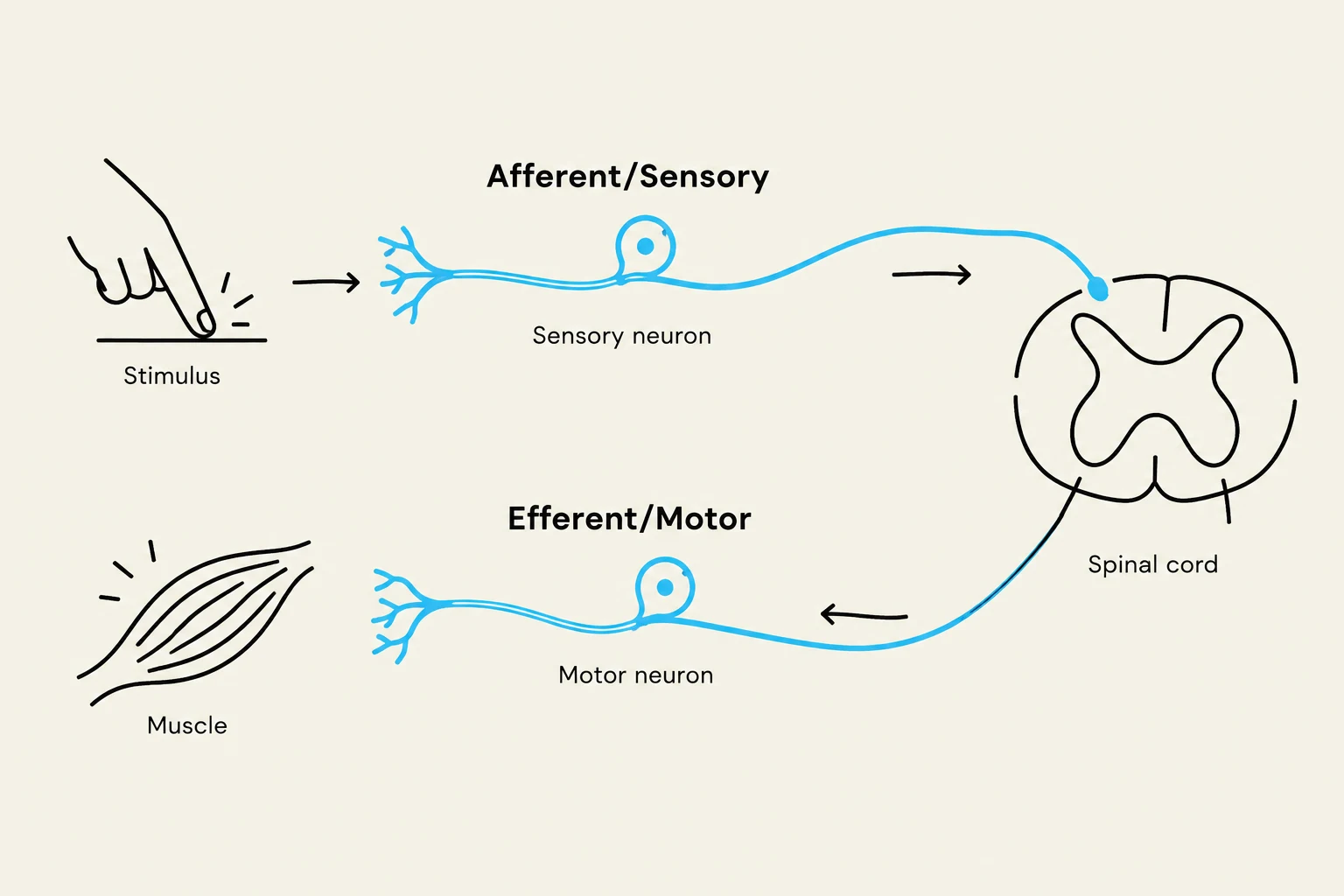
The primary role of the CNS is to receive sensory information, interpret that information, and then formulate a response. For example, if you touch a hot stove, the CNS receives the signal of "heat" and "pain," processes the danger, and immediately sends a command back out to your muscles to pull your hand away.
Exam Tip: When distinguishing between the CNS and PNS, remember that the CNS is strictly limited to the brain and spinal cord. If it is located outside these two structures, it belongs to the Peripheral Nervous System.
The Peripheral Nervous System (PNS): The Communication Network
Diagram illustrating the pathway of a reflex arc, showing a stimulus, sensory neuron, spinal cord, motor neuron, and muscle response.
While the CNS makes the decisions, it cannot act without the Peripheral Nervous System (PNS). The PNS consists of all the nerves that lie outside the brain and spinal cord. Its primary job is to serve as the communication relay between the CNS and the rest of the body, including your limbs, skin, and internal organs.
The PNS can be further divided based on the type of information it carries:
Sensory (Afferent) Neurons: These carry information toward the CNS. They tell your brain what is happening in the environment (e.g., "the room is dark" or "the coffee is hot").
Motor (Efferent) Neurons: These carry instructions away from the CNS to the muscles and glands, telling the body how to react (e.g., "move your leg" or "increase heart rate").
Functional Divisions of the Peripheral Nervous System
The most critical way to study the PNS is by looking at how it controls your body's actions. We divide the motor component of the PNS into two distinct systems: the Somatic Nervous System and the Autonomic Nervous System.
1. The Somatic Nervous System (SNS)
The Somatic Nervous System is associated with the voluntary control of body movements via skeletal muscles. When you decide to walk across a room or pick up a pen, you are utilizing your somatic nervous system. It also plays a role in transmitting sensory information from the skin and muscles to the CNS.
2. The Autonomic Nervous System (ANS)
In contrast to the somatic system, the Autonomic Nervous System governs involuntary functions. These are the processes you don't have to think about to keep you alive, such as digestion, heart rate, pupillary response, and respiratory rate.
The ANS is further subdivided into two branches that act like a biological seesaw, balancing your body's internal state:
The Sympathetic Nervous System: "Fight or Flight"
The sympathetic division is activated during times of stress, danger, or intense physical activity. It prepares the body for immediate action by mobilizing energy. When this system kicks in, you might experience:
Increased heart rate and blood pressure.
Dilation of the pupils to let in more light.
Inhibition of digestion (to divert energy to muscles).
Rapid breathing.
The Parasympathetic Nervous System: "Rest and Digest"
Once the threat has passed, the parasympathetic division takes over to restore the body to a state of equilibrium, or homeostasis. It focuses on conserving energy and maintaining long-term health. Its effects include:
Decreased heart rate.
Stimulation of digestive processes.
Constriction of the pupils.
Promotion of relaxation and recovery.
This diagram illustrates the contrasting physiological responses of the sympathetic and parasympathetic nervous systems, detailing effects on pupils, heart rate, and digestion.
Summary Table of Nervous System Organization
To help visualize these relationships, refer to the hierarchy below:
Division
Sub-Division
Primary Function
Control Type
Central (CNS)
Brain & Spinal Cord
Integration and Command
N/A
Peripheral (PNS)
Somatic
Skeletal muscle movement & sensation
Voluntary
Autonomic
Internal organ regulation
Involuntary
— Sympathetic
Mobilizes energy (Stress response)
Involuntary
— Parasympathetic
Conserves energy (Recovery)
Involuntary
By understanding this hierarchy, you can trace any physiological event—from a sudden jump in response to a loud noise to the slow process of digesting a meal—back to the specific neurological division responsible for it.
Keep reading for free.
Create an account to finish this reading and make it part of your study routine.