Negligence Causation and Proximate Cause in Tort Law
Explains the legal concepts of cause in fact (but-for test, loss of chance doctrine) and proximate cause (foreseeability test, eggshell plaintiff rule, intervening/superseding causes) in tort law, along with public policy limitations on liability.
In the law of torts, proving that a defendant was "negligent" (careless) is only half the battle. To successfully recover damages, a plaintiff must demonstrate a direct link between the defendant's breach of duty and the harm suffered. This link is divided into two distinct legal requirements: cause in fact (factual causation) and proximate cause (legal causation). While cause in fact asks if the defendant's actions physically triggered the event, proximate cause acts as a policy-driven boundary, limiting liability to those harms that are reasonably connected to the defendant's conduct.
The But-For Test illustrates factual causation in law, demonstrating that if an injury would not have occurred "but for" a defendant's negligent action, then that action is considered the factual cause of the injury.
Cause in Fact: The "But-For" Test
The primary method for establishing factual causation is the but-for test. Under this standard, the plaintiff must prove that the injury would not have occurred "but for" the defendant's conduct. If the injury would have happened anyway—regardless of the defendant's actions—then the defendant is not the factual cause.
In a trial, the plaintiff carries the burden of proving this connection by a preponderance of the evidence, meaning it is "more likely than not" that the defendant's conduct caused the harm. Mere suspicion, conjecture, or speculation is insufficient to satisfy this burden.
The Loss of Chance Doctrine
A notable exception to the strict but-for requirement is the loss of chance doctrine. This arises in medical malpractice or similar cases where a defendant's negligence does not directly cause death, but rather diminishes the plaintiff's statistical probability of survival. Instead of claiming "but for your mistake, I would be alive," the plaintiff claims "but for your mistake, I would have had a higher chance of survival".
To compensate for this diminished probability, courts use an absolute value valuation method to calculate damages:
Damages=(Chance without negligence−Chance with negligence)×Total value of life
Exam Tip: When analyzing a medical negligence hypo, check if the plaintiff can prove the "but-for" link to the injury itself. If they can only prove a reduction in survival odds, pivot your analysis to the Loss of Chance doctrine.
Proximate Cause: The Scope of Liability
Even if a defendant is the factual cause of an injury, the law may limit their liability through proximate cause. Proximate cause is a "liability limitation device" designed to ensure that defendants are not held responsible for every single rippling effect of their actions.
The Foreseeability Test
The modern standard for proximate cause is the foreseeability test, established in Wagon Mound 1. Under this rule, a defendant is liable only for those consequences that were reasonably foreseeable at the time of the negligent act. This replaced the outdated direct consequences test (Polemis), which held defendants liable for all direct results of their actions, no matter how unpredictable they were.
Manner of Harm vs. Type of Harm
A critical distinction in proximate cause is the difference between the type of harm and the manner in which it occurs. According to the rule in Hughes v. Lord Advocate, if the general type of harm is foreseeable, the specific manner of harm is immaterial.
For example, if a defendant's negligence creates a foreseeable risk of an explosion, they may be liable even if the explosion occurs in a highly unusual or unexpected way.
The Eggshell Plaintiff Rule
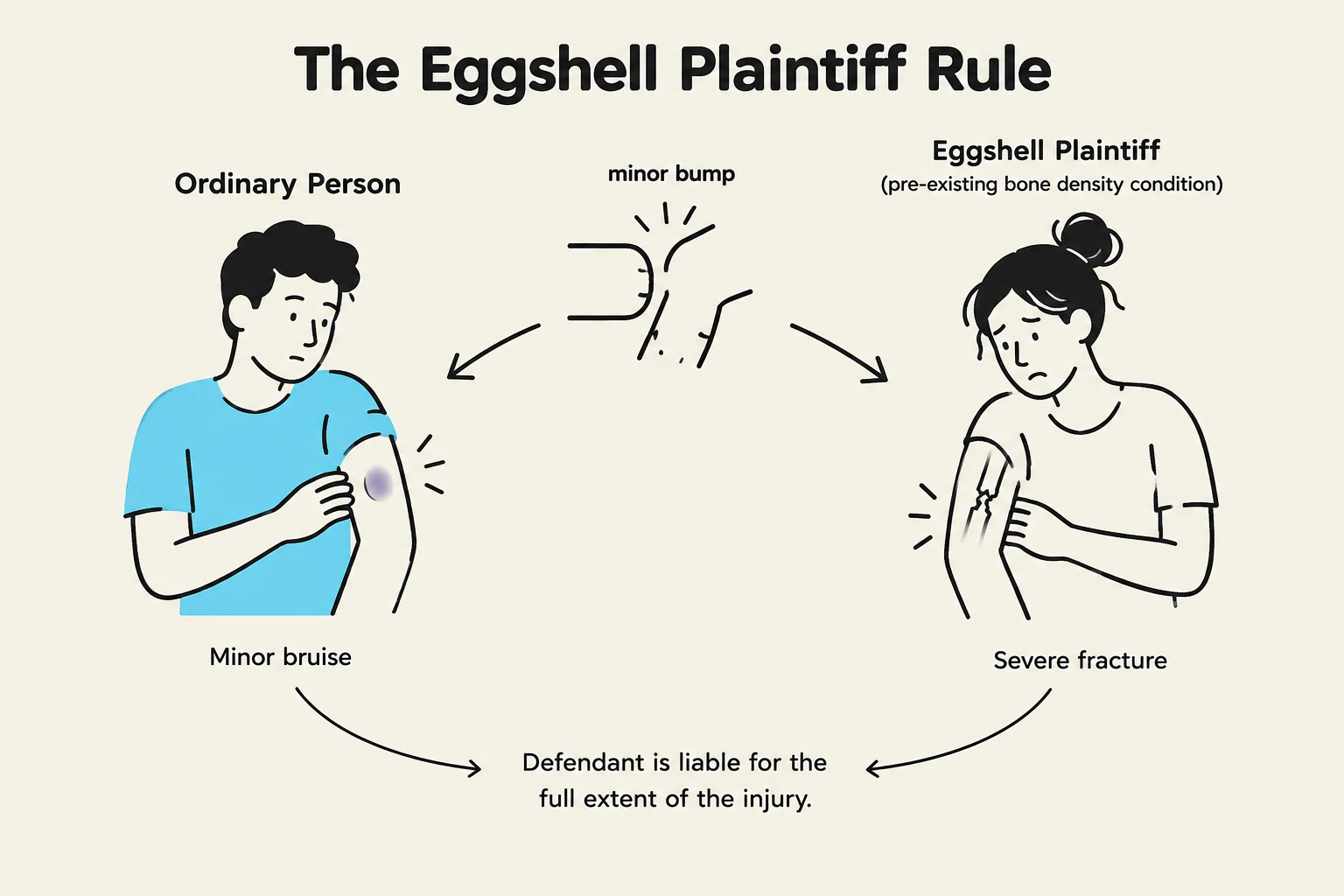
The Eggshell Plaintiff Rule illustrates how a defendant is liable for the full extent of an injury, even if the plaintiff has a pre-existing condition that exacerbates the harm from a minor incident.
While the type of harm must be foreseeable, the extent of the harm does not have to be. Under the eggshell plaintiff rule, a defendant "takes the plaintiff as they find them". If a plaintiff has a pre-existing physical condition that makes them more susceptible to injury, the defendant is liable for the full extent of the harm, even if an ordinary person would not have suffered such severe consequences.
Intervening and Superseding Causes
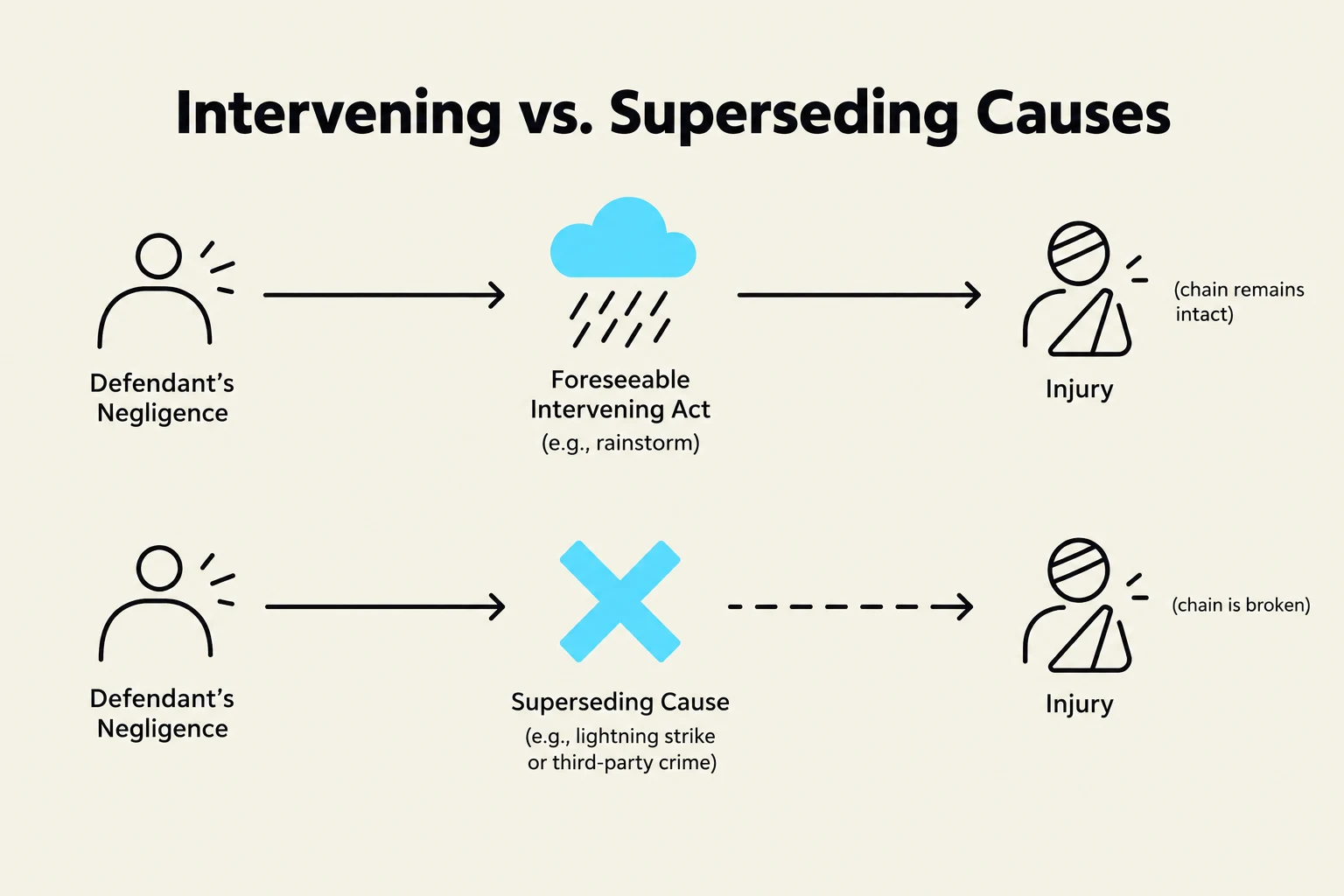
This diagram illustrates the difference between intervening and superseding causes in legal contexts. A foreseeable intervening act, like a rainstorm, does not break the chain of causation from the defendant's negligence to the injury. However, a superseding cause, such as a lightning strike or third-party crime, breaks this chain.
The causal chain can sometimes be broken by an intervening cause—an event that occurs after the defendant's negligent act and contributes to the injury.
Foreseeable Intervening Acts: If the intervening act was a reasonably foreseeable consequence of the defendant's original conduct, the defendant remains liable.
Superseding Causes: If the intervening act is so unexpected or extraordinary that it "cuts off" the defendant's liability, it is considered a superseding cause.
Criminal Acts of Third Parties: Generally, the criminal act of a third party is considered unforeseeable and acts as a superseding cause that relieves the original defendant of liability. However, if the criminal act was a foreseeable result of the defendant's negligence, liability may still attach.
Force of Nature: An extraordinary force of nature (an "act of God") does not automatically relieve a defendant of liability. If the defendant failed to take adequate precautions against foreseeable natural risks, they remain liable.
The Rescue Doctrine
The law provides special protection for those who attempt to help others in danger. Under the rescue doctrine, a defendant owes the same duty of care to a rescuer as they do to the original victim. An injured rescuer can recover damages if:
The defendant's negligence caused a peril to another;
The peril was imminent;
A reasonably prudent person would have recognized the peril; and
The rescuer acted with reasonable care.
Note: The rescue doctrine has been held to apply even in product liability cases.
Public Policy Limits on Liability
Finally, courts may use public policy to limit liability entirely, even when causation is present. This is often referred to as a "no-duty" ruling. Unlike foreseeability, which is a question of fact for a jury, a no-duty ruling is a question of law decided by a judge based on broad social concerns.
Examples of policy-based limitations include:
Crushing Liability: Preventing a chain reaction of lawsuits that would be economically devastating to society (e.g., utility companies being liable to non-customers).
Autonomy and Morality: Courts are often unwilling to impose a duty to act (nonfeasance) based solely on moral obligations or "goodwill".
Keep reading for free.
Create an account to finish this reading and make it part of your study routine.