NCCN Guidelines for Uterine Neoplasms: A Clinical Overview
This overview details the NCCN Guidelines for Uterine Neoplasms, focusing on the management of endometrial carcinomas and uterine sarcomas. It covers histological subtypes, fertility-sparing options, molecular analysis, biomarker-directed therapy, surgical staging, radiation therapy, and considerations for toxicities a
The management of uterine neoplasms has undergone a paradigm shift, moving from a purely histological approach to one deeply rooted in molecular profiling. The NCCN Guidelines for Uterine Neoplasms provide a sophisticated framework for clinicians to navigate the complexities of endometrial carcinomas and uterine sarcomas. By integrating pathology, advanced imaging, and biomarker-directed systemic therapies, these guidelines aim to optimize outcomes through highly personalized treatment regimens.
Endometrial Carcinoma Management
Endometrial carcinoma represents the most common malignancy of the uterus. The guidelines categorize these tumors not just by their appearance under a microscope, but by their molecular drivers, which dictate prognosis and therapeutic response.
Histological Subtypes
While endometrioid adenocarcinoma is the most frequent type, clinicians must remain vigilant for high-grade histologies that carry a more aggressive clinical course. These include:
Serous carcinoma: A high-grade subtype requiring intensive management.
Clear cell carcinoma: Another high-grade variant with distinct clinical implications.
Carcinosarcoma: Formerly known as malignant mixed Müllerian tumor, this is treated as a high-grade endometrial cancer.
Undifferentiated/Dedifferentiated carcinoma: Highly aggressive forms of the disease.
Fertility-Sparing Options and Ovarian Preservation
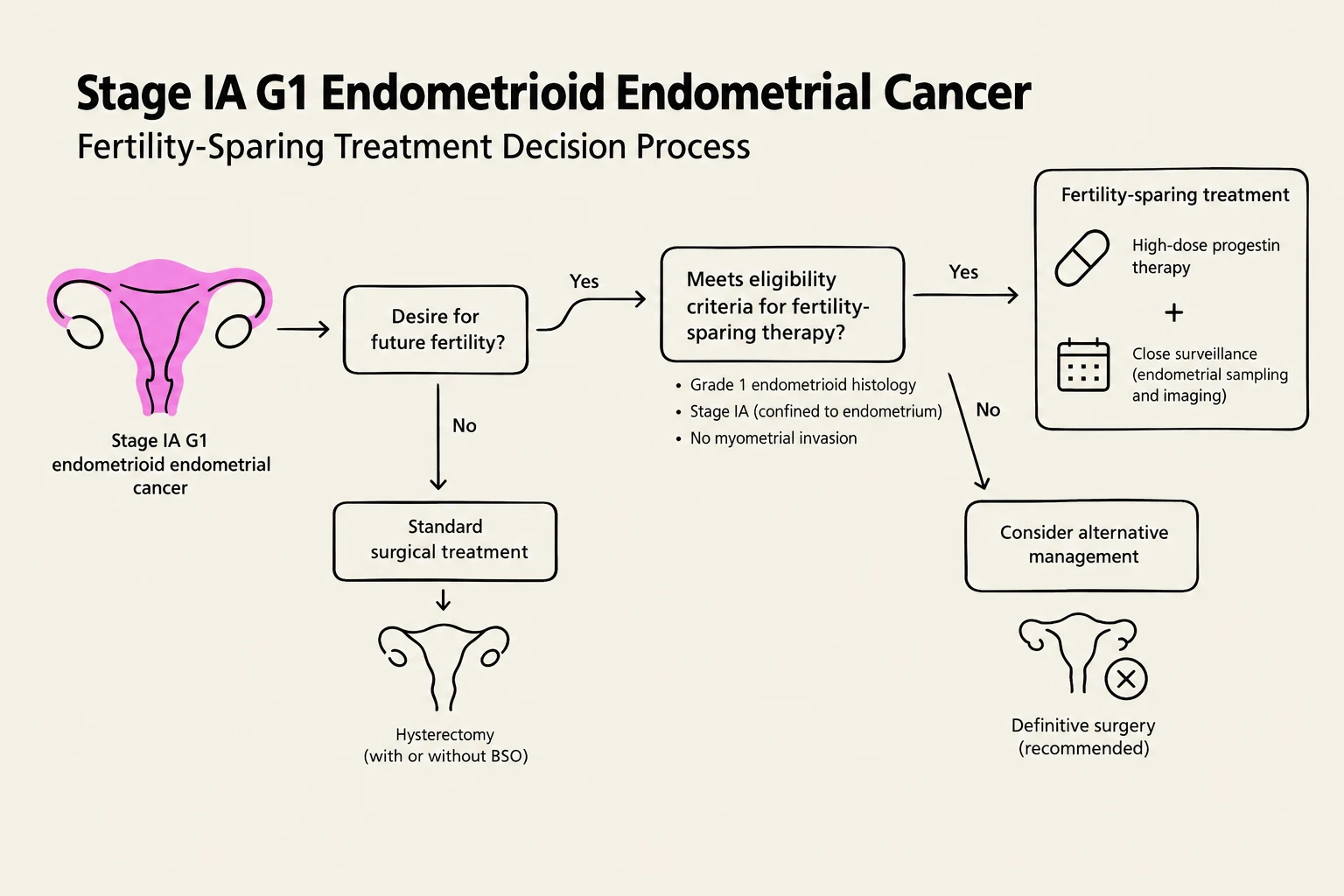
For a specific subset of patients, preserving reproductive function is a primary goal. Fertility-sparing management is reserved for select premenopausal patients with early-stage (Stage IA, G1) endometrioid cancer.
To qualify, several strict criteria must be met:
The cancer must be well-differentiated (Grade 1) endometrioid adenocarcinoma confirmed by expert pathology.
There must be no evidence of p53 abnormality, mismatch repair (MMR) deficiency, lymphovascular space invasion (LVSI), or positive cytology.
The patient must have normal-appearing ovaries and no family history of Lynch syndrome or ovarian/breast cancer.
The preferred treatment for these patients is the Levonorgestrel IUD, supplemented by regular endometrial monitoring via hysteroscopy, D&C, or biopsy every 3–6 months. In these cases, ovarian preservation may be considered safe, though salpingectomy is recommended.
Clinical Pearl: If endometrial cancer is still present at the 6-month monitoring mark, clinicians may consider dual-progestin therapy (e.g., Megestrol or Medroxyprogesterone combined with a Levonorgestrel IUD).
This flowchart outlines the decision-making process for fertility-sparing treatment in Stage IA G1 endometrioid endometrial cancer, detailing eligibility criteria and treatment options.
Molecular Analysis and Biomarker-Directed Therapy
Modern oncology relies on "precision medicine," and uterine neoplasms are no exception. Molecular profiling is now a cornerstone of the NCCN guidelines.
Key Molecular Markers
Testing for specific genetic alterations is critical for determining the appropriate systemic therapy:
POLE mutations: Associated with a distinct molecular subgroup.
MSI-H/dMMR status: Testing for mismatch repair deficiency (dMMR) or high microsatellite instability (MSI-H) is essential.
p53 abnormalities: Identifying p53 aberrant carcinomas is vital for prognosis.
HER2 testing: Recommended for all p53 aberrant carcinomas and all metastatic/recurrent disease.
TMB-H (Tumor Mutational Burden High): Testing is recommended for determining eligibility for certain immunotherapies.
NTRK and RET gene fusions: Testing is considered for metastatic or recurrent cases.
Systemic Therapy Strategies
The choice of systemic therapy is heavily influenced by the biomarkers identified above:
Carboplatin/Paclitaxel/Durvalumab or Carboplatin/Paclitaxel/Bevacizumab
TMB-H
Ipilimumab + Nivolumab
HER2-positive
Fam-trastuzumab deruxtecan-nxki (specifically for carcinosarcoma)
RET fusion-positive
Selpercatinib
Exam Tip: When evaluating a patient with recurrent endometrial cancer, always check if MSI-H/dMMR testing has been performed, as this significantly alters the first-line immunotherapy approach.
Surgical Staging and Localized Management
For patients not pursuing fertility-sparing options, the standard of care typically involves surgical intervention.
Surgical Staging
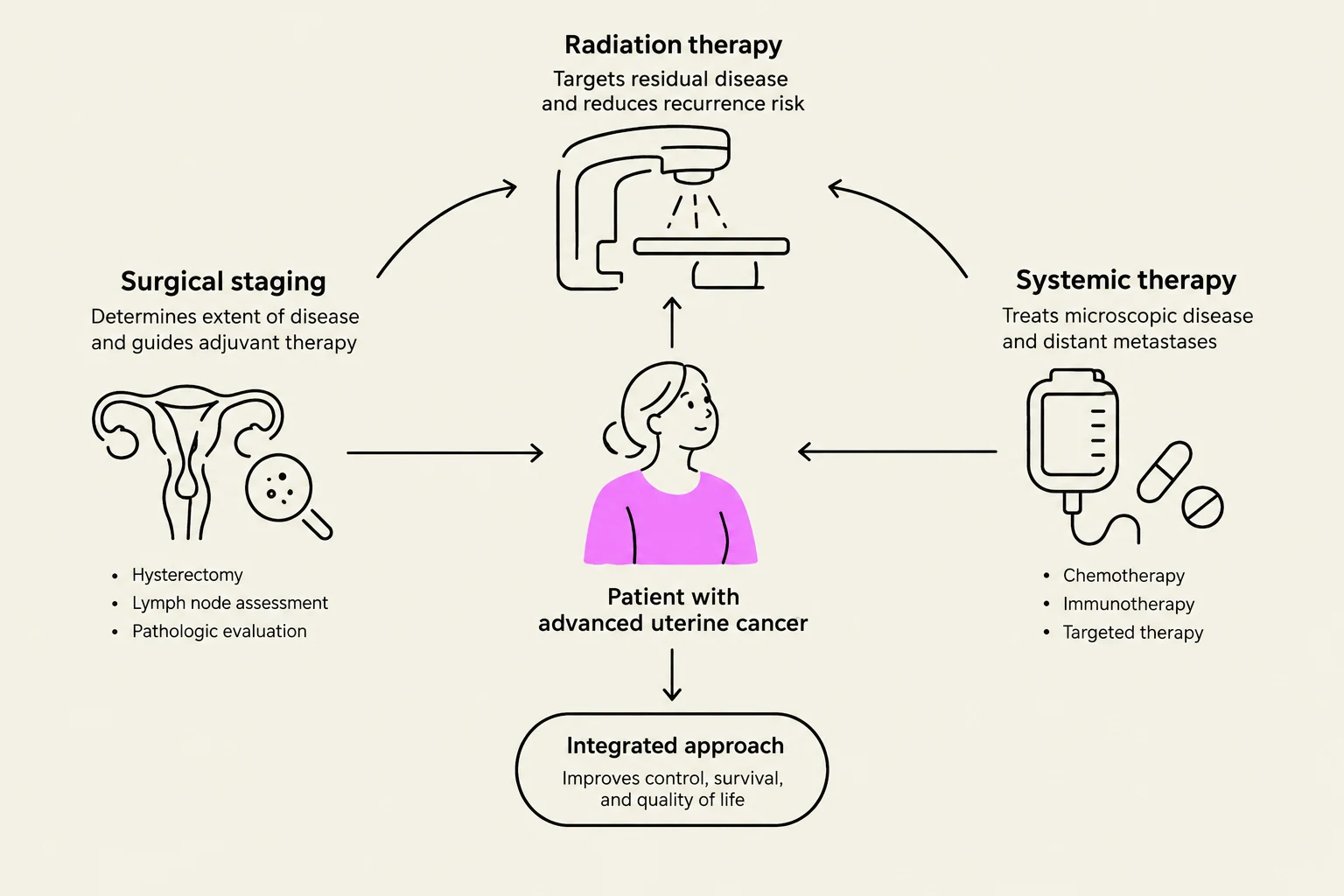
The standard management often involves a total hysterectomy and bilateral salpingo-oophorectomy (TH/BSO). The degree of surgical staging is determined by preoperative and intraoperative findings to assess the extent of the disease.
Radiation Therapy
Radiation therapy (RT), including external beam radiation therapy (EBRT) and brachytherapy, is utilized for locoregional control. For patients with oligometastatic disease (1–5 lesions), clinicians may consider ablative RT ablation if the primary cancer is controlled.
This diagram illustrates an integrated approach to managing advanced uterine cancer, encompassing surgical staging, radiation therapy, and systemic therapy, all aimed at improving patient outcomes.
Uterine Sarcoma Management
Uterine sarcomas are malignant mesenchymal tumors that require a different management paradigm than carcinomas.
Classification
The guidelines categorize sarcomas into several types:
Low-Grade Endometrial Stromal Sarcoma (ESS): Often managed with hormonal approaches.
Adenosarcoma: May present with or without sarcomatous overgrowth.
High-Grade Variants: Including Leiomyosarcoma (LMS), Undifferentiated Uterine Sarcoma (UUS), and other rare types like PEComa.
Targeted and Hormonal Therapy
Because many sarcomas are hormone-sensitive, hormonal therapy is a key component of treatment:
ER/PR-positive tumors: Aromatase inhibitors are preferred for low-grade ESS or adenosarcoma without salpingo-oophorectomy (SO). Other options include megestrol acetate or medroxyprogesterone acetate.
For advanced or recurrent disease, biomarker-directed therapy is utilized:
CDK4 amplification: May guide the use of palbociclib.
MSI, BRCA 1/2, NTRK, and RET fusions: These should be included in the molecular analysis to identify rare pan-tumor targeted therapy opportunities.
Relapse and Metastatic Disease
In cases of oligometastatic disease, clinicians may consider metastasectomy (surgical removal of metastases), which has historically been a standard approach. Local control may also be achieved through EBRT/SBRT or other local ablative therapies.
This diagram outlines the molecular testing requirements and primary therapeutic directions for endometrial carcinoma based on different molecular profiles.
Clinical Considerations: Toxicities and Survivorship
As treatment becomes more complex, clinicians must manage the side effects of advanced therapies. For patients receiving immunotherapy, the NCCN emphasizes the importance of monitoring for immune checkpoint inhibitor-related toxicities. Furthermore, the guidelines advocate for a holistic approach that includes assessing patient distress and supporting gynecologic survivorship.
Keep reading for free.
Create an account to finish this reading and make it part of your study routine.