This guide explores the complexities of managing a business in a globalized world, covering political, economic, legal, and cultural systems, organizational design, global strategies, market entry, human resources, operations, finance, and technology.
In an era of unprecedented connectivity, managing a business is no longer confined by national borders. Globalization—the increasing integration of economies and societies—is driven by market convergence, competition, and the pursuit of cost efficiencies such as economies of scale and economies of scope. However, moving from a domestic to a multinational corporation (MNC) requires more than just shipping products; it demands a sophisticated understanding of how to navigate the complex intersections of political, economic, legal, and cultural systems.
The Global Environment: Risks and Frameworks
Before expanding, managers must assess the "distance" between their home country and the target market. A vital tool for this is the CAGE analysis, which evaluates differences in Culture, Administration, Geography, and Economics.
Political, Economic, and Legal Systems
The stability of a market is dictated by its foundational systems:
Political Systems: These range from anarchy and dictatorships to democracies and monarchies.
Economic Systems: Markets may operate as traditional, command, market, or mixed economies.
Legal Systems: Managers must comply with civil, common, customary, or religious (theocratic) laws.
Beyond these, companies face specific risks. Political risk can be macro (affecting all firms) or micro (affecting specific industries), while legal risk involves navigating varying intellectual property protections.
Exam Tip: When analyzing market entry, remember that "Political Risk" isn't just about war; it includes changes in tax laws, trade barriers like tariffs or quotas, and even shifts in environmental regulations like the Paris Agreement.
Organizational Design and Decision-Making
As an MNC grows, it must decide how to structure its authority. This involves choosing between centralization and decentralization.
Centralization: Decision-making is concentrated at the top. This ensures consistency and can lead to cost savings through centralized purchasing, but it risks "centralization paralysis" if headquarters lacks local market data.
Decentralization: Authority is pushed to lower-level employees closer to the local market. This promotes empowerment and faster responses but can lead to a lack of strategic cohesion.
Common Organizational Structures
To manage these decisions, firms use various departmentalization methods:
Functional Structure: Grouping by expertise (e.g., Marketing, Finance).
Divisional Structure: Grouping by product, market, or geography.
Matrix Structure: A hybrid where employees report to both functional and project managers.
Team Structure: Cross-functional groups working toward a common goal.
This diagram illustrates four common organizational structures: Functional, Divisional, Matrix, and Geographic. Each structure organizes employees and reporting lines differently to achieve business objectives.
Global Business Strategies
A central tension in international management is the trade-off between global integration (standardizing products to save costs) and local responsiveness (customizing products to meet local tastes). This tension results in four primary strategies:
Standardization Strategy: Treating the world as one market with universal products (e.g., Apple) to maximize scale economies.
Multidomestic Strategy: High customization for specific countries (e.g., 7-Eleven) at the expense of efficiency.
Transnational Strategy: A hybrid approach attempting to achieve both scale and local flexibility (e.g., Ford's "world car").
Many modern firms practice glocalization—adapting products to local markets in subtle ways while maintaining a global brand identity.
Market Entry and Expansion
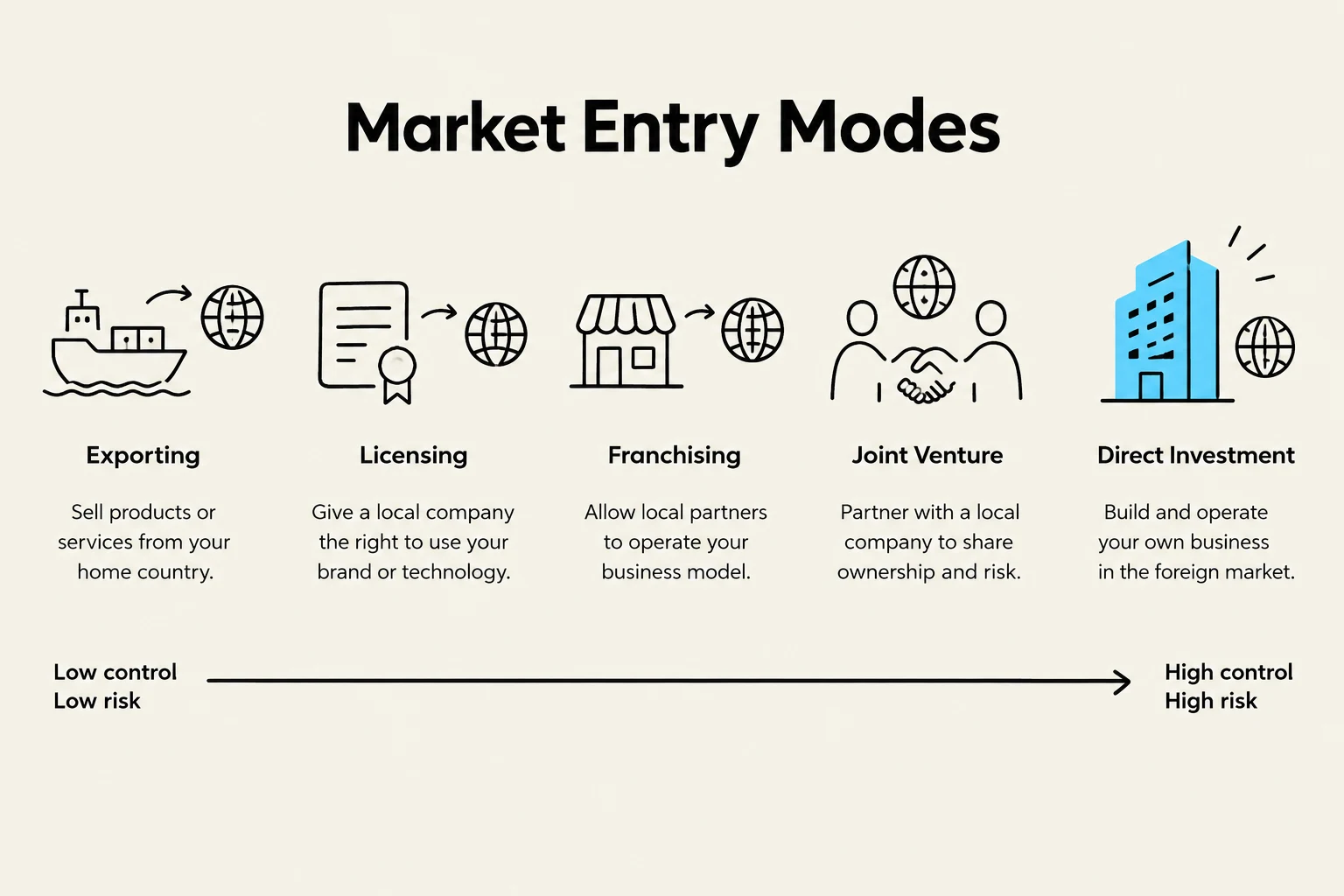
How a company enters a market depends on its desired level of control and risk:
Strategy
Control Level
Risk/Investment
Description
Exporting
Low
Low
Shipping goods from the home country.
Licensing
Low
Low
Allowing a foreign firm to use your brand/tech for a fee.
Franchising
Moderate
Moderate
A specialized form of licensing (e.g., McDonald's).
Strategic Alliance
Moderate
Moderate
Collaboration between firms to share resources.
Joint Venture
High
High
Creating a new entity shared by two or more firms.
Wholly-Owned Subsidiary
Very High
Very High
Full ownership via Greenfield (new build) or Acquisition (Brownfield).
This diagram illustrates various market entry modes, including exporting, licensing, franchising, joint venture, and direct investment, along with their associated levels of control and risk.
Culture and Human Resources
Culture is perhaps the most significant "soft" barrier to success. Managers often use Hofstede’s Cultural Dimensions to understand local behaviors:
Power Distance: Acceptance of unequal power distribution.
Individualism vs. Collectivism: Focus on "I" vs. "We".
Uncertainty Avoidance: How much a culture fears ambiguity.
Masculinity vs. Femininity: Competition vs. cooperation/quality of life.
Global Staffing Strategies
To manage a diverse workforce, HR departments choose one of three approaches:
Ethnocentric: Key roles are filled by expatriates from the home country.
Polycentric: Local professionals (host-country nationals) manage subsidiaries.
Geocentric: The best talent is hired regardless of nationality, creating a global meritocracy.
Note on Expatriates: Moving an employee abroad is risky. Expatriate failure can occur due to cultural shock or family stress, leading to high recruitment and relocation costs.
Operations, Finance, and Technology
Supply Chain and Production
Managers must choose between push models (producing based on forecasts) and pull models (producing based on actual demand). Production can range from mass production to mass customization, where technology allows for unique products at scale.
Financial Management
Operating globally introduces currency risk. To mitigate this, firms use hedging through derivatives like currency forwards, futures, swaps, or options. Additionally, firms must reconcile different accounting standards, such as GAAP (US-based) and IFRS (International).
The Digital Impact
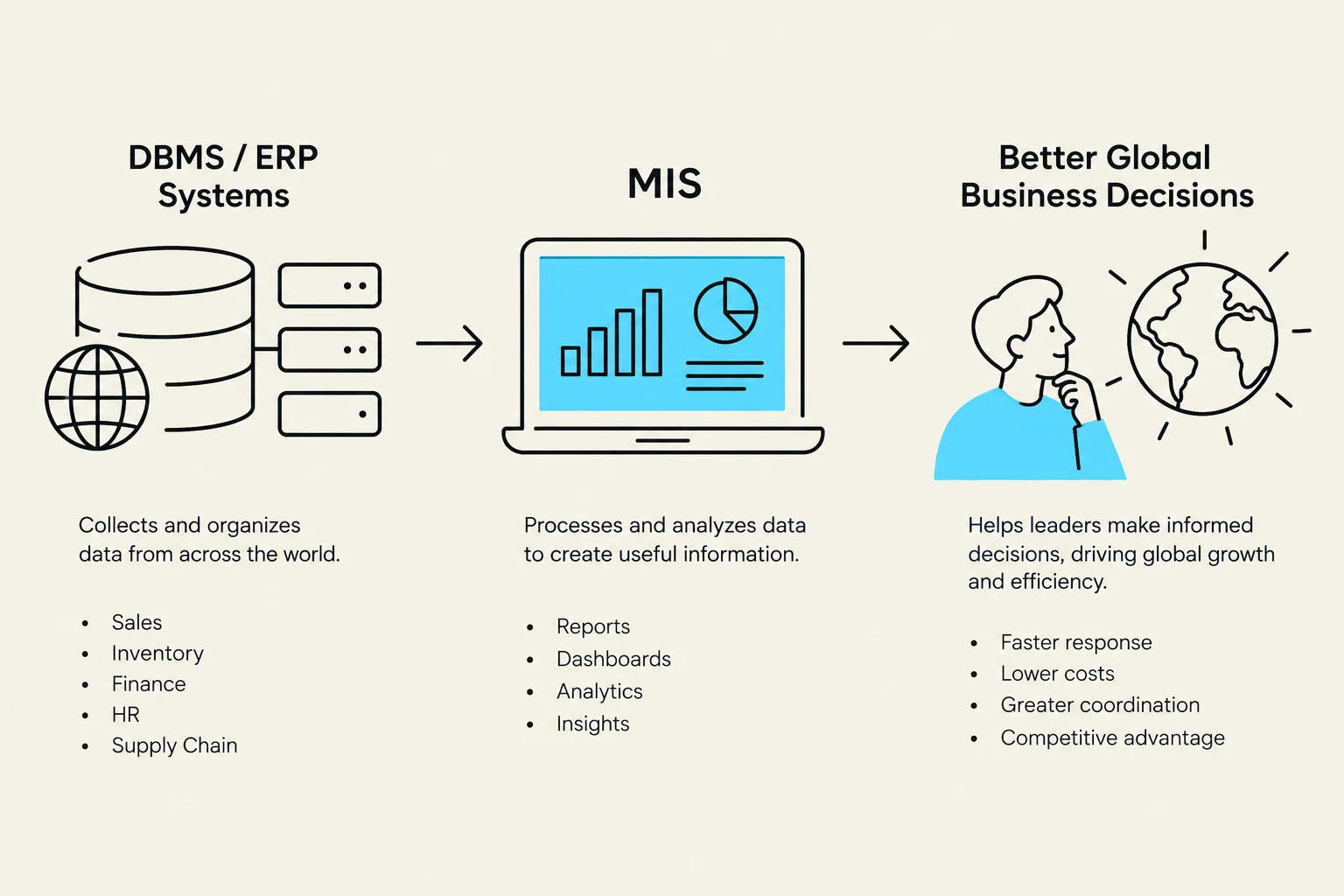
Technology acts as both a bridge and a barrier. While Enterprise Resource Planning (ERP) and Management Information Systems (MIS) streamline global operations, the digital divide—the gap in access to technology—can limit market potential in developing regions.
This diagram illustrates the flow of information from DBMS/ERP systems to MIS, leading to better global business decisions.
Keep reading for free.
Create an account to finish this reading and make it part of your study routine.