Navigating 21st Century Geopolitics: Deterrence, Alliances, and the U.S.-China Rivalry
This analysis explores the complexities of modern global power dynamics, comparing them to the Cold War era. It examines the evolution of deterrence strategies, the challenges to international alliances, the unique nature of the U.S.-China rivalry due to economic interdependence, and the critical role of domestic stabi
The geopolitical landscape of the 21st century is undergoing a profound transformation. While the Cold War provided a blueprint for managing great power competition through clear ideological lines and structured alliances, the modern era presents a far more complex "multipolar system". Today, policymakers face the daunting task of replicating the successes of the past—such as effective deterrence and international cooperation—while navigating a world defined by deep economic interdependence and a rising U.S.-China rivalry.
The Architecture of Deterrence
To maintain global stability, the United States must ensure that adversaries like Russia and China perceive the cost of conflict as prohibitively high. This is achieved through "hard power"—the use of military and economic might—and the sophisticated application of deterrence.
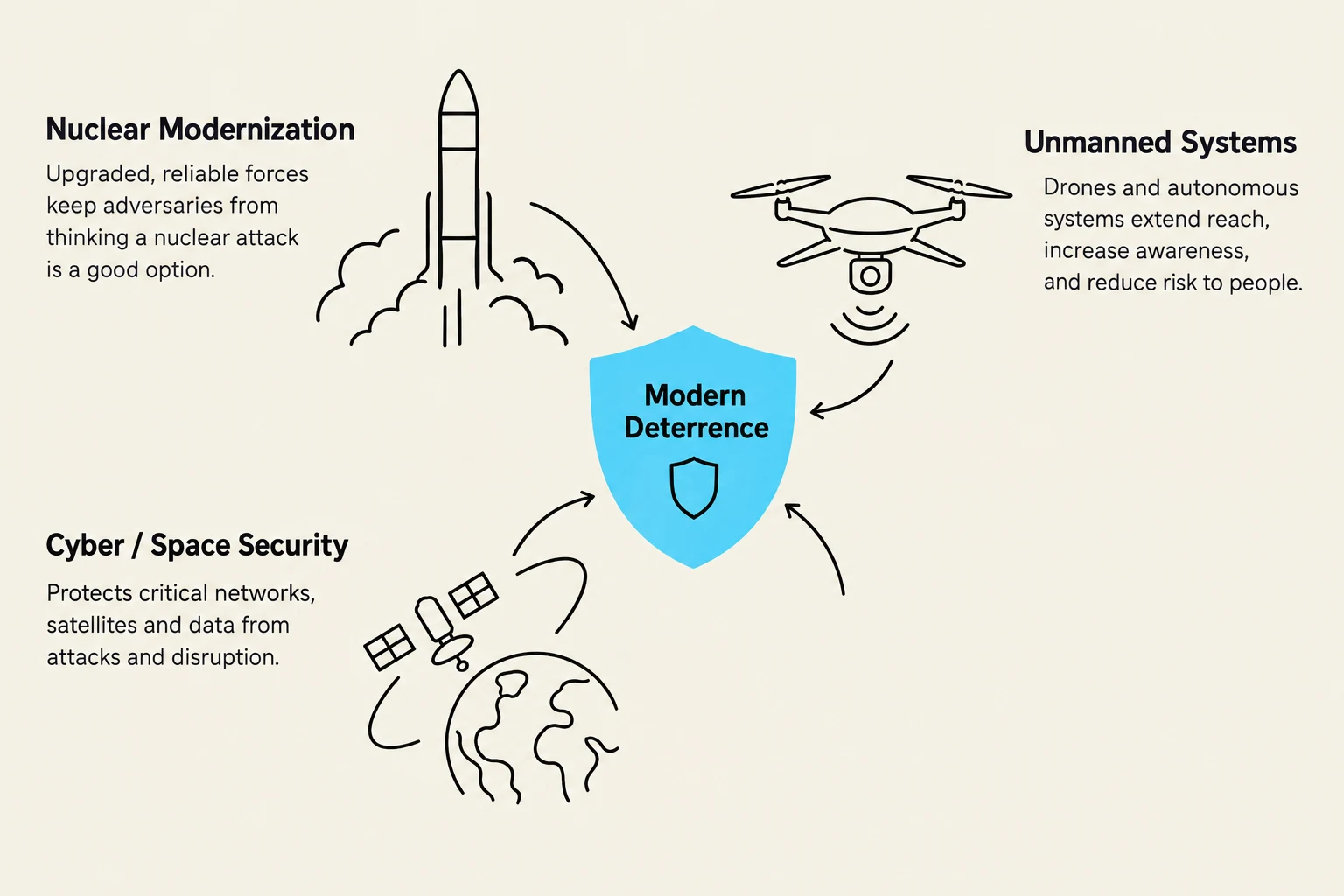
Modernizing deterrence requires more than just traditional forces. It involves a shift toward technological innovation and unmanned systems. Experts suggest that a modern arsenal should include a higher volume of long-range missiles and a focus on "small, cheap, maneuverable weapons platforms," particularly unmanned aircraft, sea vessels, and land vehicles. In contemporary conflict zones, such as Ukraine, the effectiveness of these technologies is evident: "nothing can move on the Ukraine battlefield without being attacked by drones".
To be truly effective, deterrence must also encompass:
Cyber and Space Capabilities: Protecting communications, sensing, and positioning satellites from being disabled.
Advanced Weaponry: Investing in hypersonic vehicles, anti-ship missiles, and defensive interceptors.
Strategic Ambiguity: Particularly regarding Taiwan, maintaining uncertainty about the U.S. response can serve as a deterrent against a Chinese invasion.
This diagram illustrates the components of modern deterrence, including nuclear modernization, unmanned systems, and cyber/space security.
Exam Tip: When discussing deterrence, distinguish between hard power (military force) and soft power (cultural and ideological influence). Effective deterrence often requires a balance of both, but modern technological shifts are placing a heavier emphasis on unmanned and cyber capabilities.
Alliances and the Challenge of A2/AD
A cornerstone of Cold War success was the strength of collective security, exemplified by NATO and various bilateral treaties in Asia. However, these alliances face modern pressures. For instance, the rise of Chinese Anti-Access/Area Denial (A2/AD) capabilities—technologies designed to prevent an opponent from entering a specific theater of operations—threatens U.S. ability to project power in the Pacific.
To counter A2/AD, the U.S. must stockpile munitions in strategic locations like Taiwan and utilize "smart sea mines" that can be activated or deactivated as needed. Furthermore, the cohesion of NATO is vital; as Russia continues to take high levels of risk, NATO members must increase military spending and deepen integration with partners like Ukraine.
The U.S.-China Rivalry: A Different Kind of Competition
Unlike the Cold War, the current rivalry with China is complicated by economic interdependence. The two economies are so deeply entwined that "decoupling" from China could cost the U.S. trillions of dollars in sales and severely damage American competitiveness.
This creates a strategic paradox:
The Interdependence Benefit: Trade and investment can act as a stabilizer, as China may be more reluctant to disrupt trade through military action, such as an invasion of Taiwan.
The Security Risk: The U.S. must simultaneously ensure it does not facilitate the modernization of the Chinese military or allow Chinese companies to gain unfair advantages.
Furthermore, the emergence of a "deep and scary" China-Russia partnership presents a unified front of military and economic power that challenges the traditional Western-led order.
This diagram illustrates the tension between economic interdependence and national security, showing how increased interdependence can lead to both greater risks and benefits.
Soft Power, Democracy, and Domestic Stability
The ability of the United States to lead depends heavily on its soft power—the ability to persuade and attract through values, culture, and democratic ideals. When the U.S. undermines international cooperation by withdrawing from multilateral organizations (like the WHO or the Paris Climate Accords) or by pursuing isolationist policies, it weakens its global influence and benefits its rivals.
Crucially, the ability to promote democracy abroad is directly linked to the health of democracy at home. The U.S. currently faces significant domestic polarization and an erosion of democratic norms.
Threat to Democracy
Impact on Foreign Policy
Domestic Polarization
Weakens the ability to maintain consistent long-term alliances
Erosion of Trust
Reduces "soft power" and the ability to model democratic values
Isolationism
Creates power vacuums that rivals like China can fill
The greatest threat to American security may actually come from within. Issues such as the widening gap between rich and poor, the loss of confidence in election fairness, and the defiance of constitutional norms all undermine the nation's capacity to project strength and lead the international community.
Study Note: To improve democratic resilience, scholars suggest reforms such as campaign finance transparency, ending gerrymandering, and implementing ranked-choice voting to limit political extremism.
Conclusion
Replicating the successes of the Cold War requires more than just military spending. It demands a sophisticated navigation of a multipolar world where economic ties are as important as naval fleets. To succeed, the U.S. must modernize its deterrence, strengthen its alliances, manage the complexities of the China relationship, and—perhaps most importantly—address the domestic polarization that threatens its foundational strength.
Keep reading for free.
Create an account to finish this reading and make it part of your study routine.