


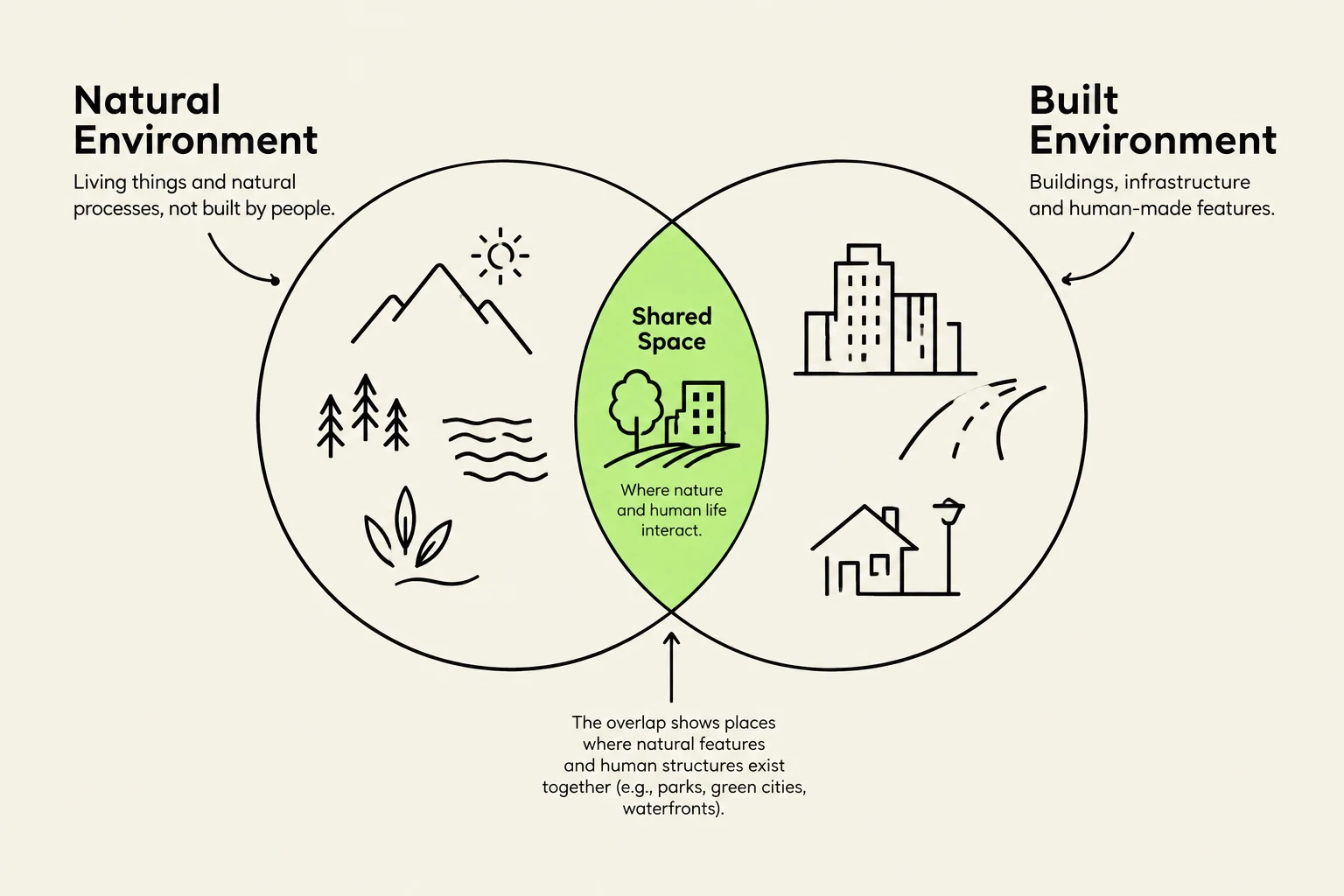
When we hear the word "environment," our minds often jump to images of lush rainforests, melting glaciers, or perhaps the smoggy air of a metropolis. While these images are correct, the term "environment" is much broader than any single landscape. At its core, the environment refers to the complex web of physical, chemical, and biological factors that surround an organism or a community. To study geography and environmental science effectively, we must learn to distinguish between the two primary ways these surroundings are organized: the natural environment and the built environment.
The Natural Environment: Systems of Nature
The natural environment encompasses all living and non-living things occurring naturally on Earth. This includes the biosphere (all living organisms), the lithosphere (the Earth's crust), the hydrosphere (water in all its forms), and the atmosphere (the layers of gases surrounding the planet).
Natural environments are characterized by ecological processes that function without direct human intervention. For example, a forest operates through cycles of nutrient exchange, photosynthesis, and decomposition. A lake ecosystem relies on the natural flow of water and the biological interactions between aquatic plants, fish, and microorganisms. In these spaces, the "rules" of the environment are dictated by evolutionary biology, geology, and climate patterns.

Exam Tip: When asked to define a natural environment, focus on "self-regulating processes." Mention that while humans can impact these systems, a purely natural environment is one where biological and geological cycles occur independently of human engineering.
Keep reading for free.
Create an account to finish this reading and make it part of your study routine.
Continue reading freeAlready have an account? Log in
Updated