This content explores natural systems, population dynamics, and species interactions. It covers methods for estimating population size, population growth models (exponential and logistic), tolerance limits, ecological niches, and various species interactions like competition, predation, mutualism, and commensalism. It
Understanding the natural world requires "systems thinking"—the ability to view the environment not as a collection of isolated parts, but as a complex, dynamic web of interacting components. Natural systems are constantly changing, driven by the flow of energy and nutrients between biotic (living) and abiotic (non-living) components. To understand these systems, ecologists study various scales of organization, moving from individuals to species-populations, and finally to entire communities and landscapes.
Estimating Population Size and Distribution
Before we can model how a population changes, we must first know how many individuals exist and how they are spread across a landscape. Because it is often impossible to count every single organism in an ecosystem, ecologists use sampling methods to estimate population size.
Two primary methods are commonly used:
Quadrat Sampling: This involves using a square frame (a quadrat) of a known area and counting the individuals within it. By repeating this in multiple locations, researchers can estimate the density of a species across a larger area.
Mark and Recapture: This method is better suited for mobile animals. A portion of the population is captured, marked, and released. Later, a second sample is captured; the ratio of marked to unmarked individuals in the second sample allows for a mathematical estimate of the total population size.
Once size is estimated, ecologists look at population distribution—how individuals are arranged in space.
Population Dynamics and Growth Models
Population dynamics refers to the study of how populations change over time and space. To predict these changes, scientists use mathematical models based on data like population density and growth rates.
Exponential Growth
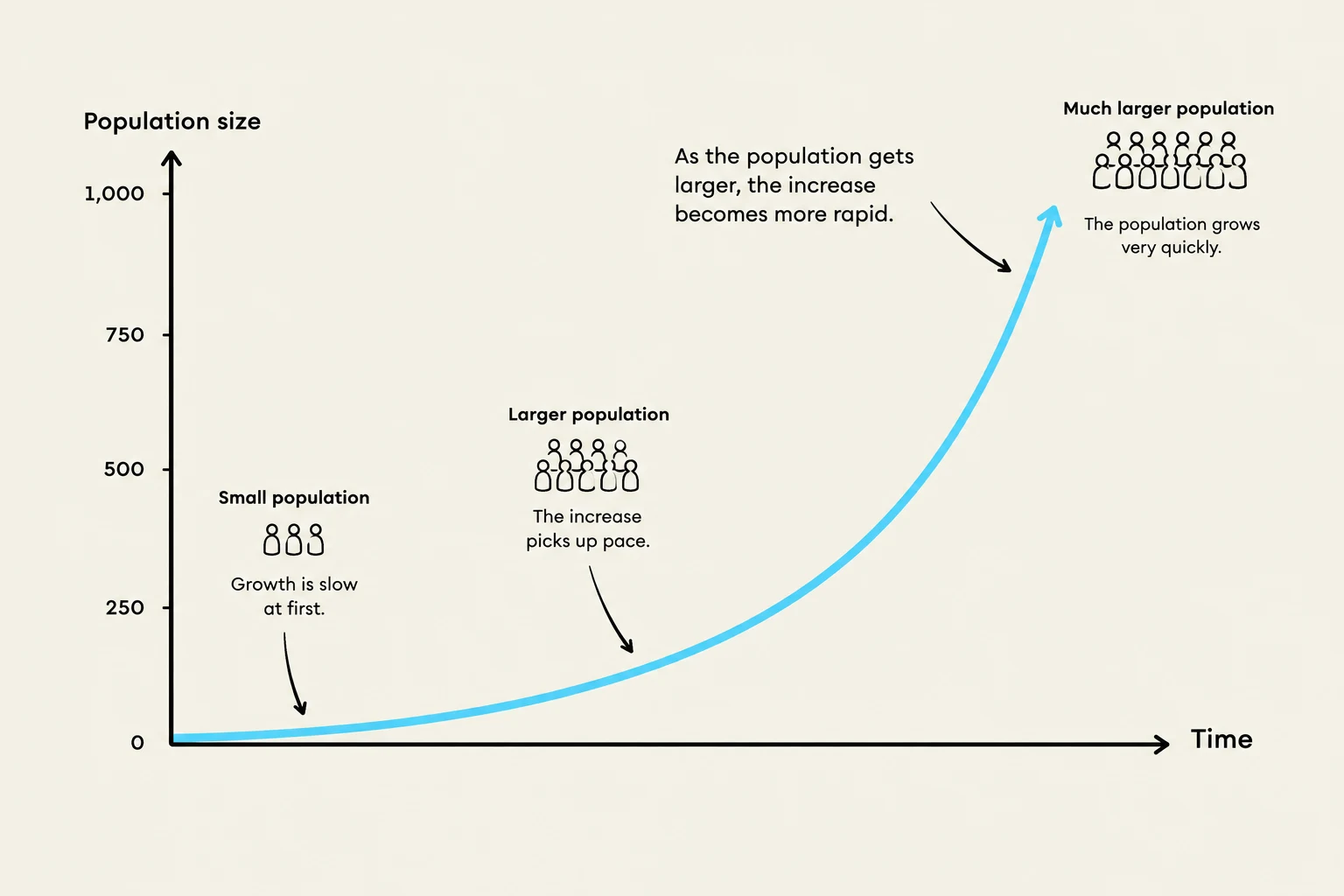
When resources are abundant and environmental constraints are absent, populations can undergo exponential growth. In this model, the population size increases at a rate proportional to its current size.
The formula for exponential growth is:
N(t)=N0⋅(1+r)t
Where:
N(t) is the population size at time t.
N0 is the initial population size.
r is the rate of increase (expressed as a decimal between 0 and 1).
t is the time elapsed.
Worked Example: The Algae Pond
Imagine a pond where algae doubles in area every day (100% growth). If the pond is completely covered on Day 30, when was it half-covered? Because the growth is exponential, it was half-covered just one day prior, on Day 29. If it doubles every day, it would have been only 1% covered on Day 23.
This graph illustrates exponential population growth, showing how a population's size increases at an accelerating rate over time.
Logistic Growth and Carrying Capacity
In the real world, exponential growth cannot continue forever. Populations eventually encounter limiting factors—such as limited nutrients, space, or water—that slow growth. This leads to the logistic growth model, where the population size levels off as it reaches the carrying capacity (K). The carrying capacity is the maximum number of individuals that a particular environment can sustainably support.
Tolerance Limits and Environmental Factors
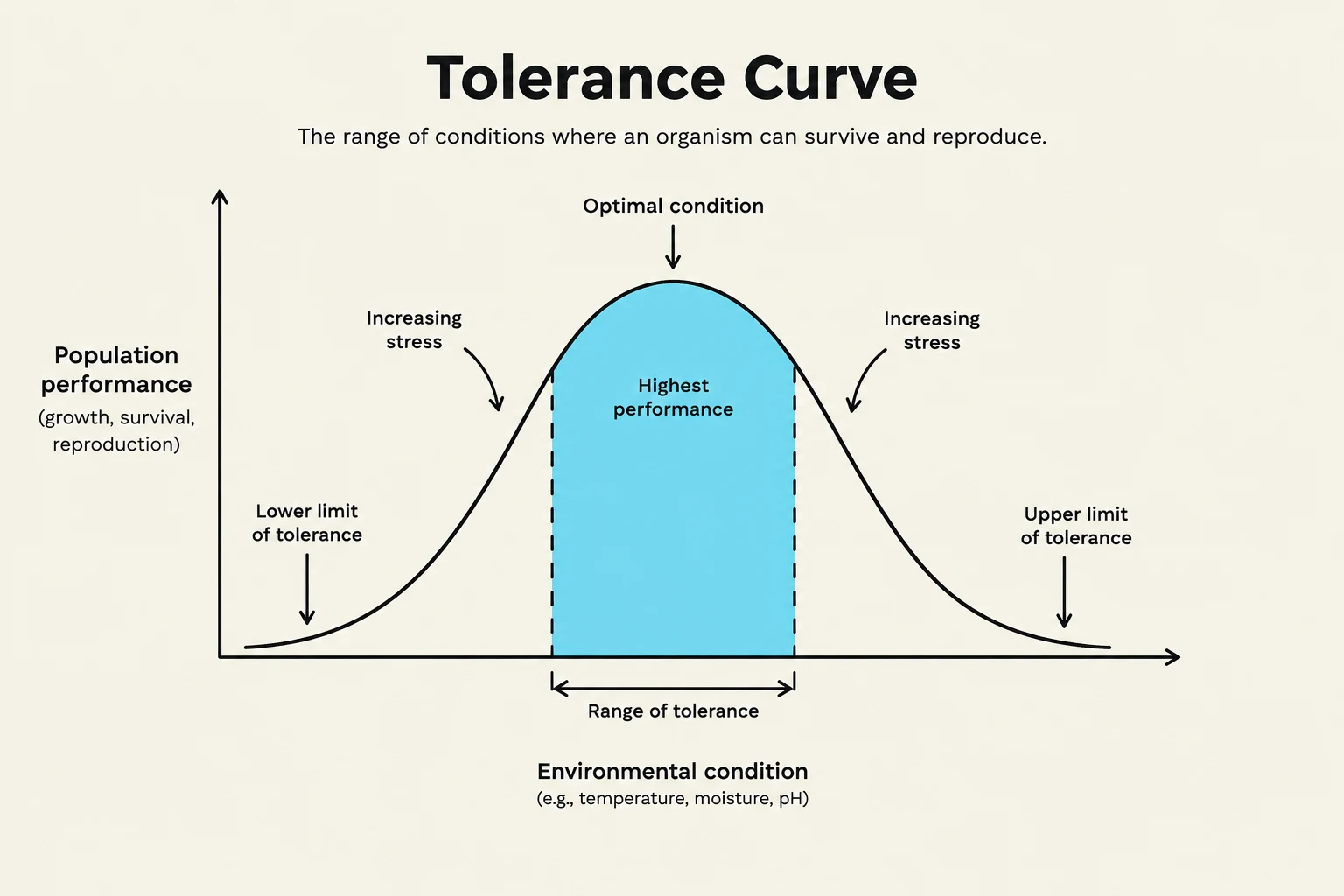
Why do certain species live in specific locations? The answer lies in tolerance limits. Every species has a range of environmental conditions (such as temperature, moisture, or nutrient levels) within which it can survive.
While a single factor might be the primary driver for some species, most organisms are influenced by the interaction of several factors. If an environmental factor moves outside a species' tolerance limit, that species will decline or disappear from that area.
Indicator Species: Some species are particularly sensitive to environmental changes. These are known as indicator species (or bioindicators). Because they react quickly to changes in their environment, they act as early warning systems for ecological shifts.
A tolerance curve illustrates the range of environmental conditions under which an organism can survive and reproduce, with optimal conditions leading to the highest performance.
Evolution, Speciation, and the Ecological Niche
The interaction between populations and their environments drives evolutionary processes. Through natural selection, individuals with traits best suited to their specific environmental conditions are more likely to survive and reproduce. Over long periods, if a population faces significant selective pressure or geographical isolation, it may undergo speciation, eventually becoming an entirely new species.
The Concept of the Niche
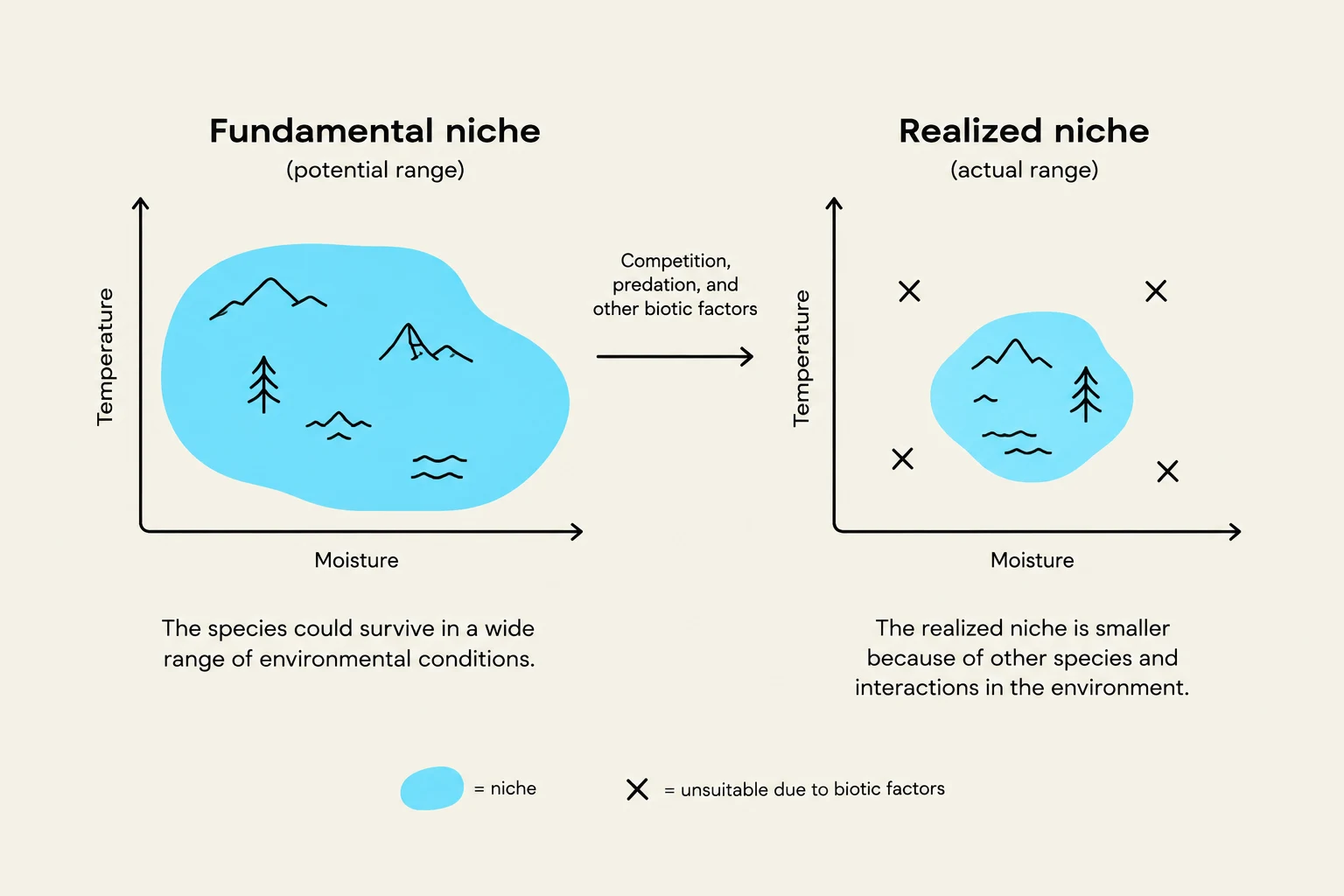
An ecological niche describes the role a species plays in its environment, including its habitat and the resources it uses. Ecologists distinguish between two types of niches:
Fundamental Niche: The full range of resources and habitats a species could theoretically exploit if there were no competition or predation.
Realized Niche: The actual range of resources and habitat a species does use, which is often much smaller due to competition and other species interactions.
Species are often categorized by the breadth of these niches:
Generalist species have broad niches and wide tolerance limits (e.g., mice, raccoons).
Specialist species have narrow niches and limited tolerance limits (e.g., giant pandas, spotted owls).
Species Interactions
No species exists in isolation. Interactions between species can be categorized by whether they benefit (+), harm (-), or have no effect (0) on the participants:
Competition (-/-): When organisms compete for limited resources, both are negatively affected. This can be intraspecific (between members of the same species, often involving territoriality) or interspecific (between different species). According to the competitive exclusion principle, two species cannot occupy the exact same niche indefinitely; one will eventually outcompete the other, or they will undergo resource partitioning to use different subsets of the resource.
Predation (+/-): One organism (the predator) kills and eats another (the prey). This interaction stimulates natural selection by removing the "least fit" members of a population. Prey often evolve defensive mechanisms, such as Batesian mimicry (a harmless species mimicking a poisonous one) or Mullerian mimicry (two poisonous species evolving to look alike).
Mutualism (+/+): Both species benefit from the interaction, such as the relationship between fungi and plant roots (mycorrhizae).
Commensalism (+/0): One species benefits while the other is neither helped nor harmed.
This diagram illustrates the difference between a fundamental niche (the potential range of environmental conditions a species can survive in) and a realized niche (the actual range of conditions a species occupies, influenced by biotic factors like competition and predation).
Landscape Structure and Resilience
At the largest scale, we look at landscapes. The structure of a landscape is influenced by the species present, the type of habitat, biological interactions, and disturbances.
Ecological systems are dynamic. While some may reach a climax community—a state that resists further change—most are shaped by periodic disturbances. The ability of an ecosystem to repair itself after such a disturbance is called resilience. Interestingly, the intermediate disturbance hypothesis suggests that species diversity is often highest when disturbances occur at moderate frequencies—neither too rare nor too frequent.
Keep reading for free.
Create an account to finish this reading and make it part of your study routine.